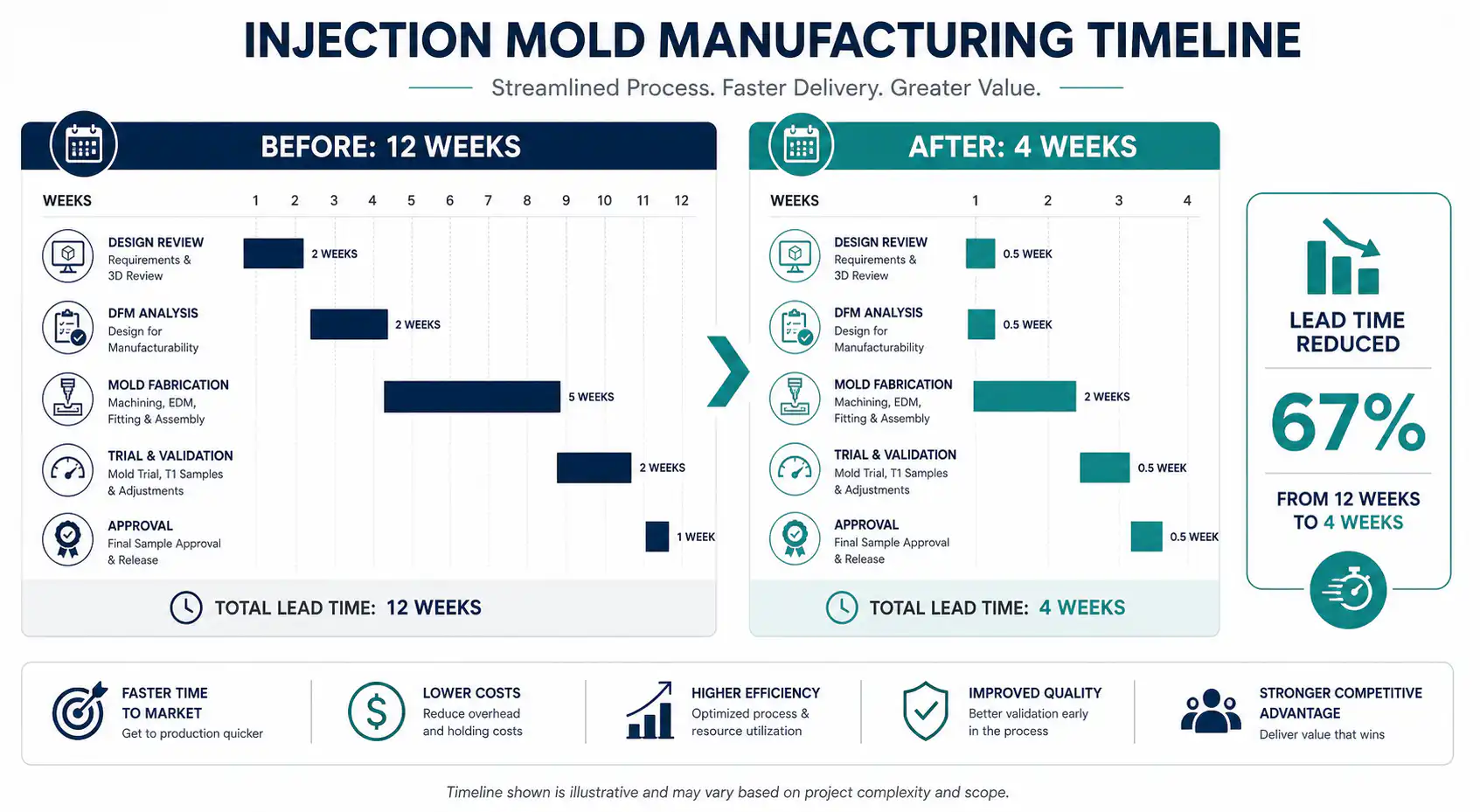
In injection molding, lead time is often more critical than unit price. A four-week faster mold can mean hitting a product launch window, winning a competitive bid, or preventing a production line shutdown. This guide covers every practical strategy for reducing injection molding lead time — from tooling material choices to communication tactics with Chinese mold makers.

Typical Lead Times by Mold Type
| 金型の種類 | 一般的なリードタイム | Lifespan | 最優秀アプリケーション |
|---|---|---|---|
| アルミニウム7075 | 1–3 weeks | 5,000~50,000発 | Prototypes, bridge production |
| P20 Pre-hardened Steel | 4–6 weeks | 100,000–500,000 shots | Medium-volume production |
| H13 Hardened Steel (52 HRC) | 6–12 weeks | 500,000–2,000,000+ shots | High-volume, abrasive materials |
| Rapid Prototype Mold (3D printed) | 3~7日 | 50–500 shots | Design validation, fit testing |
Lead Time Breakdown — Where Time Goes
Understanding the standard mold-making timeline is the first step to shortening it. Here is the typical breakdown for a P20 steel production mold:
| フェーズ | % of Total Time | Days (40-day mold) | Where to Save Time |
|---|---|---|---|
| Tool Design & DFM | 15% | 6 days | Parallel DFM engagement |
| Steel Procurement | 10% | 4 days | Stock standard mold base sizes |
| Rough Machining (CNC) | 15% | 6 days | High-speed machining, 5-axis |
| EDM (Sinker + Wire) | 25% | 10 days | Reduce EDM by CNC-machining more features |
| Polishing & Fitting | 20% | 8 days | Pre-approve texture before steel cut |
| Tryout & Testing | 15% | 6 days | In-process inspection reduces rework |

8 Strategies That Actually Reduce Lead Time
1. Standard Mold Bases
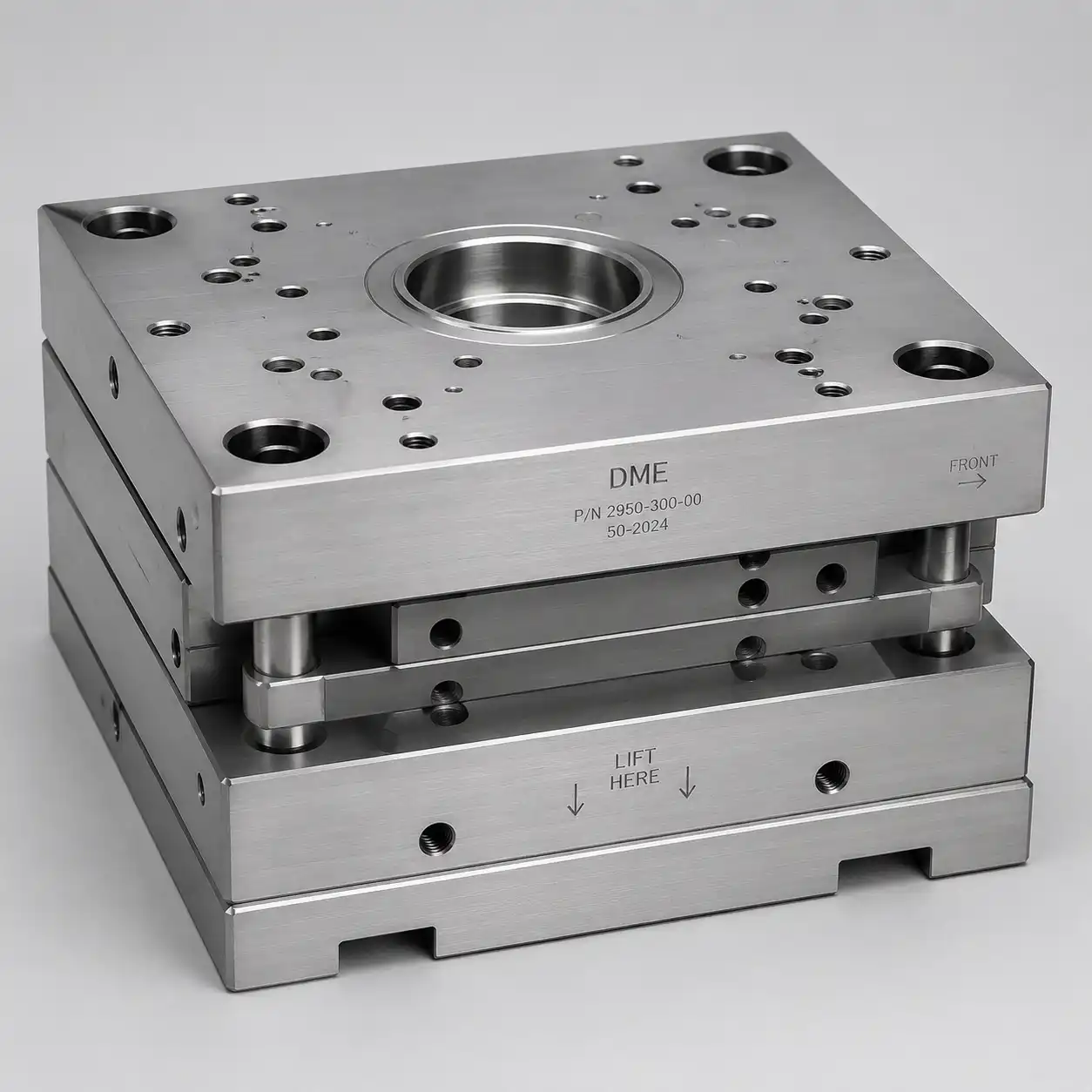
Using standard mold bases from DME, Hasco, or Futaba saves 1–3 days compared to custom-built bases. These off-the-shelf bases come pre-machined with guide pins, return pins, and ejector systems already installed. Your mold maker starts machining cavity inserts on day one instead of building the base from scratch.
2. Reduce EDM by Maximizing CNC
EDM is the slowest and most expensive mold-making operation. Every feature that can be CNC-machined instead of EDM-burned saves 3–5 days and reduces cost. The key is design for CNC: avoid sharp internal corners (use radius instead), keep ribs above 0.5mm width-to-depth ratio, and eliminate blind pockets where possible. Modern 5-axis CNC machines with 0.5mm end mills can machine features that used to require EDM.
3. 3D Printed Conformal Cooling Inserts
For molds with complex cooling requirements, 3D-printed metal inserts with conformal cooling channels achieve two time savings: faster mold making (the insert is printed in days instead of weeks of gun-drilling) and faster cycle times (conformal cooling reduces cooling time by 20–40%). The technology is now mature — DMLS-printed maraging steel (MS1) inserts are used in production molds at major automotive suppliers. Our conformal cooling guide goes deeper on the engineering tradeoffs.
4. Parallel Processing
The single biggest time-saver: machine mold components simultaneously instead of sequentially. While the cavity is being CNC-machined, the core can be on a separate machine, the ejector system assembled off-line, and the hot runner manifold being wired. This requires a mold maker with sufficient machine capacity and skilled project management — it is a sign of a top-tier shop.
5. Family Mold vs Single Cavity Tradeoff
Family molds (multiple different parts in one mold) have longer build times than single-cavity tools, but they deliver faster aggregate output. For a 4-part assembly, a family mold might take 8 weeks to build but produces all 4 parts simultaneously. Four single-cavity molds might take 5 weeks each but need sequential runs. The right choice depends on your urgency and production volume.
6. Bridge Tooling Strategy
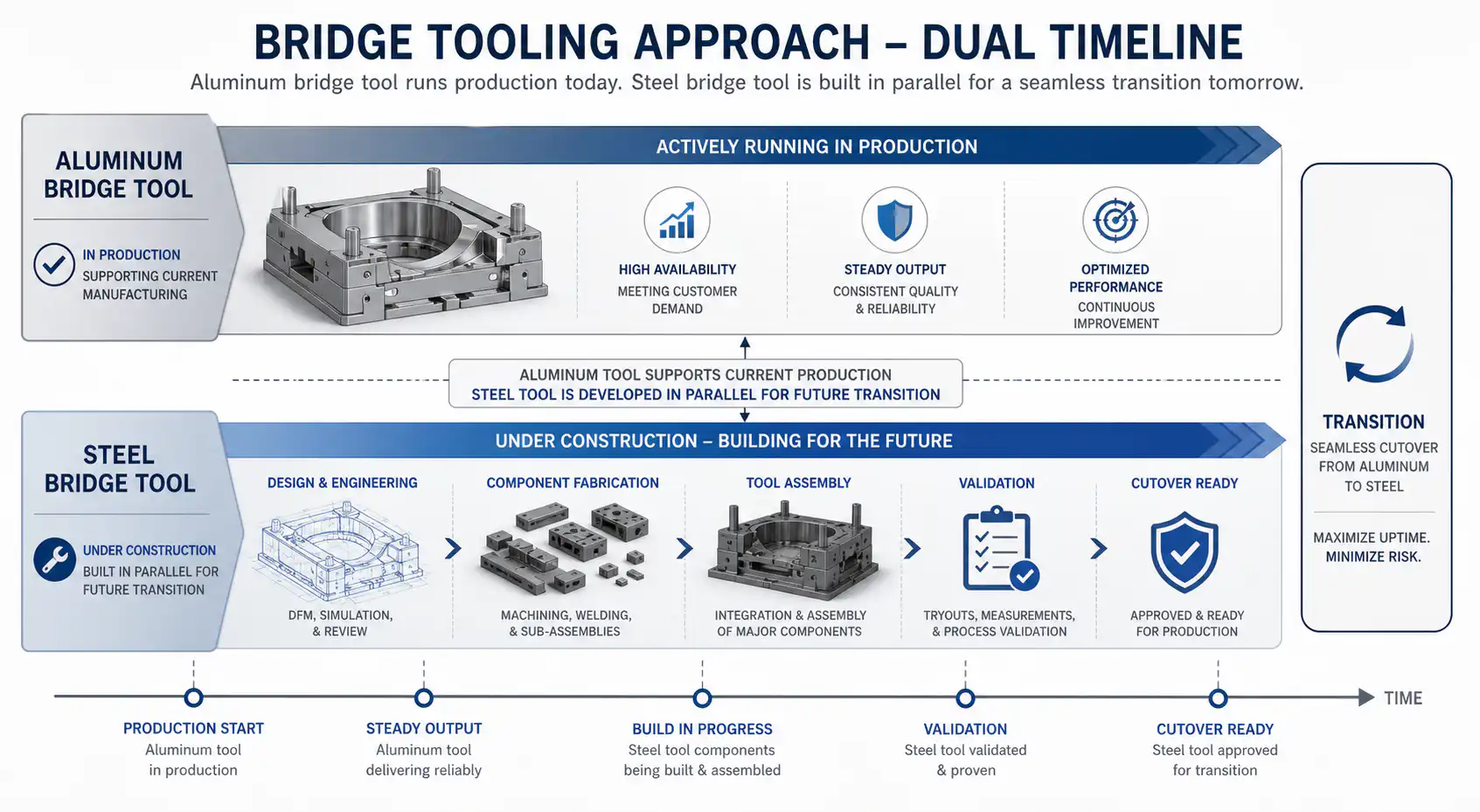
A two-phase approach: order an aluminum or 3D-printed bridge tool (1–3 weeks) for immediate parts while the production steel tool (8–12 weeks) is being built. Bridge tools cost a fraction of production tools and can produce 5,000–50,000 parts — enough for initial market entry, testing, and validation. This decouples your timeline from mold making.
7. Pre-Approve Texture Before Steel Cut
Texture specification is the most common last-minute delay in mold making. Mold textures (VDI/SPI) are applied by chemical etching or laser after the cavity is machined. If the texture specification changes after EDM, the cavity may need re-polishing and re-etching — adding 3–5 days. Lock down the texture specification during the DFM phase and put it in writing. Our surface finishing guide explains why this decision is more consequential than it looks.
8. DFM Parallel Engagement
The traditional workflow — complete your design, send to supplier, wait for DFM report, revise — eats 7–10 days. Modern practice: share your 3D model early (even at 80% complete) with your mold maker. They review it in parallel with your design work, flagging molding issues before you finalize the design. By the time your design is final, the DFM is already done and mold design can start immediately. If you want to understand what a good review should actually include, see our mold flow analysis and DFM guide.

China Tooling Timeline Reality
Chinese mold makers have compressed lead times to levels that surprise many Western engineers:
- Standard P20 steel mold: 20–35 calendar days is typical for a quality Chinese mold shop. This is 30–50% faster than equivalent Western shops.
- Sprint timeline: 15–18 days is achievable for simple single-cavity molds when the shop dedicates resources and runs 24/7 shifts. This typically carries a 20–30% premium.
- Red flags: Any shop promising a production steel mold in under 12 days is cutting corners — insufficient EDM time, skipping polishing steps, or using unqualified steel.
The speed comes from vertical integration (mold design, machining, EDM, and tryout all in one facility), 24/7 operation with multiple shifts, and pre-stocked standard steel blocks for common mold base sizes.
| Mold Complexity | Standard Timeline | Expedited Timeline | プレミアム |
|---|---|---|---|
| Simple (single cavity, no slides) | 20–25 days | 12–15 days | +25–40% |
| Medium (2–4 cavities, 1–2 slides) | 28–35 days | 18–22 days | +20–30% |
| Complex (multi-cavity, hot runner, lifters) | 35–55 days | 25–35 days | +20–30% |

Communication Hacks for Faster Molds
Poor communication is the leading cause of mold delays — more than machine capacity or steel availability. Here is what works:
- 24-hour response SLA: Establish that every email or WeChat message gets a reply within 24 hours, even if it is just “received, will check.” Gaps of 3–5 days between responses are the single biggest source of schedule slip.
- WeChat + Email dual-channel: WeChat for daily photos, quick questions, and urgent issues. Email for formal documentation, drawing revisions, and decisions that need a paper trail. Do not try to conduct everything on one channel.
- Weekly progress photos: Require photos of the mold every Friday — cavities being machined, electrodes being prepared, EDM in progress. This is not about distrust; it is about catching issues early. A photo of an electrode that does not match your CAD can save 2 weeks of rework.
- English-Capable Project Manager: The mold maker’s English-speaking project manager is your most important contact. They translate between your requirements and the shop floor. If communication is difficult during the quoting phase, it will only be worse during production.
QA Without Adding Delay
Quality inspection can add time, but skipping it adds risk. The optimal approach:
- In-process inspection: Critical dimensions are checked during machining (not after) so that corrections can be made immediately. This prevents spending 3 days polishing a cavity that was machined 0.1mm out of tolerance.
- First-shot review decision: For standard molds under $10,000, request detailed photos and video of first shots plus a dimensional report. For molds over $30,000 or high-complexity parts, flying out for first-shot review at the mold maker’s facility is worth the travel cost — catching one mold modification before shipping saves 2–4 weeks of back-and-forth.
- ISIR/PPAP documentation: Specify upfront whether you need a full dimensional report with ISIR format. Adding this requirement after the mold is complete delays shipment by 2–3 days.
結論
Reducing injection molding lead time is not about a single silver bullet — it is about applying pressure across every phase of the mold-making process. The most impactful strategies are standard mold bases (save days), parallel DFM engagement (save a week), and the bridge tooling strategy (decouple your timeline from the production mold entirely). Combined, these approaches can cut 3–5 weeks from a typical mold-making timeline without compromising quality. The key is to start these conversations during the quoting phase — retrofitting speed into a project already in progress is far harder than building it in from the beginning.
For detailed PA66 GF30 properties and grade selection, see our glass-filled nylon grade comparison guide covering GF15, GF30, and GF60 stiffness, heat, warpage, and molding data.
よくある質問
What is the realistic fastest time for a production steel mold?
A simple single-cavity P20 steel mold can be completed in 15–18 calendar days by a well-equipped Chinese mold shop running 24/7 shifts. This requires the part design to be simple (no slides, no complex undercuts), the mold base to be a standard size, and the texture/finish to be pre-approved. More complex molds with multiple cavities, slides, or hot runner systems realistically need 25–35 days minimum even on an expedited timeline.
Is aluminum tooling a good alternative for 50,000 parts?
Yes. Aluminum 7075-T6 tooling is rated for 50,000–100,000 shots with unfilled materials and 25,000–50,000 with glass-filled materials. For PA66 GF30, aluminum will show measurable wear by 30,000 shots (loss of edge definition, increased flash). If your total lifetime volume is 50,000 parts or under, aluminum tooling at 1–3 weeks lead time is an excellent alternative to P20 steel at 4–6 weeks. The cost savings (aluminum is 30–50% cheaper to machine) plus the time savings often outweigh the shorter tool life.
How much does expedited tooling cost vs standard?
Expedited tooling typically carries a 20–40% premium over standard timeline pricing. This covers overtime labor, dedicated machine allocation (tying up a CNC or EDM that could be running other jobs), and priority steel procurement. The premium is highest for simple molds (40%+) because the baseline cost is lower and the fixed cost of expediting is proportionally larger. Complex molds see a 20–30% premium because the expediting cost is spread over a larger base price. Most shops require 50% upfront payment for expedited orders.
Can I split production into bridge tool and steel tool to save time?
Absolutely — this is one of the most effective time-compression strategies. Order an aluminum bridge tool (1–3 weeks, $3,000–$10,000) that produces parts while your production steel tool (8–12 weeks, $15,000–$50,000) is being built. You get parts in 2–3 weeks instead of 8–12 weeks. The bridge tool pays for itself if hitting a product launch window or trade show deadline is critical. The parts from the bridge tool may have slightly different surface finish or dimensional characteristics than the steel tool, so plan for a validation batch from the steel tool before switching over.