Introduction
Cooling time accounts for 50-70% of the total injection molding cycle. When you reduce cooling time, you directly reduce part cost and increase production capacity. Yet most molds still rely on straight drilled cooling channels – lines that cannot follow curved part geometry, leaving hot spots that dictate the entire cycle.
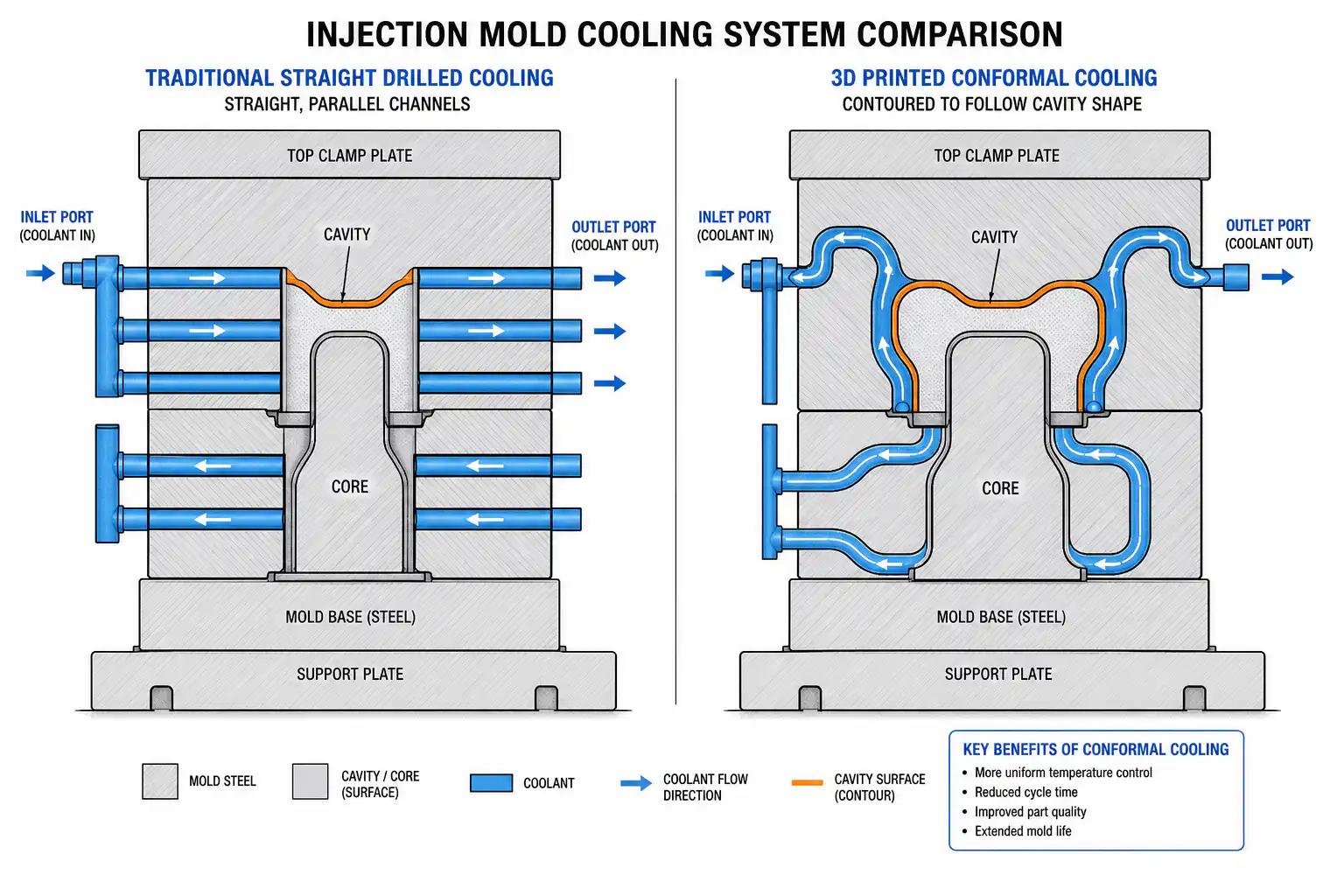
Traditional cooling channels are created by gun-drilling intersecting straight holes through the mold steel, then plugging unused openings. The result is a network of straight lines that keeps a safe distance from the cavity wall everywhere, even where they could safely come closer. This one-size-fits-all approach wastes 20-40% of potential productivity.
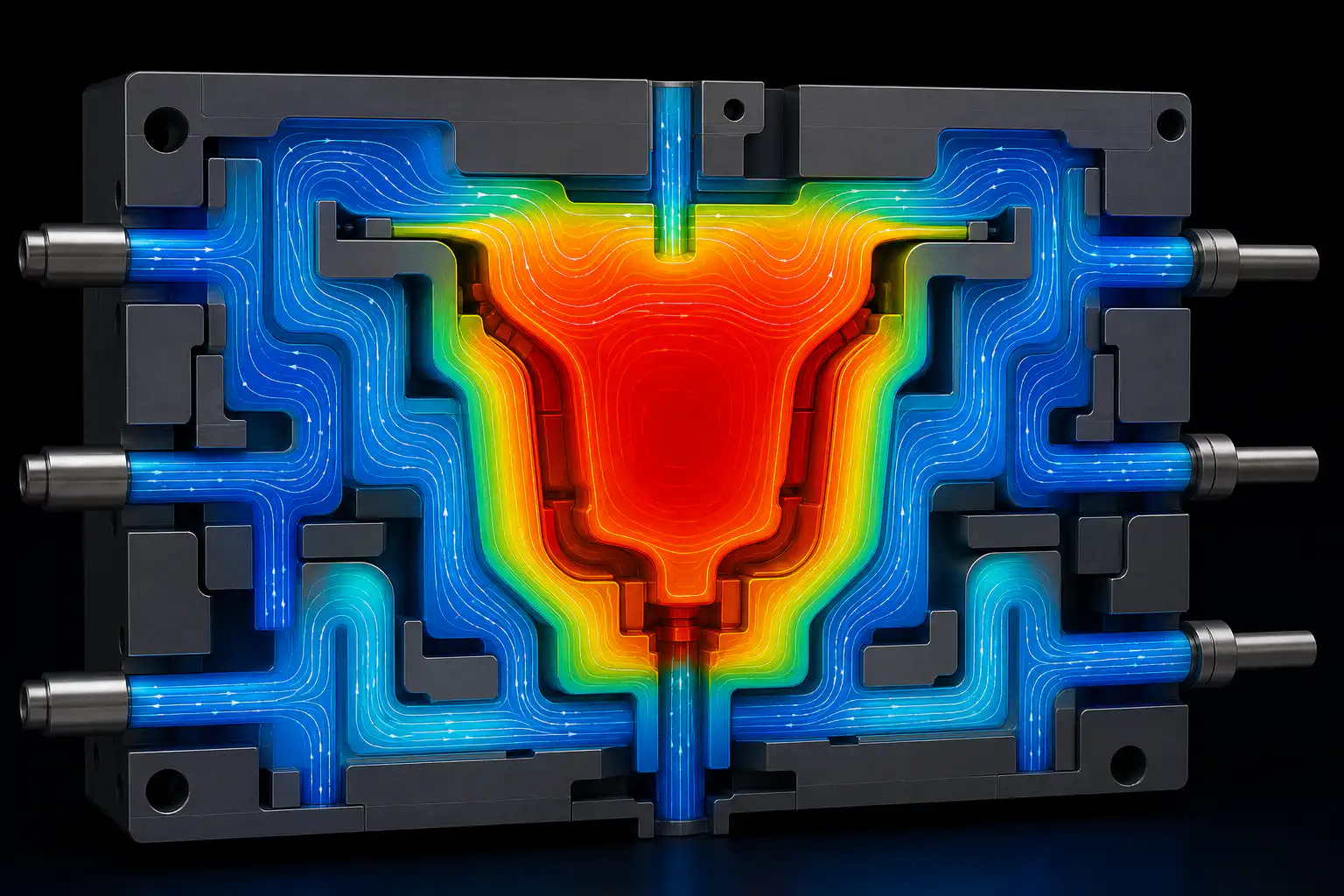
Conformal cooling changes the equation entirely. By building cooling channels that follow the part contour – maintaining a uniform distance from the cavity surface along the entire flow path – heat extraction becomes predictable, uniform, and significantly faster.
What Is Conformal Cooling?
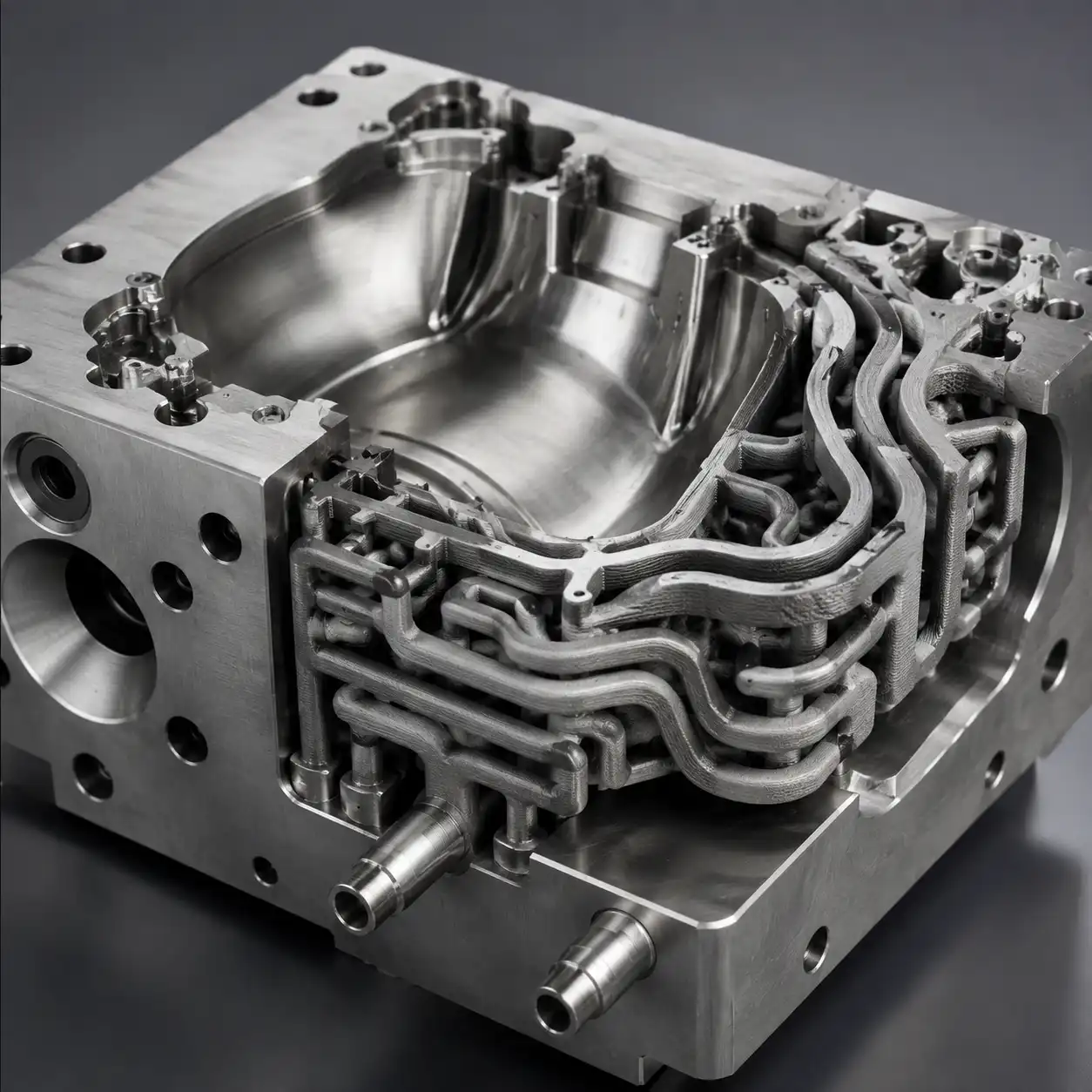
Conformal cooling channels are cooling lines whose geometry matches (conforms to) the shape of the molded part. Instead of straight lines, they curve, spiral, and branch to maintain a consistent standoff distance from the cavity surface wherever heat removal is needed.
Key Differences: Traditional vs. Conformal
| 特集 | Traditional Drilled Channels | Conformal Cooling Channels |
|---|---|---|
| 幾何学 | Straight lines only | Any 3D path, follows part contour |
| Distance to cavity | Variable; safety margins everywhere | Uniform; optimized per region |
| Cooling uniformity | Poor; hot spots common | Excellent; near-isothermal surface |
| Manufacturing method | Gun drilling + plugging | DMLS/SLM 3D printing, vacuum brazing |
| Cross-section shape | チラシ限定 | Circular, elliptical, teardrop, or hybrid |
| リードタイム | Standard (part of CNC machining) | Additional 1-3 weeks for printing + finishing |
Benefits: Quantified Performance Gains
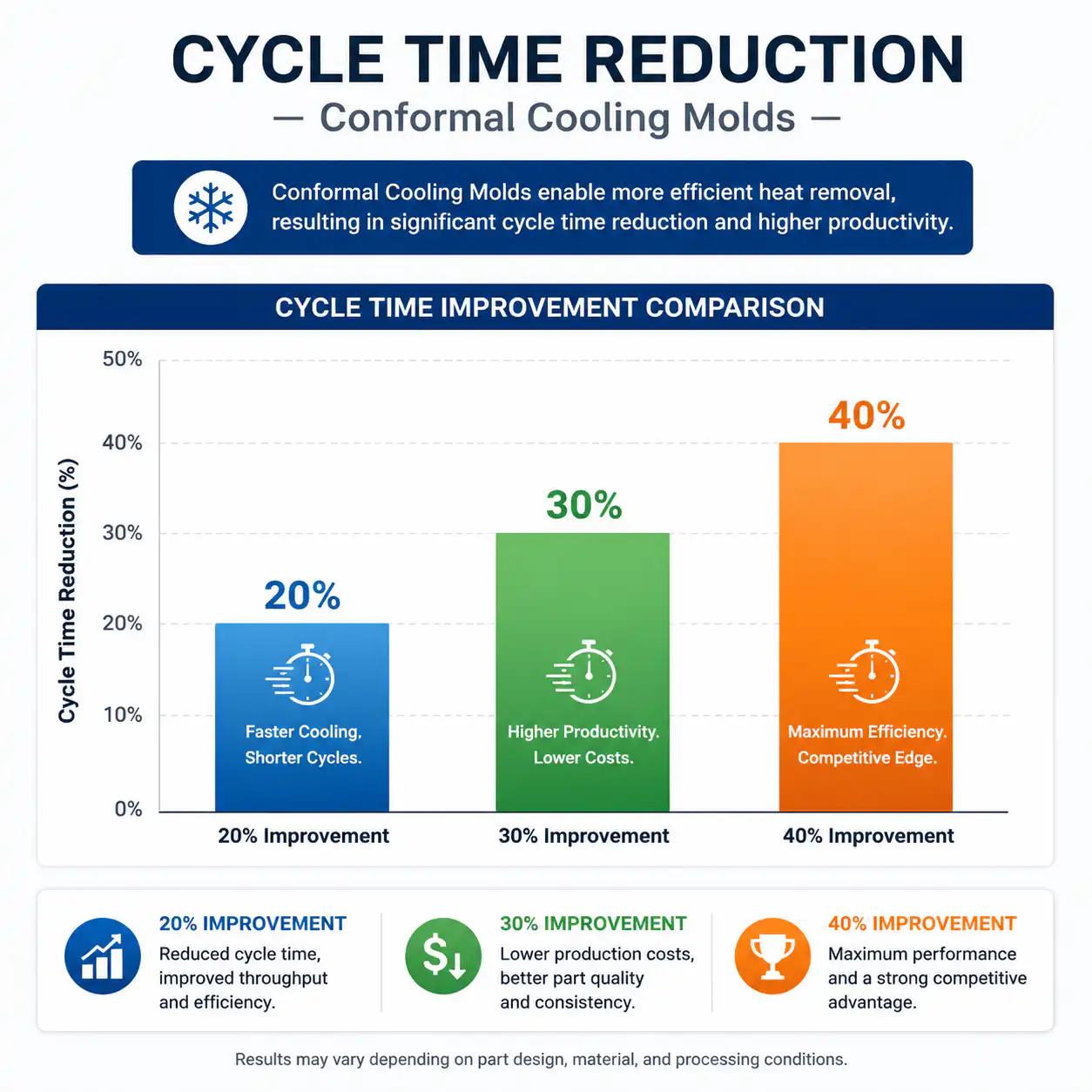
Conformal cooling delivers measurable improvements across three dimensions: cycle time, part quality, and dimensional consistency. Independent studies and production case data converge on the following ranges. If dimensional stability is your main KPI, our plastic part tolerances guide explains how cooling uniformity feeds directly into achievable tolerance bands.
- サイクルタイムの短縮: 20-40%, with some complex geometries exceeding 50%
- Warpage reduction: 15-45%, depending on part geometry and material
- Dimensional stability: Reduced shrinkage variation, tighter Cp/Cpk values
- Surface quality: Fewer sink marks, reduced residual stress patterns
- Energy consumption: Lower melt temperatures possible due to faster cooling, reducing barrel heating energy
Why the Improvement Is So Large
In a conventionally cooled mold, the thickest section determines cooling time – and that section is often the one furthest from the nearest straight drilled channel. Conformal channels eliminate this bottleneck by bringing cooling to every thick section simultaneously. The part ejects when the last region reaches ejection temperature, not when the slowest-cooling region does.
Manufacturing Methods
Three primary manufacturing routes exist for conformal cooling channels. The choice depends on production volume, budget, lead time, and performance requirements.
| 方法 | コスト | リードタイム | Cooling Performance | カビの寿命 |
|---|---|---|---|---|
| DMLS/SLM 3D Printing | High (machine + material) | 1~3週間 | Best; full design freedom | 100k-500k+ shots |
| Vacuum Brazing | ミディアム | 2-4 weeks | Good; limited to near-planar parting surfaces | 500k+ shots |
| Diffusion Bonding | 中~高 | 3~6週間 | Good; multi-layer lamination | 1M+ shots |
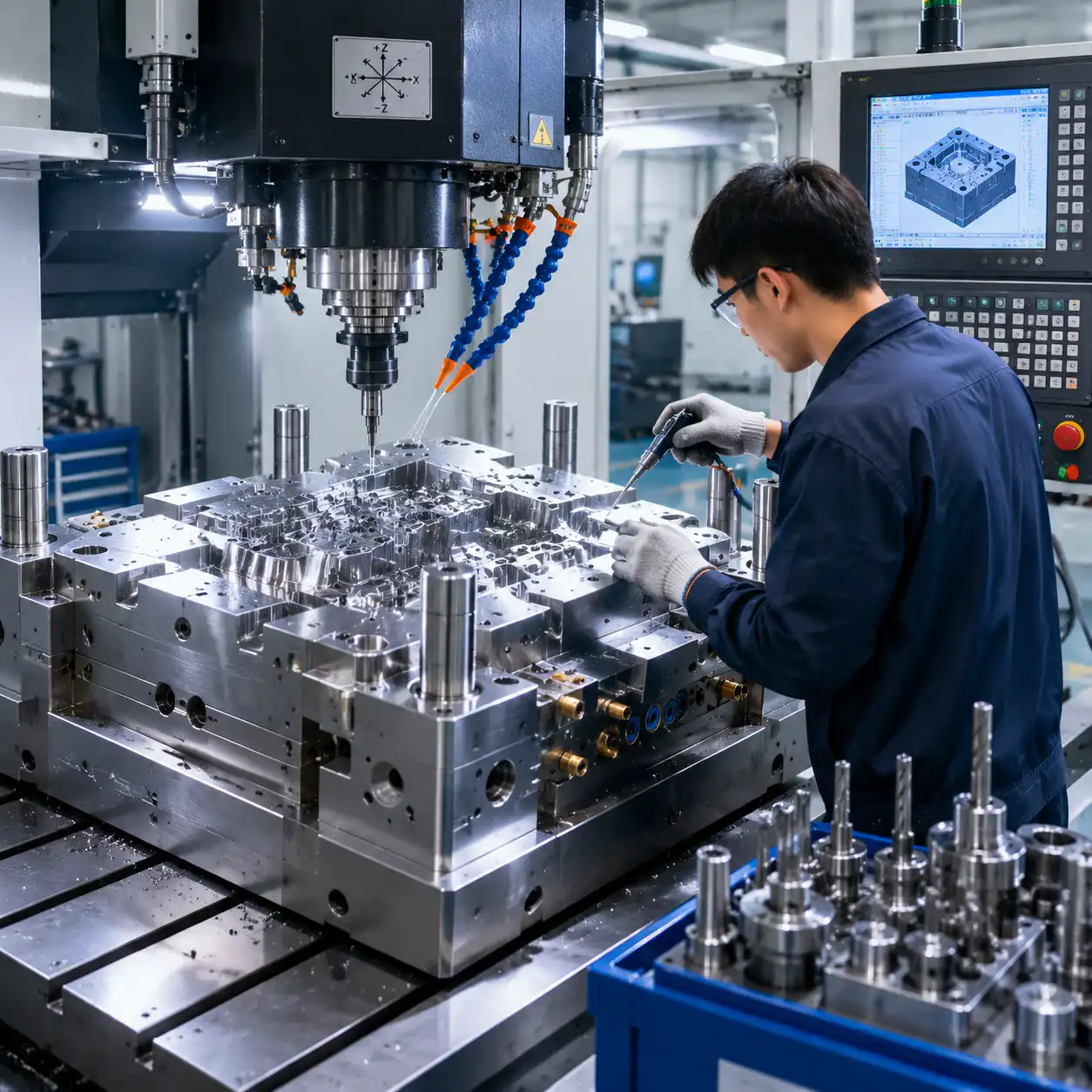
DMLS/SLM is the dominant method today. A laser selectively melts layers of metal powder to build the insert from the ground up, including internal channels. After printing, the insert undergoes stress relief, wire EDM separation from the build plate, and finish machining of critical surfaces.
Design Principles for Conformal Cooling Channels
Effective conformal cooling design follows a set of engineering rules derived from heat transfer fundamentals and manufacturing constraints:
Channel Sizing and Placement
- Channel diameter: Typically 3-8 mm. Larger diameters increase flow and reduce pressure drop but reduce structural strength of the insert.
- Pitch (channel-to-channel spacing): 2-3 times the channel diameter. Closer spacing improves uniformity at the cost of more complex printing.
- Distance from cavity surface: 1.5-2.5 times channel diameter. Closer distances improve heat transfer but increase risk of insert failure under injection pressure.
- Aspect ratio: Non-circular cross-sections (elliptical, teardrop) can increase the wetted perimeter and improve heat transfer coefficient by 10-25%.
Channel Patterns
- Spiral/helical: Wraps around cylindrical or conical cores. Most common for round parts. Maintains constant cross-section and predictable pressure drop.
- Lattice/network: Branched patterns for complex geometries with multiple hot spots. Requires careful balancing to ensure even flow distribution.
- Contour-following: Single or multiple channels that trace the 3D surface at a constant offset. Best for parts with deep draws or irregular surfaces.
- Baffle-replacement: Conformal channels can replace traditional baffles and bubblers in deep cores, eliminating flow restrictions and dead zones.
Material Options for 3D Printed Mold Inserts
The material choice affects thermal performance, mold life, and printability. Three grades dominate production:
| 素材 | Thermal Conductivity (W/mK) | 硬度(HRC) | 最適 |
|---|---|---|---|
| Maraging Steel MS1 | ~25 | 33-36 (as-printed), 50-54 (aged) | General purpose; best printability; most common choice |
| Stainless Steel 17-4PH | ~15-18 | 36-44 (H900) | Corrosive resins (PVC, flame-retardant grades) |
| H13 Tool Steel | ~24-28 | 48-52 (heat treated) | High-volume production; abrasive materials |
Maraging steel MS1 is the workhorse material for conformal cooling. It prints reliably, age-hardens to 50+ HRC, and offers good thermal fatigue resistance. For chemically aggressive resins, 17-4PH provides the necessary corrosion resistance despite its lower thermal conductivity. For million-shot production with glass-filled materials, H13 provides the wear resistance needed – though it is more difficult to print without micro-cracking.
CFD Analysis and Simulation: Validating Before Printing
Given the cost of 3D printed mold inserts (typically $3,000-$15,000 per insert), simulation is not optional – it is essential. The design workflow should follow this sequence. Our mold flow and DFM guide is a useful parallel reference if you are new to reading these reports.
- Part-level cooling analysis: Run a mold-filling simulation (Moldflow, Moldex3D, Sigmasoft) on the part geometry to identify hot spots and required cooling intensity per region.
- Channel design: In CAD, create conformal channels targeting the identified hot regions. Generate the 3D channel geometry.
- CFD simulation of channel flow: Use ANSYS Fluent, COMSOL, or STAR-CCM+ to model the coolant flow through the designed channels. Key metrics: pressure drop, flow velocity distribution, Reynolds number (target turbulent flow, Re greater than 10,000), and heat transfer coefficient (HTC).
- Coupled thermal-structural FEA: Model the complete insert including the channels, cavity surface, and injection cycle. Predict cycle-averaged temperature distribution and compare against conventional cooling.
- Iterate: Adjust channel diameter, spacing, and routing until the simulated cycle time reduction justifies the manufacturing cost.
- Print and validate: After printing, use thermal imaging or embedded thermocouples to validate the simulation predictions during production trials.
ROI Calculation: When Conformal Cooling Pays for Itself
The economic case for conformal cooling is straightforward once you quantify the value of reduced cycle time. The payback period can be calculated as:
Payback Period (days) = (Additional Cost of Conformal Insert) / (Cycle Time Saved per Shot x Machine Hour Rate x Shots per Day)
Example Calculations
Case 1: High-Volume Automotive Connector
- Additional insert cost: $8,000
- Cycle time reduction: 8 seconds (from 28s to 20s, 29% reduction)
- Machine hour rate: $45/hour
- Production: 4,000 shots/day (single cavity)
- Daily savings: (8 seconds x 4,000 shots / 3,600) x $45 = $400/day
- Payback: 20 production days
- First-year net savings: approximately $92,000 (assuming 250 production days)
Case 2: Mid-Volume Medical Device Housing
- Additional insert cost: $12,000 (complex geometry, 2-cavity)
- Cycle time reduction: 12 seconds (from 45s to 33s, 27% reduction)
- Machine hour rate: $60/hour (medical-grade production environment)
- Production: 1,500 shots/day (both cavities)
- Daily savings: (12 seconds x 1,500 shots / 3,600) x $60 = $300/day
- Payback: 40 production days
- Quality improvement: Warpage reduced from 0.8mm to 0.35mm, eliminating secondary straightening operation ($0.15/part)
Case 3: Low-Volume Aerospace Bracket
- Additional insert cost: $10,000
- Cycle time reduction: 15 seconds (from 60s to 45s, 25% reduction)
- Machine hour rate: $75/hour (engineering-grade materials)
- Production: 200 shots/day
- Daily savings: (15 seconds x 200 shots / 3,600) x $75 = $62.50/day
- Payback: 160 production days
- Even at low volumes, conformal cooling pays back within the first production run if dimensional requirements are tight enough that conventional cooling cannot meet Cpk targets.
Limitations and Practical Considerations
- Minimum channel size: DMLS can reliably produce channels down to 0.8-1.0 mm diameter, but powder removal becomes increasingly difficult below 2 mm. Most production designs use 3 mm minimum.
- Powder removal: Un-sintered powder must be completely evacuated from all channels before the insert goes into service. Residual powder can contaminate coolant, block flow, or cause corrosion. Every channel needs straight-line access for cleaning tools – no blind pockets.
- Surface roughness: As-printed channel surfaces have roughness of Ra 10-25 microns, compared to Ra 1.6-3.2 for drilled and reamed channels. This increases pressure drop and can promote fouling over time. Abrasive flow machining (AFM) or chemical polishing can reduce channel roughness but adds cost and lead time.
- Mold size limits: Current DMLS build volumes limit inserts to approximately 250 x 250 x 300 mm (EOS M290) or 400 x 400 x 400 mm (EOS M400). Larger molds require segmented inserts or alternative methods like vacuum brazing.
- Post-processing requirements: Every 3D printed insert needs stress relief, support removal, wire EDM cut-off, and finish machining on functional surfaces (parting line, cavity surface, ejector pin bores). Budget 40-60% of the printing cost for post-processing.
- Design verification cost: The simulation and design optimization phase typically adds $2,000-$5,000 in engineering time, separate from the insert manufacturing cost.
よくある質問
How much faster is conformal cooling than traditional drilled cooling?
Production data shows conformal cooling reduces cooling time by 20-40% on average, with some complex geometries achieving over 50% reduction. The exact improvement depends on part wall thickness variation, material, and how poorly the existing straight-drilled channels serve the hot spots. Parts with uniform wall thickness see smaller gains (10-20%); parts with significant thickness variation see the largest improvements (30-50%). The key mechanism is eliminating the bottleneck: in traditional molds, the slowest-cooling region – often far from any drilled channel – dictates the entire cycle. Conformal channels bring cooling directly to that region.
Can conformal cooling channels be added to existing molds?
Generally, no – conformal cooling cannot be retrofitted into existing molds. Conformal channels are built into the mold insert during its initial manufacture (via 3D printing, vacuum brazing, or diffusion bonding). Modifying an existing conventionally machined insert to add conformal channels is not practical because:
- DMLS printing builds the entire insert around the channels – you cannot print channels into a finished steel block.
- Vacuum brazing requires channels machined into laminations before assembly.
- Attempting to machine curved channels into solid steel is not feasible with conventional tooling.
However, you can create a new conformal insert for an existing mold base – the mold frame, ejector system, and other components remain unchanged; only the cavity/core inserts are replaced. This approach captures most of the cycle time benefit at a fraction of a complete new mold cost, and it often fits well into the tooling acceleration strategies discussed in our lead-time guide.
What mold steel grades work with DMLS 3D printing for conformal cooling?
The production-proven materials for DMLS mold inserts are:
- Maraging Steel MS1 (1.2709): The most widely used grade. Excellent printability, age-hardens to 50-54 HRC, good thermal conductivity (~25 W/mK), and good polishability. Available from all major DMLS machine vendors (EOS, Concept Laser, SLM Solutions).
- Stainless Steel 17-4PH (1.4542): Best corrosion resistance. Suitable for PVC, flame-retardant resins, and medical applications requiring cleanability. Lower thermal conductivity (~15-18 W/mK) means less cooling benefit.
- H13 Tool Steel (1.2344): Highest wear resistance and hot hardness. Suitable for abrasive, glass-filled materials at high production volumes. More difficult to print due to cracking tendency; requires optimized parameters and post-build heat treatment.
- CX Stainless Steel (Corrax): A newer precipitation-hardening stainless with high hardness (50+ HRC) and excellent corrosion resistance. Combines 17-4PH corrosion performance with MS1 hardness levels.
Always specify the powder grade explicitly and require the print service provider to certify the chemical composition and mechanical properties of the printed material.
Is conformal cooling worth it for low-volume production?
It depends on the driving factor – cycle time savings alone may not justify the cost, but quality requirements often do. Here is the breakdown:
- Production volumes under 5,000 parts/year: Cycle time savings rarely cover the additional insert cost. However, if the part has tight tolerances and conventional cooling cannot hold Cpk over 1.33, conformal cooling may be the only way to meet dimensional specifications without secondary operations. In these cases, the justification shifts from cycle time to quality assurance.
- Production volumes 5,000-50,000 parts/year: The sweet spot for ROI analysis. Run the payback calculation described above. If payback is under 6 months (approximately 120 production days), conformal cooling is typically justified on cycle time alone.
- Production volumes over 50,000 parts/year: Conformal cooling is almost always justified on cycle time savings. The only question is which manufacturing method provides the best balance of insert life and cooling performance for the specific volume and material.
A practical approach for low-volume programs: Start with a conventionally cooled mold. If dimensional issues arise or if the program volume increases during the product lifecycle, invest in a conformal insert for the next mold revision.