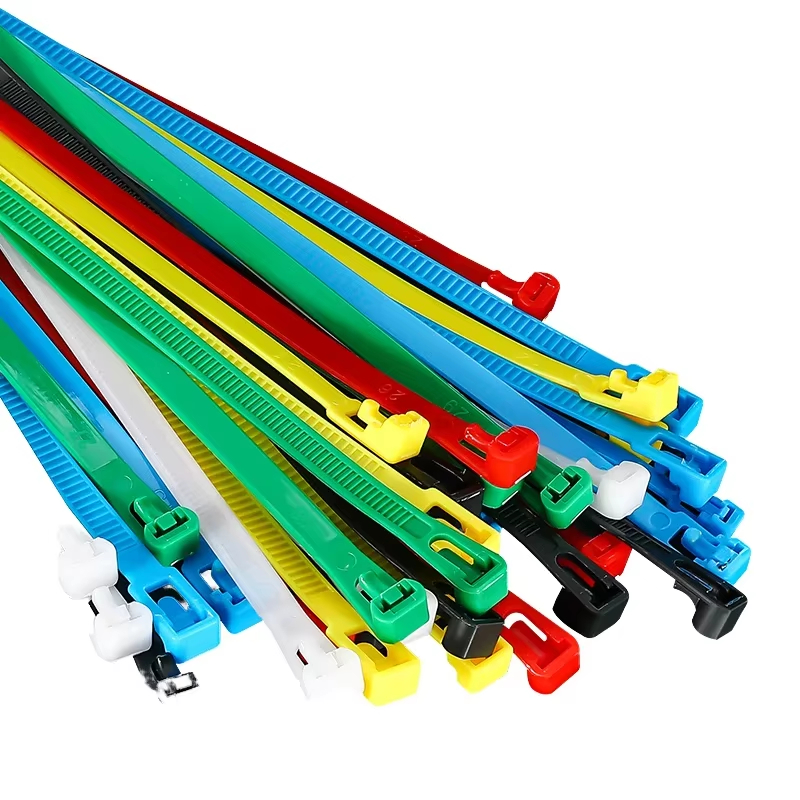
PA6、すなわちナイロン6の選定は、対象用途に必要な具体的なグレード、水分状態、温度、機械的要件の確認から始まります。
PA6(ナイロン6) は、成形部品や切削加工部品に用いられる、高強度で耐摩耗性に優れたエンジニアリング熱可塑性樹脂です。以下では、密度、融点、吸湿による変化、選択できるグレード、加工要件、購入時の確認事項を比較します。
PA6 grades are used for molded components, extruded shapes, fibers and films. For a molded part, check stiffness and dimensions after moisture conditioning, then compare the exact resin grade against the load and temperature the part will see.

PA6購入時の要点
PA6は対象部品に適していますか?
PA6は、靭性、耐疲労性、耐摩耗性を必要とする部品の実用的な候補になります。製造仕様では「PA6」という名称だけでなく、具体的なグレード、補強材、使用環境、水分状態、重要寸法を定める必要があります。
PA6 Material Properties at a Glance
These typical datasheet values describe two named grades: BASF Ultramid B3K as a PA6 reference and WanHan WHG30A as a PA6 GF30 reference. Confirm the grade, test method and specimen condition before using a value in a purchase specification.
| プロパティ | PA6 B3K | PA6 GF30 WHG30A | 試験方法 |
|---|---|---|---|
| 密度 | 1.13 g/cm³ | 1.36 g/cm³ | ISO 1183 |
| Melting temperature | 220 °C | — | DSC, ISO 11357-1/-3 |
| 引張弾性率 | 3,100 / 1,000 MPa (dry / conditioned) | — | ISO 527-1/-2 |
| Tensile stress | 80 / 40 MPa at yield (dry / conditioned, 50 mm/min) | 165 MPa tensile strength (conditioning unstated) | ISO 527-1/-2 (B3K), ISO 527-2 (WHG30A) |
| Moisture uptake | 2.6–3.4% at 23 °C / 50% RH | — | Similar to ISO 62 (B3K) |
| Water saturation | 9–10% in water at 23 °C | — | Similar to ISO 62 (B3K) |
| Heat deflection at 0.45 MPa | 180 °C | 175 °C | ISO 75-1/-2 (B3K), ISO 75-2/B (WHG30A) |
A dash marks data omitted from this comparison. The tensile rows in the source sheets use different definitions. WHG30A does not state specimen conditioning. B3K has an HDT of 60 °C at 1.8 MPa, so specify the test load whenever you compare HDT values.
購入仕様書でPA6グレードを指定する方法
PA6、ポリアミド6、ナイロン6は同じ基本ポリマー系統を指しますが、この名称だけでは製造に用いる具体的なグレードは定まりません。性能に影響する場合、図面や購入仕様書には、補強材、耐衝撃改質、熱安定化、UV安定剤の構成、難燃性の等級、色、調湿状態も明記する必要があります。
| グレードの説明 | 主に変わる特性 | 見積依頼に記載する事項 |
|---|---|---|
| 非充填PA6 | 靭性、耐疲労性、耐摩耗性があり、水分状態の影響が大きい | 具体的なグレード、色、調湿条件、重要寸法 |
| PA6-GF30またはガラス充填率の異なるグレード | 剛性の向上、成形収縮の低減、方向による物性差 | 繊維含有率、繊維配向の影響を受ける形状、表面要件 |
| 耐衝撃改質PA6 | 低温またはノッチ付き衝撃性能の改善。ただし剛性が低下する場合が多い | 衝撃試験の条件、温度、最低強度の目標値 |
| 熱安定化・UV安定化・難燃PA6 | 使用環境に対する長期耐性、または法規制に関わる特性 | 曝露条件、使用寿命、難燃性等級、必要な適合宣言 |
For injection-molding pellets, compare PA6 GF15 そして PA6 GF30. The GF30 page identifies WHG30A and offers a datasheet and quote request. For an alternative to an approved grade, include the current grade code or datasheet so the proposed replacement can be compared against it.
一般的な「PA6」という表記だけで代替材料を承認しないでください。供給元のデータシート、水分状態、試験方法、公称厚さを比較したうえで、選定したグレードを実際の成形条件と使用環境で検証してください。
既に承認されたPA6グレードの代替品を検討する場合は、 エンジニアリングプラスチックのグレード代替チェックリスト を使って具体的な候補を絞り込み、金型試験の条件を記録し、承認前に完成部品を検証してください。
PA6とはどのような材料ですか?
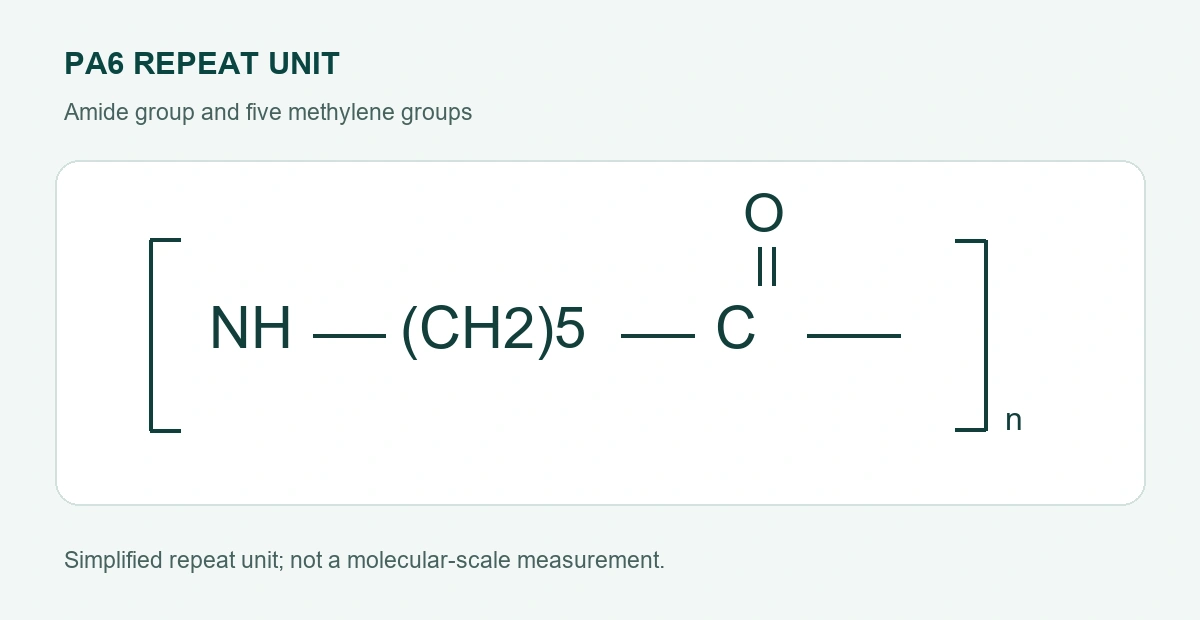
PA6は、炭素原子を六つ持つ環状モノマーであるカプロラクタムを開環重合して得られる半結晶性の熱可塑性ポリアミドです。ナイロン6という名称は、この炭素数に由来します。重合によって、アミド基(-CO-NH-)がペンタメチレン鎖で連結された長い分子鎖が形成されます。化学構造は-[NH-(CH2)5-CO]n-と表せます。
The regular spacing of amide groups along the polymer backbone enables strong intermolecular hydrogen bonding between adjacent chains. These hydrogen bonds are responsible for PA6’s high melting point (approximately 220 degrees Celsius), excellent mechanical strength, and good chemical resistance. The degree of crystallinity in molded parts typically ranges from 25 to 45 percent, depending on cooling rate and nucleating additives, and this crystallinity directly governs the material’s stiffness, strength, thermal resistance, and chemical resistance.
PA6は世界の主要メーカーがさまざまな商標で製造しており、多くのグレードがあります。一般成形・押出用の非強化グレード、高強度構造用途向けに通常GFを15、25、30、50パーセント含むガラス繊維強化グレード、寸法安定性を高める無機充填グレード、靭性を重視した耐衝撃改質グレード、電気・電子用途向けの難燃グレード、高温使用向けの熱安定化グレードなどがあります。
当社のエンジニアリングプラスチックの供給について
As an ISO 9001 certified engineering plastics manufacturer and exporter based in China, we specialize in providing high-quality nylon (PA6, PA66, PA12), polyacetal (POM), thermoplastic polyurethane (TPU), polypropylene (PP), and specialty engineering compounds to industrial buyers worldwide. Our products include glass fiber reinforced, carbon fiber filled, flame retardant, and custom-modified grades tailored to your application requirements. With in-house testing laboratories and a dedicated R&D team, we ensure consistent quality across every batch. Whether you need standard grades or custom formulations, we deliver reliable material solutions for automotive, electronics, industrial, and consumer goods applications.
主な物理的、機械的、および熱的特性
PA6の物性は、成形直後の乾燥状態(DAM)で試験するか、調湿後に試験するかによって大きく異なります。PA6は周囲の水分を吸収するため、通常の使用状態を表す調湿後の値のほうが、設計上適切な場合が多くあります。
物理的性質
非強化PA6の密度は1立方センチメートルあたり1.12~1.15グラムであり、エンジニアリング熱可塑性樹脂の中でも軽量な素材です。 融点は220℃、乾燥状態でのガラス転移温度(Tg)は約50~60℃ですが、水分を飽和吸収すると0℃近くまで低下します。 23°C/相対湿度50%における平衡吸湿量と、水中の飽和状態は、異なる試験条件です。グレード別の例として、 BASF Ultramid B3K 製品仕様書 平衡状態では2.6~3.4%、水飽和状態では9~10%と報告されている。これらの数値はB3Kに関するものであり、すべてのPA6グレードに当てはまるわけではない。 成形収縮率は、非強化グレードで1.0~1.5%であり、30%ガラス繊維強化グレードでは0.2~0.5%に低下する。
機械的特性(成形直後の乾燥状態)
Tensile strength at yield for unreinforced PA6 typically ranges from 70 to 85 MPa, while 30 percent glass-fiber-reinforced grades achieve 160 to 180 MPa. Tensile modulus climbs from approximately 3,000 MPa (unreinforced) to 9,500 to 11,000 MPa (PA6 GF30). Flexural strength follows a similar pattern: 100 to 115 MPa unreinforced versus 240 to 270 MPa for GF30. Charpy notched impact strength of unreinforced PA6 is 4 to 6 kJ per square meter in the dry state, but this can increase dramatically to 15 to 30 kJ per square meter after moisture conditioning, as absorbed water acts as an internal plasticizer. Elongation at break ranges from 20 to 50 percent for unreinforced dry PA6, climbing to well over 200 percent in the conditioned state.
熱的特性
Heat deflection temperature measures deformation under a specified test load. Melting temperature describes a phase transition. For a part under sustained heat, ask for temperature aging or creep data for the selected grade and check how load, time and exposure affect the part. For glass-filled PA6, review thermal expansion along and across the flow direction when fit matters.
その他の注目すべき物件
PA6 can be considered for wear components and electrical housings. Check friction and wear against the actual mating surface, load and lubrication. For electrical applications, confirm the required flammability rating for the exact grade and tested thickness. For example, the B3K sheet lists HB at 1.5 mm and V-2 at 3.05 mm.
吸水:原因、影響、および対策
吸水性は、PA6の挙動を左右する最も重要な特性です。用途に適した設計と加工を行うには、この特性を理解することが欠かせません。
PA6はなぜ水分を吸収するのでしょうか?
The amide groups (-CO-NH-) along the PA6 polymer chain are highly polar and readily form hydrogen bonds with water molecules. In the dry state, these groups hydrogen-bond to neighboring polymer chains. When exposed to humidity, water molecules compete for these hydrogen-bonding sites, inserting themselves between polymer chains. This process is reversible: drying the material drives off the absorbed water and restores the original mechanical properties. At equilibrium with 50 percent relative humidity at 23 degrees Celsius, PA6 absorbs approximately 2.5 to 3.0 percent water by weight. At full immersion in water, saturation can reach 8 to 10 percent.
機械的特性への影響
Absorbed water acts as an internal plasticizer, increasing chain mobility and reducing intermolecular forces. The practical consequences are significant: tensile strength and modulus decrease by 30 to 50 percent from dry to conditioned states, while impact strength and elongation at break increase dramatically — often by a factor of 3 to 5. The glass transition temperature drops from approximately 55 degrees Celsius to near 0 degrees Celsius at saturation. Dimensional changes of 0.5 to 0.8 percent in linear dimensions are typical from dry to conditioned equilibrium. These changes are not defects; they are designed into the material selection process, and the conditioned values should be used for final part design.
吸水性の管理
Several strategies exist for managing the effects of moisture absorption. During processing, always dry PA6 thoroughly before molding: if the residual moisture content exceeds 0.2 percent, dry at 80 degrees Celsius for 3 to 4 hours using a desiccant dryer. If the material has been exposed to ambient air for more than 8 hours, vacuum drying at 105 degrees Celsius for 1 to 2 hours is recommended. For design, use the conditioned mechanical property values rather than dry-as-molded values for final part validation. Glass fiber reinforcement reduces total water absorption proportionally to filler content, since the glass does not absorb water — PA6 GF30 absorbs roughly 1.5 to 2.0 percent versus 2.5 to 3.0 percent for unreinforced PA6. For applications where water absorption is unacceptable, consider PA66 (which absorbs slightly less, at 2.0 to 2.5 percent), polyolefins, or specialty low-moisture polyamides such as PA12 or PA610.
PA6の加工指針
PA6の性能を十分に引き出すには、適切な加工が重要です。一部のエンジニアリング熱可塑性樹脂よりも加工条件の変動に対応しやすい材料ですが、乾燥、温度管理、金型設計に配慮することで、部品品質を大きく改善できます。
乾燥条件
PA6 pellets are hygroscopic and must be dried to a residual moisture content below 0.15 to 0.20 percent by weight before melt processing. Standard drying procedure is 80 degrees Celsius for 3 to 4 hours in a desiccant dryer with a dew point of minus 30 degrees Celsius or lower. A drying time of 4 to 6 hours is recommended for glass-fiber-reinforced grades. If material has been exposed to ambient humidity for more than 8 hours, vacuum drying at 105 degrees Celsius for 1 to 2 hours is the most effective method. Inadequate drying produces surface splay (silver streaks), reduced mechanical properties due to hydrolytic degradation, and increased brittleness. If using a hot-air oven rather than a desiccant dryer, use a tray depth no greater than 25 millimeters and extend drying time to 8 to 12 hours.
射出成形パラメータ
The recommended processing temperature range for unreinforced PA6 is 230 to 280 degrees Celsius. For glass-fiber-reinforced grades, the range should be 250 to 280 degrees Celsius to ensure adequate fiber wet-out and dispersion. A typical barrel temperature profile for unreinforced PA6 is rear zone 230 to 240 degrees Celsius, middle zone 240 to 260 degrees Celsius, front zone 250 to 270 degrees Celsius, and nozzle 245 to 265 degrees Celsius. For reinforced grades, shift this profile upward by approximately 10 to 15 degrees Celsius.
Mold temperature is a particularly important parameter for PA6. For unreinforced grades, a mold temperature of 80 to 90 degrees Celsius is recommended to achieve adequate crystallization and dimensional stability. For glass-fiber-reinforced grades, mold temperature should be greater than 80 degrees Celsius, typically 90 to 100 degrees Celsius, to promote good fiber encapsulation and surface finish. For parts with wall thickness above 3 millimeters, mold temperature can be reduced to 20 to 40 degrees Celsius for unreinforced PA6 to shorten cycle time, though this will produce a less crystalline, less dimensionally stable part. For reinforced grades with thick walls, 60 to 80 degrees Celsius is a practical minimum.
Injection speed should be medium to fast to prevent premature freeze-off, especially for thin-walled parts. Holding pressure of 50 to 70 percent of the injection pressure, applied for 5 to 15 seconds depending on wall thickness and gate geometry, compensates for the relatively high volumetric shrinkage of unreinforced PA6. Back pressure of 0.5 to 1.0 MPa aids melt homogeneity without excessive shear heating. Screw speed should be kept moderate — 50 to 150 RPM — to avoid degradation.
金型設計における考慮事項
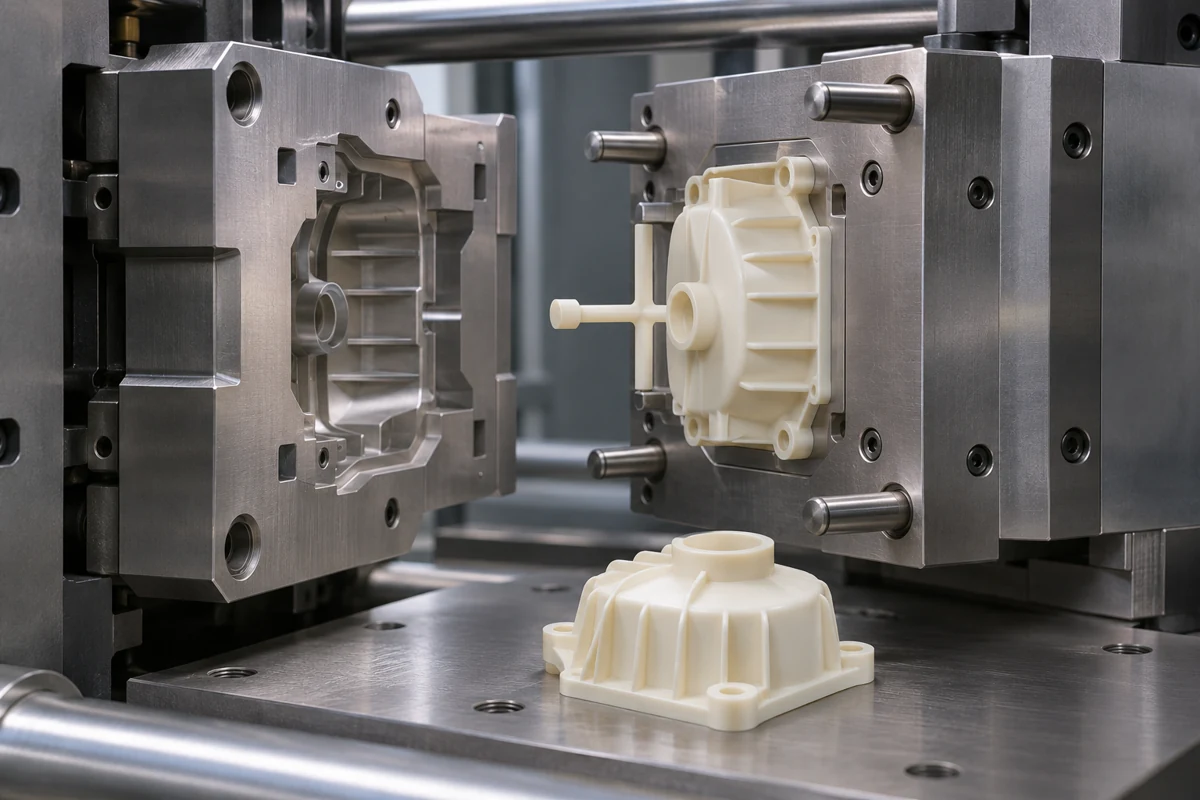
Gate design should minimize flow restrictions. Generous gate dimensions with a land length not exceeding 0.5 to 1.0 millimeter are recommended. Venting of 0.01 to 0.03 millimeters depth is important to prevent gas burn marks, particularly at weld lines and the end of fill. Draft angles of 0.5 to 1 degree are usually sufficient. Because PA6 crystallizes rapidly, mold cooling should be uniform to avoid differential shrinkage and warpage. For glass-fiber-reinforced grades, hard (Rockwell C 54 or higher) mold steel is recommended for production volumes exceeding 50,000 cycles to resist abrasive wear from the glass fibers. Runner systems should be generously sized and streamlined to minimize pressure drop.
ガラス繊維強化・無機充填PA6グレード
非強化PA6は汎用性の高い材料ですが、補強によって適用範囲が大きく広がります。
ガラス繊維強化PA6(PA6 GF)
Glass reinforcement typically increases stiffness and changes shrinkage in the flow and cross-flow directions. PA6 GF30 contains 30% glass fiber by weight. Check the selected grade for the actual stiffness, HDT, density and processing window. Gate position and fiber orientation affect warpage, while exposed fibers can affect surface appearance. Common applications include structural brackets and tool housings.
無機充填PA6
Mineral fillers — typically calcium carbonate, talc, or wollastonite — are added to PA6 primarily to improve dimensional stability and reduce cost. Mineral-filled grades exhibit significantly lower and more isotropic mold shrinkage than unreinforced PA6, with shrinkage values of 0.5 to 0.8 percent versus 1.0 to 1.5 percent. Surface finish is better than glass-fiber-reinforced grades, and the material is less abrasive to tooling. Mineral fillers do not provide the same level of strength improvement as glass fibers; tensile strength typically increases only modestly, to 75 to 95 MPa. These grades are commonly specified for dimensionally critical parts that do not bear high structural loads, such as housings, covers, and interior trim components.
ハイブリッド補強(GF+GB)
PA6 GF GB30のようにガラス繊維とガラスビーズを組み合わせたコンパウンドは、繊維補強による強度と球状充填材による寸法安定性の両立を図る材料です。構造性能と寸法精度の双方が重要な自動車・電子機器の精密部品で、こうした材料の採用が増えています。PA6 GF GB30の詳細は、この材料についての個別記事をご参照ください。
耐衝撃性グレードおよび特殊グレード
Impact-modified grades can be evaluated for parts that face notched impacts or cold service. Heat- and UV-stabilized grades address different exposure conditions. For flame retardancy or ESD, specify the required rating or resistance range and request documentation for the proposed formulation.
産業分野別の用途
PA6 is used in molded components, fibers, films and stock shapes. For procurement, identify the required form first, then compare grades intended for that manufacturing process.
Textile Fibers
PA6の主な用途は合成繊維です。PA6繊維は、アパレル(スポーツウェア、靴下、ランジェリー、アウターウェア)、カーペット(住宅用および業務用)、および産業用繊維(コンベアベルト、シートベルト、エアバッグ、ロープ、ウェビング)に使用されています。 PA6繊維は、高い引張強度、優れた弾性回復性、良好な耐摩耗性を備え、幅広い色への染色が可能である。この素材の吸湿性は、エンジニアリング用途ではしばしば欠点とされるが、繊維製品においては着用時の快適性に寄与する利点となる。
Tire Cord
PA6のタイヤコードは、タイヤ産業における重要な補強材です。乗用車、トラック、オフロード車用タイヤのカーカスやキャッププライに使われます。高い強度、ゴム配合物との良好な接着性、優れた耐疲労性によって、タイヤの耐久性や高速走行性能に貢献します。
エンジニアリングプラスチック
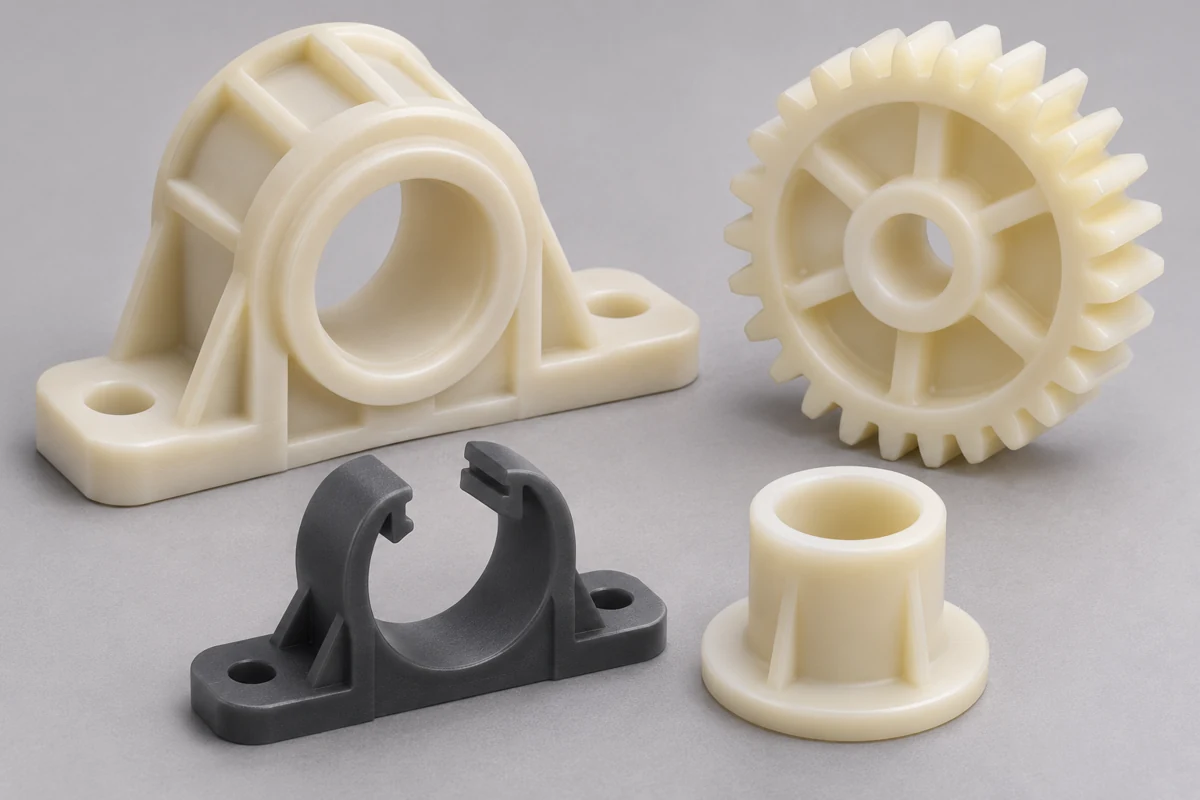
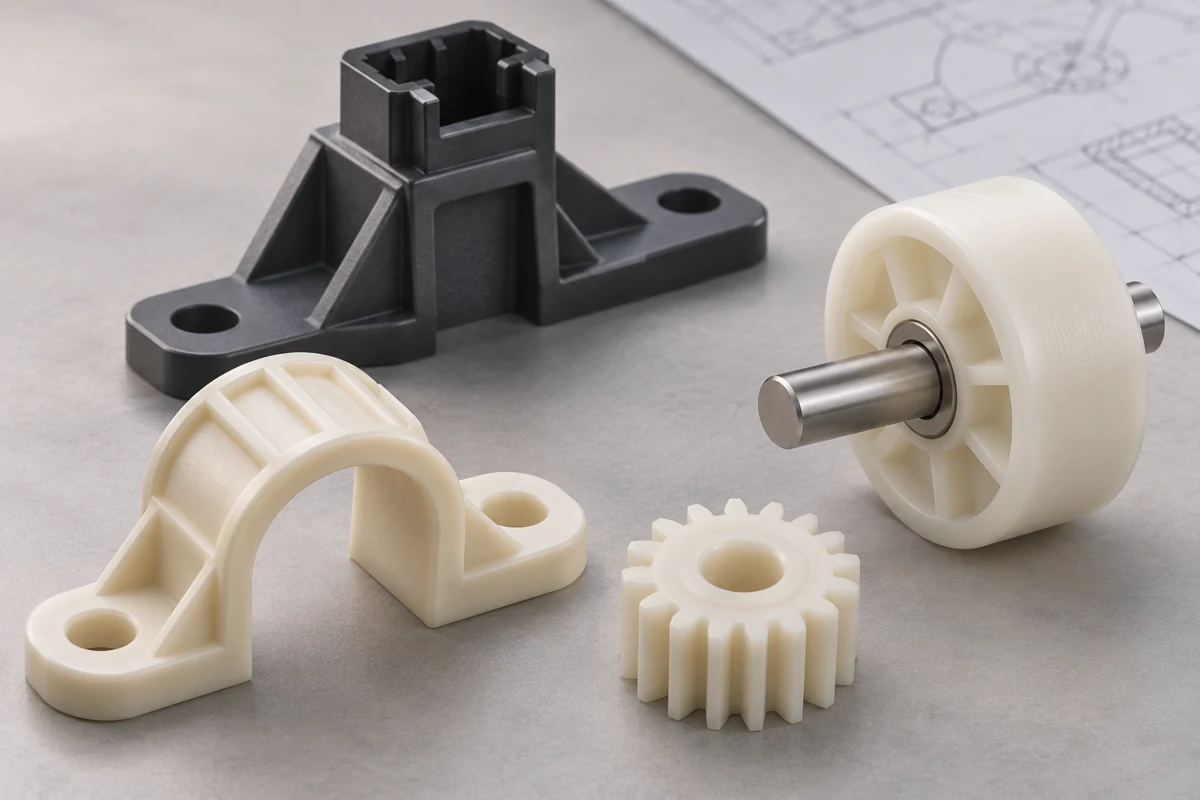
自動車分野では、PA6はエンジンカバー、吸気マニホールド、ラジエーターのエンドタンク、冷却ファンの羽根、燃料系部品、ドアハンドル、ミラーハウジング、ペダルユニット、結束バンドに使われます。電気・電子分野では、コネクター、遮断器、コイルボビン、端子台、ケーブルグランド、スイッチ筐体、電動工具のケースに使用されます。産業用品や消費財では、歯車、軸受、カム、ポンプハウジング、配管継手、家具用キャスター、ファスナー、かばん用金具などに用いられます。
Fishing Nets
PA6のモノフィラメントおよびマルチフィラメント糸は、商業用漁網、養殖用ケージ、スポーツ用ネットなどで広く使用されています。この素材は、高強度、優れた結び目保持性、耐摩耗性、そして低コストという特長を兼ね備えているため、こうした過酷な海洋用途において好んで採用されています。
BOPA Film
PA6樹脂から作られる二軸延伸ポリアミド(BOPA)フィルムは、食品包装のバリア層として広く使われます。酸素や香気成分に対する優れたバリア性、良好な耐突刺し性・耐引裂き性、高い透明性を備えています。ポリエチレンとラミネートし、食肉、チーズ、スナック、ペットフード向けの多層包装フィルムにするのが一般的です。
Staple Fibers and Stock Shapes
PA6の短繊維は、不織布、ろ過材、混紡糸に使用されます。PA6を押し出した丸棒、テープ、異形材は、一般機械部品の切削用素材や、重量物の包装用結束テープとして使われます。
PA6とPA66:用途に応じた選び方
PA6とPA66は、合わせて世界のポリアミド消費量の大部分を占めています。多くの特性を共有していますが、用途によっては両者の違いが材料選定の決め手になります。
化学構造と結晶性
PA66 has a slightly more symmetrical chemical structure than PA6, with amide groups spaced at regular intervals along chains derived from hexamethylene diamine and adipic acid. This symmetry enables a higher degree of crystallinity (35 to 50 percent versus 25 to 45 percent for PA6) and a higher melting point (260 degrees Celsius versus 220 degrees Celsius). The higher melting point of PA66 is its single most important performance advantage over PA6.
機械的性能
In the dry-as-molded state, PA66 offers slightly higher tensile strength (80 to 90 MPa versus 70 to 85 MPa for unreinforced) and modulus (3,200 to 3,500 MPa versus approximately 3,000 MPa). However, the performance gap narrows significantly after moisture conditioning, and for many applications the two materials are interchangeable from a mechanical standpoint. PA6 generally offers better impact strength, especially at low temperatures, and better fatigue resistance.
熱性能
PA66 generally has a higher melting point than PA6. Compare HDT at the same test load, and use grade-specific aging and creep data to assess sustained temperature under the expected load. Ask for the service environment and exposure time before selecting a resin.
吸水性と寸法安定性
PA6 absorbs more water at equilibrium than PA66 (2.5 to 3.0 percent versus 2.0 to 2.5 percent at 50 percent RH, 23 degrees Celsius). For dimensionally sensitive applications, PA66’s lower moisture absorption provides a stability advantage. However, PA6 compensates with better oil resistance and lower processing temperatures.
加工とコスト
PA6 generally processes at lower melt temperatures than PA66. For a cost comparison, use quotes for the proposed grades and include drying, cycle time, scrap and the part’s validation requirements.
用途に応じた材料選定ガイド
Consider PA6 when the conditioned stiffness, impact resistance and processing window fit the part. When heat, creep or dimensional stability drives the choice, compare candidate PA6 and PA66 grades using the same test conditions. If the drawing calls for an approved grade, follow the customer’s substitution process.
PA6に関するよくある質問
PA6はどのような部品に適しているのでしょうか?
PA6は、その耐荷重、使用温度範囲、湿気への耐性、摩耗特性、および加工方法が実際の使用条件と一致する場合に、その部品に適しています。
注文する前に、PA6のどの特性を確認すべきですか?
強度、剛性、耐衝撃性、耐熱性、吸湿性、寸法安定性、摩擦、摩耗、および化学的適合性を確認する。.
Can I select a PA6 grade from its datasheet alone?
Use the datasheet to shortlist grades. Then check the part in its actual moisture and temperature conditions, especially where fit, load or long-term exposure matters.
PA6製の部品は、いつ使用環境下で試験を行うべきでしょうか?
部品が荷重、熱、化学物質、湿気、厳しい公差、規制要件、あるいは新たな動作環境にさらされる場合は、試験を行うことをお勧めします。.
PA6素材に関するお問い合わせ
適切なPA6グレードを選ぶ
材料選定に必要な情報をお知らせください。材料のみのお問い合わせでは、図面の提出は任意です。
技術的検討およびデータ出典
技術文書作成者および校閲者: WanHan 技術チーム
前回の技術レビュー: 2026年9月28日
- WanHan PA6 WHG30A 技術データシート は、具体的な市販グレードの参照例です。
- について PA6 GF30データシート解説 は、引用したISO試験方法、調湿条件の制約、個別グレードのデータと複数供給元の参考範囲の違いを説明しています。
- 本ガイドのPA6の一般値は参考範囲であり、供給元、グレード、加工工程、調湿条件によって異なります。選定したグレードの最新TDSを確認してください。