PA6 GF30 is Nylon 6 reinforced with a nominal 30% glass fiber by weight. It is selected when unfilled PA6 does not provide enough stiffness, creep resistance or dimensional stability. This guide combines a real commercial-grade datasheet, typical cross-supplier property ranges, moisture effects and injection-molding starting conditions.
PA6 GF30 at a Glance
The example values below come from the downloadable PA6 WHG30A datasheet. That PDF does not state specimen conditioning; confirm the method and validate molded parts before design approval.
What Does PA6 GF30 Mean?
- PA6 identifies Polyamide 6, also called Nylon 6.
- GF identifies glass-fiber reinforcement.
- 30 identifies the nominal glass-fiber content by weight.
PA6 GF30 is a material family, not one universal recipe. Heat stabilizers, impact modifiers, lubricants, pigments, flame retardants, resin viscosity and fiber system can all change the final properties and molding behavior. Two materials marked PA6 GF30 are therefore not automatically interchangeable.
PA6 WHG30A Manufacturer Datasheet
The downloadable manufacturer TDS identifies the commercial grade as PA6 WHG30A. The following values are reproduced from that one-page document. They are typical product values, not guaranteed design limits.
| プロパティ | テスト基準 | 単位 | PA6 WHG30A |
|---|---|---|---|
| 引張強度 | ISO 527-2 | MPa | 165 |
| Tensile Strain at Break | ISO 527-2 | % | 9 |
| 曲げ強度 | ISO 527-2 | MPa | 230 |
| 曲げ弾性率 | ISO 178 | MPa | 6000 |
| Izod Notched Impact Strength | ISO 179 | kJ/m² | 17 |
| Temperature of Deflection Under Load | ISO 75-2/B | °C | 175 |
| Melting Index | ISO 1183 | g/10 min | 20 |
| 密度 | ISO 1183 | g/cm³ | 1.36 |
| Molding Shrinkage | ISO 2577 | % | 0.6 |
| 可燃性 | UL 94 | - | - |
Read the test conditions: ISO 75-2/B is the 0.45 MPa HDT method; it cannot be compared directly with the 1.8 MPa ranges below. The PDF does not state specimen conditioning. Its impact row names Izod but cites ISO 179 (Charpy), its flexural-strength row cites the tensile standard ISO 527-2, and its melting-index row cites ISO 1183 (density); confirm those methods with the supplier before using the figures for approval. The UL 94 result is blank. Request the current signed TDS, batch certificate of analysis and applicable RoHS, REACH or UL documents for the selected grade.
Download PA6 WHG30A Datasheet (PDF)
Need the compound rather than only the data? See the PA6 GF30 製品ページ for grade selection and send the part requirements with your datasheet or sample request.
PA6 GF30 Typical Property Data
The following tables show illustrative ranges across commercial PA6 GF30 formulations, not additional specifications for WHG30A. Use them only to identify questions for grade selection; values can differ with formulation, specimen thickness, method and conditioning. The WHG30A PDF above is the source for that named grade.
Illustrative PA6 GF30 Mechanical Ranges (Dry as Molded Examples)
| プロパティ | 値(標準範囲) | 試験方法 | 単位 |
|---|---|---|---|
| 引張弾性率 | 9,500-10,500 | ISO 527-1/-2 | MPa |
| 破断引張強度 | 170-190 | ISO 527-1/-2 | MPa |
| 破断伸度 | 3.0-4.5 | ISO 527-1/-2 | % |
| 曲げ弾性率 | 8,000-9,500 | ISO 178 | MPa |
| 曲げ強度 | 260-290 | ISO 178 | MPa |
| シャルピー衝撃強度(ノッチ付き) | 12-16 | ISO 179/1eA | kJ/m² |
| シャルピー衝撃強度(ノッチなし) | 75-95 | ISO 179/1eU | kJ/m² |
| アイゾット衝撃強度(ノッチ付き) | 11-15 | ISO 180/A | kJ/m² |
| ボール圧痕硬度 | 200-230 | ISO 2039-1 | MPa |
物理的性質
| プロパティ | 値(標準範囲) | 試験方法 | 単位 |
|---|---|---|---|
| 密度 | 1.35-1.38 | ISO 1183 | g/cm³ |
| 吸水率(23 ℃、飽和状態) | 5.5-6.5 | ISO 62 | % |
| 吸水率(23 ℃、50% 相対湿度平衡) | 1.5-2.0 | ISO 62 | % |
| 成形収縮(平行方向、1.6 mm) | 0.25-0.40 | ISO 294-4 | % |
| 成形収縮(標準、1.6 mm) | 0.80-1.10 | ISO 294-4 | % |
| 成形後の収縮(平行方向、110℃で1時間) | 0.05-0.10 | ISO 294-4 | % |
| 成形後の収縮(通常、110℃で1時間) | 0.10-0.15 | ISO 294-4 | % |
熱的特性
| プロパティ | 値(標準範囲) | 試験方法 | 単位 |
|---|---|---|---|
| 融点(DSC、10 K/min) | 218-222 | ISO 11357-1/-3 | C |
| 0.45 MPaにおけるHDT | 215-220 | ISO 75-1/-2 | C |
| 1.8 MPaにおけるHDT | 195-210 | ISO 75-1/-2 | C |
| ビカット軟化温度(VST/B50) | 205-215 | ISO 306 | C |
| 線熱膨張係数(平行方向、23~55 ℃) | 2.0-3.0 x 10⁻⁵ | ISO 11359-1/-2 | 1/K |
| 線熱膨張係数(標準状態、23~55 ℃) | 6.0-9.0 x 10⁻⁵ | ISO 11359-1/-2 | 1/K |
| 熱伝導率 | 0.28-0.35 | DIN 52612 | W/(m·K) |
| 比熱 | 1.5-1.7 | — | J/(g・K) |
電気的特性
| プロパティ | 値(標準範囲) | 試験方法 | 単位 |
|---|---|---|---|
| 誘電率(1 MHz) | 3.5-4.5 | IEC 60250 | — |
| 散逸係数(1 MHz) | 0.01-0.03 | IEC 60250 | — |
| 体積抵抗率 | 1013-1015 | IEC 60093 | オーム・センチメートル |
| 表面抵抗率 | 1012-1014 | IEC 60093 | オーム |
| 比較トラッキング指数(CTI) | 500-600 | IEC 60112 | V |
| 絶縁耐力(1.6 mm) | 30-35 | IEC 60243-1 | kV/mm |
可燃性
| プロパティ | 価値 | 試験方法 | 備考 |
|---|---|---|---|
| UL 94 規格(0.8 mm) | HB | UL 94 | 標準仕様のGF30には難燃性はありません |
| UL 94 規格(1.6 mm) | HB | UL 94 | FR V-0には専用の難燃性コンパウンドが必要です |
| 限界酸素指数(LOI) | 22-24% | ISO 4589 | 常圧下での燃焼 |
| 自然発火温度 | >400 C | ASTM D1929 | — |
湿度調整による物件の変化
PA6は周囲の湿気を吸収します。23℃で相対湿度50%の平衡状態において、PA6 GF30製の部品は、重量比で約1.5~2.0%の水分を吸収します。これにより、機械的特性は著しく変化します。 引張強度は30~40%低下し、曲げ弾性率は25~35%低下する一方、衝撃強度は50~100%向上します。 以下のデータ表は、成形直後の乾燥状態から調整済み(50%の相対湿度)の状態への値のおおよその変化を示しています:
| プロパティ | 乾燥状態(成形直後) | 調整済み(50% RH、23℃) | 変更 |
|---|---|---|---|
| 引張強さ (MPa) | 180 | 110-130 | -30 ~ -40% |
| 曲げ弾性率 (GPa) | 9.0 | 6.0-7.0 | -25 ~ -35% |
| シャルピーノッチ衝撃強度(kJ/m²) | 14 | 20-28 | +50 ~ +100% |
| 1.8 MPa における HDT(C) | 200 | 65-75 (wet) | Significant drop at full saturation |

処理パラメータ
乾燥
PA6 GF30は、射出成形前に含水率を0.10%未満(目標値:0.05%)まで乾燥させる必要があります。推奨される乾燥方法:露点-30℃以下の乾燥剤式乾燥機で、80℃、4~6時間乾燥させます。 重要度の低い用途であれば、80℃で8~12時間のトレイ乾燥でも問題ありませんが、吸着式乾燥ほど信頼性は高くありません。90℃以上での乾燥は避けてください。高温になると酸化による変色(黄変)が始まります。.
射出成形
| パラメータ | 推奨範囲 | 備考 |
|---|---|---|
| 溶融温度(ノズル) | 250~280℃ | 薄い壁には下側を、厚い壁には上側を使用してください |
| 金型温度 | 80~100℃ | 結晶性と表面特性の観点から、100 Cが推奨される |
| 射出速度 | 中速から高速 | 充填速度の向上により、繊維配向のばらつきが低減される |
| 圧力を維持する | 50~80%の射出圧力 | 収縮分を十分に考慮し、詰めすぎを防ぐ |
| 背圧 | 5~15 bar(油圧) | 背圧を高めると、溶融物の均一性が向上する |
| ねじの回転速度 | 50~150 rpm | せん断発熱を防ぐため、より大きなショットサイズでは下限値を設定する |
| 滞留時間(溶融温度での最大値) | 10~15分 | それより長い場合は除去してください。劣化したPA6は焼け跡を残し、強度が低下します。 |
金型設計における考慮事項
- ゲートタイプ: すべての標準的なゲートタイプが適しています。ピンゲート、エッジゲート、ファンゲートはいずれも使用可能です。トンネル(サブマリン)ゲートを使用する場合は、ゲート径に注意が必要です。30% GFを使用する際、過度なせん断を避けるためには、ゲート径を0.8 mm以上にする必要があります。.
- ゲートの位置: ゲートを、溶融材が最も厚い部分に流れ込むように配置してください。キャビティが満たされる前に溶融材の先端が冷却されてしまうような、長い流れ路は避けてください。.
- 愚痴: 適切なベント加工は極めて重要です。ベント加工が不十分だと、焼け跡、充填不足、金型への付着物が発生します。ベントの深さ:0.01~0.02 mm。.
- ドラフト角: テクスチャ加工面の場合、最低1度、2度が望ましい。GFグレードはコアにきつく収縮するため、適切な抜き勾配を設けることで、取り出し時の損傷を防ぐことができる。.
- 鋼材の選定: 30%ガラス繊維は研磨性があります。10万ショットを超える生産ロットでは、キャビティおよびコア、特にゲートや摩耗の激しい箇所には、焼入れ工具鋼(最低52 HRC)を使用してください。.
Comparing PA6 GF30 with Related Grades
PA6 GF30 is a common selection, but the following cross-grade values are screening examples, not a matched set of supplier specifications. Compare test method, load and conditioning before using them in a design decision. See the PA6 GF15, PA6 GF30 そして PA6 GF40 pages for the available grade routes.
| プロパティ | PA6(充填剤なし) | PA6 GF15 | PA6 GF30 | PA6 GF50 | PA66 GF30 |
|---|---|---|---|---|---|
| 引張強さ (MPa) | 80 | 120-140 | 170-190 | 200-230 | 180-200 |
| 曲げ弾性率 (GPa) | 2.8 | 5.5-6.5 | 8.0-9.5 | 14-16 | 9.0-10.5 |
| ノッチ付きアイゾット(kJ/m²) | 5-7 | 7-10 | 11-15 | 13-18 | 10-13 |
| 1.8 MPa における HDT(C) | 65-75 | 180-195 | 195-210 | 210-215 | 240-255 |
| 密度(g/cm³) | 1.14 | 1.23 | 1.36 | 1.56 | 1.37 |
| 相対コスト | 1.0x | 1.1x | 1.2x | 1.4x | 1.3x |
PA6 Glass Fiber Grade Comparison: GF15 vs GF30 vs GF40 vs GF50
Glass fiber content drives the performance-cost trade-off in PA6 compounds. The table below shows how increasing glass fiber from 15% to 50% changes key mechanical and thermal properties. Use these screening values to narrow your grade selection before requesting commercial datasheets.
| プロパティ | PA6(充填剤なし) | PA6 GF15 | PA6 GF30 | PA6 GF40 | PA6 GF50 |
|---|---|---|---|---|---|
| 引張強度(MPa、乾燥時) | 70 – 85 | 110 – 130 | 160 – 190 | 180 – 200 | 200 – 220 |
| 曲げ弾性率 (MPa) | 2,500 – 3,000 | 4,500 – 5,500 | 8,000 – 10,000 | 10,500 – 12,000 | 13,000 – 15,000 |
| 破断伸度(%) | 20 – 40 | 3 – 5 | 3 – 5 | 2 – 3 | 1.5 – 2.5 |
| Charpy Notched Impact (kJ/m², 23°C) | 5 – 8 | 8 – 12 | 10 – 15 | 12 – 16 | 13 – 17 |
| 密度 (g/cm³) | 1.13 – 1.15 | 1.20 – 1.23 | 1.35 – 1.38 | 1.44 – 1.48 | 1.55 – 1.58 |
| HDT/A, 1.8 MPa (°C) | 60 – 75 | 180 – 195 | 200 – 210 | 210 – 215 | 215 – 220 |
| 融点 (°C) | 220 – 225 | 220 – 225 | 220 – 225 | 220 – 225 | 220 – 225 |
| Mold Shrinkage (flow, %) | 1.0 – 1.5 | 0.4 – 0.7 | 0.2 – 0.5 | 0.15 – 0.35 | 0.10 – 0.25 |
| 代表的なアプリケーション | Non-structural clips, covers | Housings, brackets, medium stiffness | Engine covers, fan shrouds, power tool housings | High-stiffness frames, pump bodies | Metal replacement, extreme rigidity |
Selection guidance: PA6 GF30 is the most commonly specified glass-filled PA6 grade because it delivers the best stiffness-to-cost ratio for typical structural applications. Move to GF40 or GF50 only when the application demands stiffness approaching aluminum or when wall thickness is constrained. Stay with GF15 when flow into thin-wall features or impact toughness at low temperature matters more than maximum rigidity.
PA6 GF30 Commercial Grade Equivalents
| サプライヤー | PA6 GF30 Grade | Key Features |
|---|---|---|
| BASF | Ultramid B3WG6 / B3EG6 | General-purpose, heat-stabilized, excellent surface finish |
| デュポン | Zytel 73G30 HSL | Heat-stabilized, widely specified in automotive |
| LANXESS | Durethan BKV 30 H2.0 | Heat-aged, good flow for thin-wall parts |
| DSM / Envalior | Akulon K224-G6 | General-purpose, good chemical resistance |
| Domo / Solvay | Technyl C216 V30 | Widely available in Asia, good processability |
| EMS-Grivory | Grilon BG-30 | Good impact balance, suitable for structural parts |
| Radici | Radilon S RV300 | Easy flow, suitable for complex geometries |
| エンシンガー | TECAMID 6 GF30 | Stock shapes and machined parts |
When substituting between PA6 GF30 suppliers, compare full datasheets in the same conditioned state (dry-as-molded vs 50% RH), verify mold shrinkage in both flow and transverse directions, and run a production-tool trial. Even nominally equivalent PA6 GF30 grades differ in fiber length retention, color stability, heat aging, and processing window.
Where PA6 GF30 Is Used
PA6 GF30 is commonly considered for structural parts that need higher stiffness and heat resistance than unfilled PA6. The selected commercial grade still has to meet the part’s impact, moisture, chemical, appearance, electrical and flame requirements.
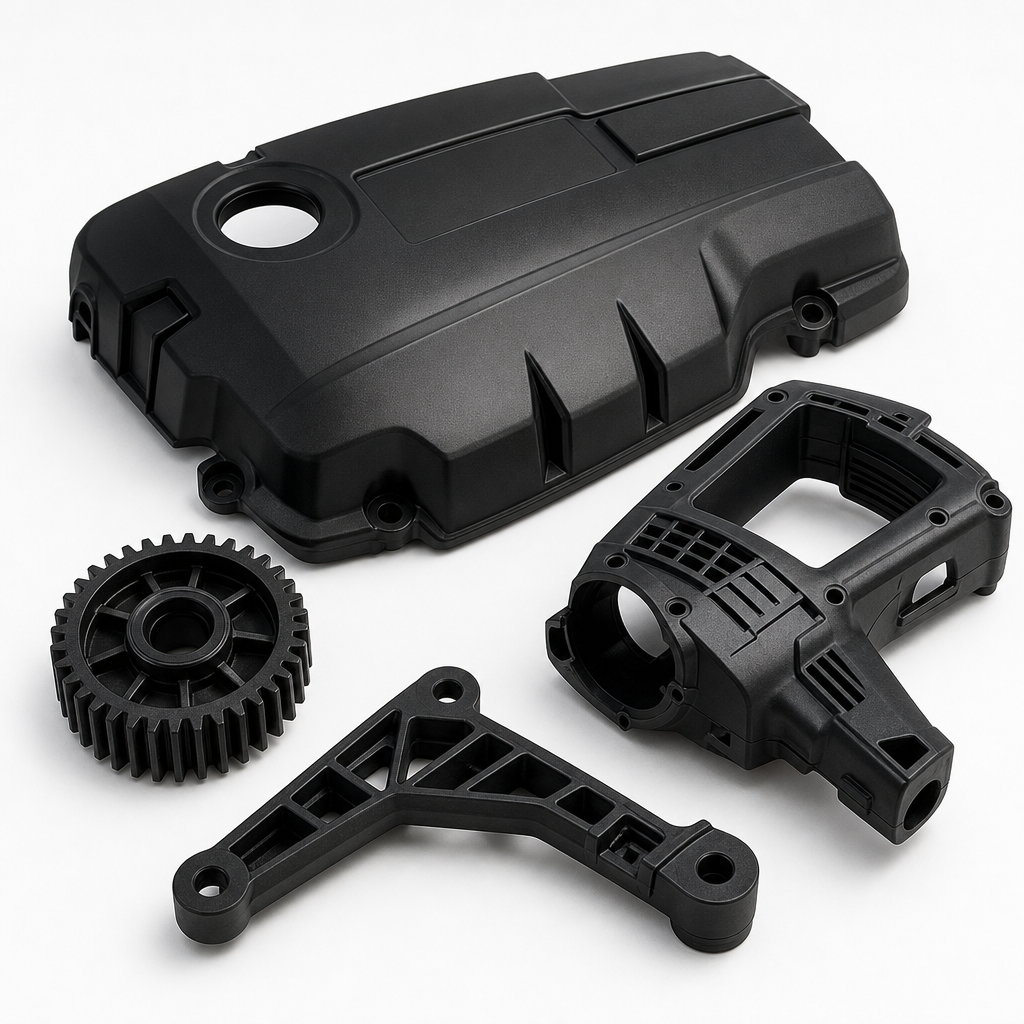
Fan shrouds, structural housings, brackets and selected under-hood components.
Pump bodies, impellers, machine housings and load-bearing supports.
Housings, connectors and supports when the grade meets the required electrical and flammability ratings.
Stiff housings, frames and mechanical components where fiber orientation and surface finish are controlled.
当社のエンジニアリングプラスチックの供給について
As an ISO 9001 certified engineering plastics manufacturer and exporter, we produce PA6 GF30 in heat-stabilized, impact-modified, UV-stabilized and color-matched variants. For the selected formulation, our technical team can provide the matching datasheet, batch-specific certificate of analysis and applicable RoHS, REACH or UL documentation. Send your target properties, annual volume and delivery destination to discuss a standard grade or custom formulation.
Need a PA6 GF30 datasheet for your application or a quotation for supply? Contact our team — specify your volume, delivery destination, and any special requirements (color, certification, impact modification). The current datasheet and quotation scope are confirmed for the selected grade and requirements.
よくある質問
Is PA6 GF30 one standardized material?
No. PA6 GF30 identifies a PA6 material family with a nominal 30% glass-fiber level. The additive package, resin viscosity, fiber system and conditioning state vary by commercial grade, so compare the complete TDS and validate the molded part.
Is PA6 GF30 the same as PA66 GF30?
No. Both contain nominal 30% glass fiber, but PA6 and PA66 use different base polymers. They differ in melting and heat performance, moisture response, processing window and grade availability.
Is standard PA6 GF30 flame retardant?
Not automatically. A standard grade and a PA6 GF30 FR grade are separate selections. Confirm the exact UL 94 rating, specimen thickness and certification for the chosen commercial grade.
PA6-GF30のデータシートでは、どのような主要な特性を確認すべきですか?
Check tensile strength, flexural modulus, the named impact method, HDT test load, density, shrinkage and specimen conditioning. As a named example, WHG30A lists 165 MPa tensile strength (ISO 527-2), 6,000 MPa flexural modulus (ISO 178) and 175°C HDT (ISO 75-2/B, 0.45 MPa). Do not treat the cross-supplier ranges as guarantees for WHG30A.
PA6-GF30のデータシートに記載されている強度が、サプライヤーによって異なるのはなぜですか?
Glass fiber type and length, coupling system, base resin, additives and conditioning can change the result. Compare values measured by the same method and conditioning state; there is no universal percentage allowance that makes two grades equivalent.
自分の設計において、PA6-GF30のデータシートの数値をどのように解釈すればよいでしょうか?
Choose dry or conditioned data to match the part’s actual service environment, then validate critical dimensions and loads on molded samples. The WHG30A PDF does not state conditioning. Set design margins from the part loads, environment and failure consequences; the datasheet alone does not define a universal safety factor.
優れたPA6-GF30のデータシートには、どのような加工パラメータが記載されていますか?
Check the selected grade’s drying, melt and mold temperatures, moisture limit and injection settings. The WHG30A one-page PDF provides property data but no processing window; the parameters above are starting points for trials, not guaranteed WHG30A settings.
Technical Review and Data Sources
Technical author and reviewer: WanHan Technical Team
Last Technical Review: September 28, 2026
- WanHan PA6 WHG30A Technical Data Sheet is the source for the named WHG30A values on this page.
- ISO 1183, ISO 527-2, ISO 178, ISO 179, ISO 75-2/B and ISO 2577 are cited as printed in that TDS; noted method inconsistencies must be confirmed before approval.
- Cross-supplier values are reference ranges. Exact properties depend on grade, test method and conditioning; use the current grade TDS and representative testing for qualification.