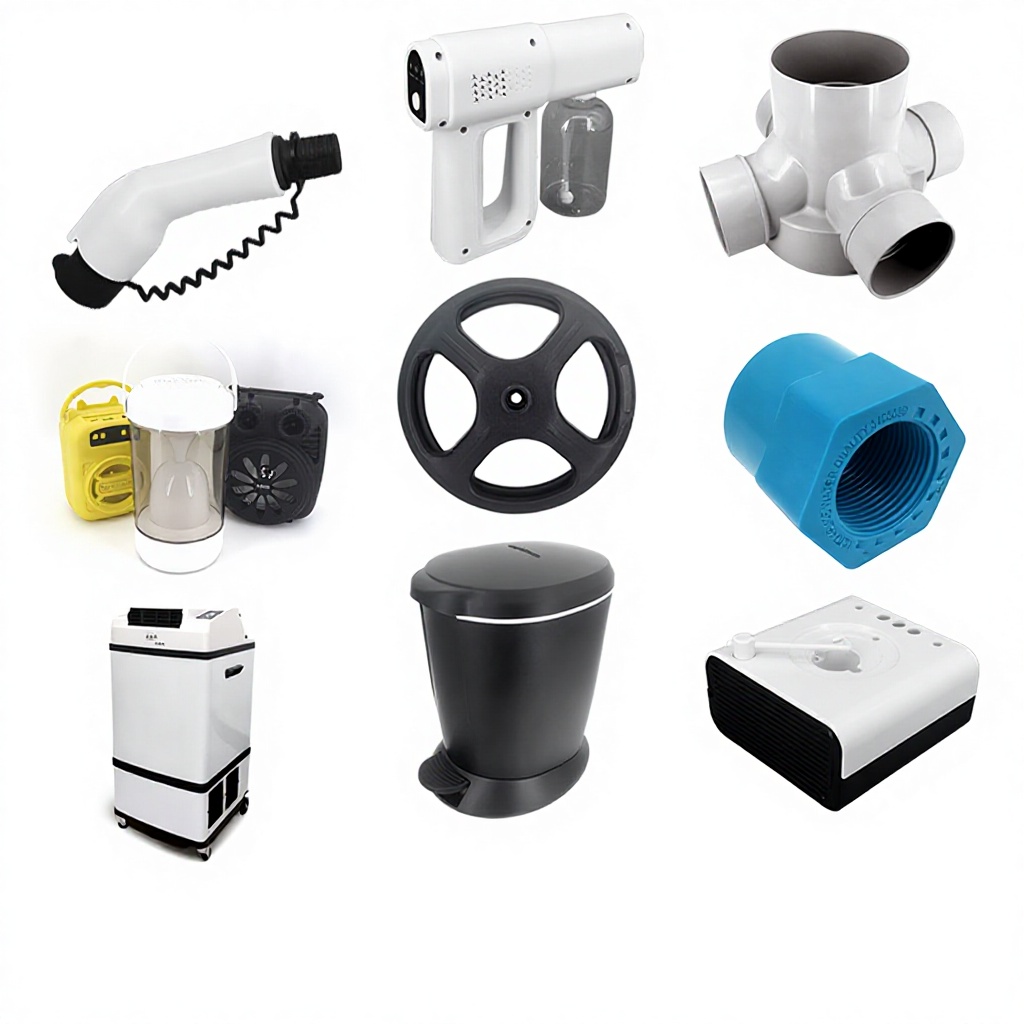
UL94は、プラスチック材料の可燃性を分類するための世界的な基準です。アンダーライターズ・ラボラトリーズ(UL)によって策定されたこの規格は、プラスチック試験片が直火に対してどのように反応するか――自然消火するか、燃えさかる粒子を滴下するか、あるいは完全に燃え尽きるか――を判定するものです。 電気機器の筐体、自動車部品、民生用電子機器向けの材料を選定するエンジニアにとって、UL94の等級を理解することは単なる選択肢ではなく、コンプライアンス上の必須要件です。.
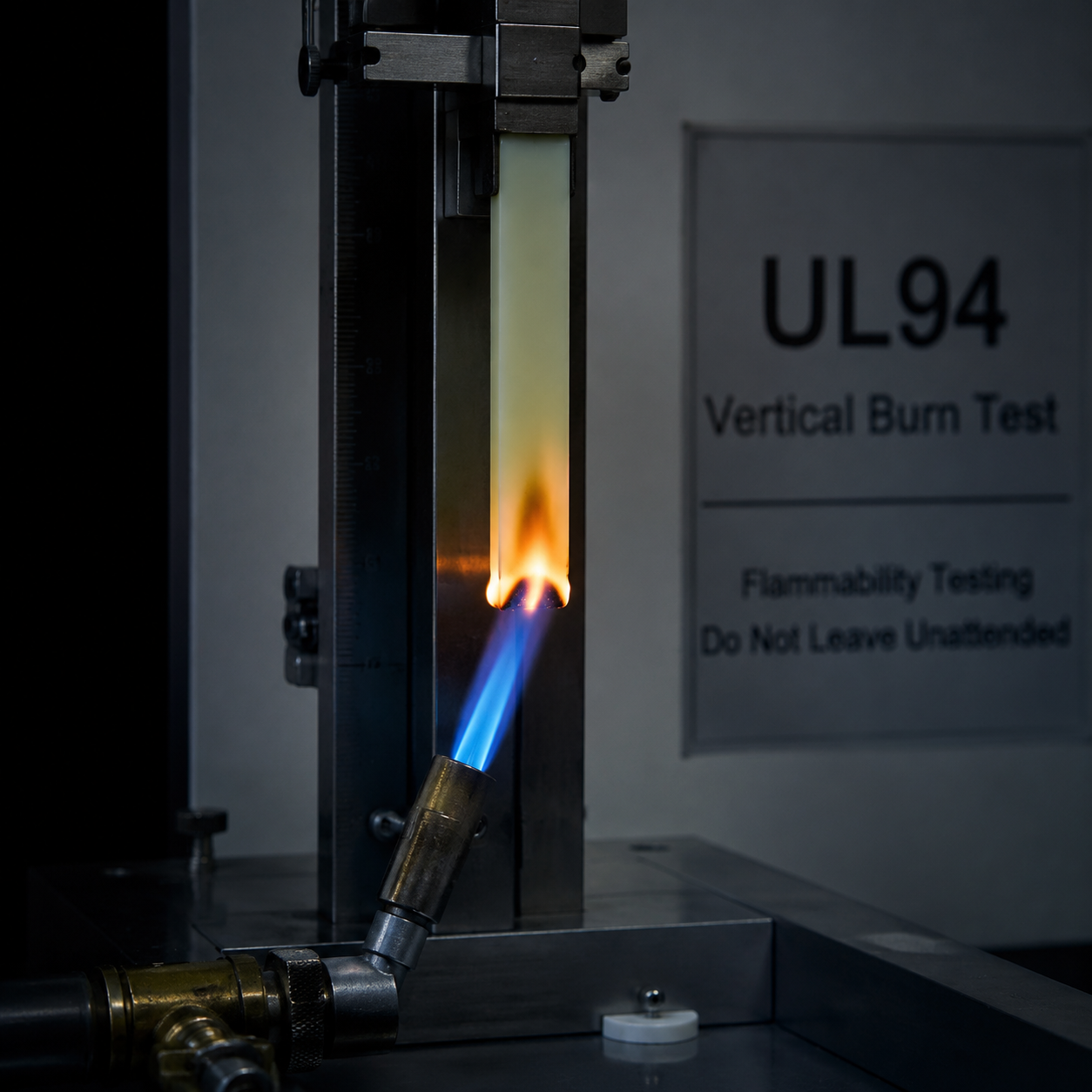
UL94試験方法
UL94規格では、3つの主要な試験方向が規定されています。それぞれが、実際の使用環境で遭遇するさまざまな火災暴露シナリオを模擬したものです。.
水平燃焼(HB)
水平燃焼試験は、最も基準が緩い試験です。 試験片を水平に保持し、その自由端に30秒間炎を当てます。HB等級を取得するには、材料の燃焼速度が所定の閾値(通常、厚さ3 mm未満の試験片では75 mm/min)を下回るか、あるいは100 mmの基準マークに到達する前に燃焼が停止する必要があります。.
HB等級の材料は、火災リスクが低く、規制要件も最小限の用途において使用可能です。内部に電流を流さない部品を含む消費者向け製品では、HB等級の材料がよく使用されています。.
垂直燃焼(V-0、V-1、V-2)
垂直燃焼試験は、はるかに厳しい条件で行われます。試験片を垂直に保持し、その下端に20 mmの炎を2回、各回10秒間当てます。耐火等級は、残炎時間、残光時間、および燃焼粒子が発生するかどうかによって決定されます。.
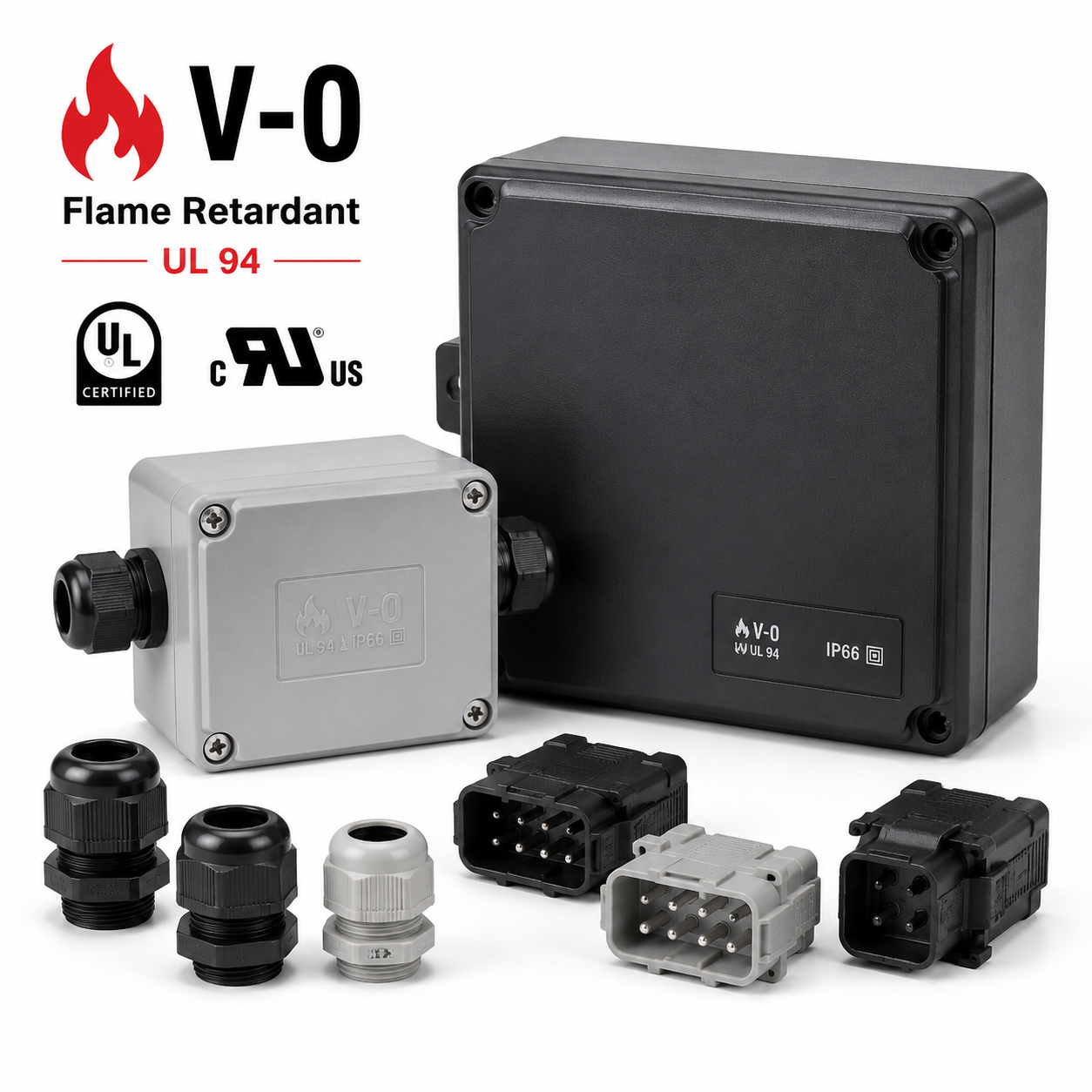
- V-0: 1回の塗布あたりの残火時間 ≤ 10 秒、5つの試験片全体の残火時間の合計 ≤ 50 秒、炎を伴う滴下なし
- V-1: 1回の塗布あたりの残火時間は30秒以下、5つの試験片全体の残火時間の合計は250秒以下、炎を伴う滴下は認められないこと
- V-2: V-1と同じアフターフレームの基準ですが、炎を伴う滴下は許可されています
5V 試験(5VA、5VB)
5V試験は、UL94規格において最も厳しい試験条件に相当します。小型のバーナーの炎の代わりに、125 mmの炎をバー試験片およびプラーク試験片の両方に、5秒間ずつ5回照射します。これにより、より強烈で持続的な火災への曝露が模擬されます。.
- 5VA: 残火時間 ≤ 60 秒、プラーク試験片に貫通(穴)がないこと
- 5VB: 残火時間は60秒以下とし、試験片における燃え抜け(穴の形成)は許容される
UL94 耐火等級定義表
| 評価 | 試験の概要 | 炎の応用 | アフターフレイム制限(1回の適用あたり) | フレイミング・ドリップス | バーン・スルー |
|---|---|---|---|---|---|
| HB | 水平 | 30秒(シングル) | 該当なし(バーンレートの上限) | 許可済み | 該当なし |
| V-2 | 縦 | 2 × 10秒 | 30秒以下 | 許可済み | 該当なし |
| V-1 | 縦 | 2 × 10秒 | 30秒以下 | 許可されていません | 該当なし |
| V-0 | 縦 | 2 × 10秒 | 10秒以下 | 許可されていません | 該当なし |
| 5VB | 縦棒+銘板 | 5 × 5 秒(炎の長さ 125 mm) | 60秒以下 | 許可されていません | 許可済み |
| 5VA | 縦棒+銘板 | 5 × 5 秒(炎の長さ 125 mm) | 60秒以下 | 許可されていません | 許可されていません |
難燃剤の種類
UL94規格の認定を取得するには、ポリマーマトリックスに難燃剤(FR)を配合する必要があります。難燃剤の化学組成の選択は、性能、コスト、および環境規制への適合性に大きな影響を及ぼします。.
ハロゲン系難燃添加剤
臭素化および塩素化化合物は、燃焼連鎖反応を遮断する上で非常に効果的です。これらは主に気相において、フリーラジカルを捕捉することで作用します。ハロゲン化系は、比較的低濃度(10~20%)でUL94 V-0規格を満たすことができ、費用対効果に優れています。 しかし、燃焼時に腐食性および有毒ガスを放出するため、RoHS指令やWEEE指令の下で規制が強化されつつある。.
ハロゲンフリー難燃剤(リン系)
Phosphorus-based flame retardants — including organophosphates, phosphonates, and red phosphorus — function primarily in the condensed phase by promoting char formation. This char layer acts as a barrier, insulating the underlying polymer from heat and oxygen. These systems are the dominant choice for halogen-free formulations, particularly in electronics where environmental compliance is mandatory.
Nitrogen-Based FR Additives
Melamine and its derivatives (melamine cyanurate, melamine polyphosphate) release inert nitrogen gases upon decomposition, diluting combustible gases and cooling the flame zone. They are often used synergistically with phosphorus-based FRs to achieve V-0 ratings in polyamides and polyurethanes.
Inorganic FR Additives
Aluminum trihydrate (ATH) and magnesium hydroxide (MDH) decompose endothermically, absorbing heat and releasing water vapor. They require high loadings (often 40-65%) to be effective, which can severely impact mechanical properties. These fillers are widely used in wire and cable insulation and low-smoke halogen-free applications.

Physical Property Trade-Offs
Adding flame retardants inevitably compromises mechanical performance. The degree of impact depends on the FR chemistry, loading level, and base polymer.
- Tensile strength reduction: 10-25% depending on FR type and loading
- Impact strength reduction: 15-30%, particularly with inorganic fillers
- Elongation at break: May decrease by 30-50% in FR-modified grades
- Density increase: FR additives typically increase material density by 5-15%
- Processing window: Some FR additives narrow the processing temperature range, increasing the risk of thermal degradation during molding
Halogen-free phosphorus-based systems generally preserve mechanical properties better than inorganic alternatives at equivalent UL94 ratings. Glass fiber reinforcement (typically 15-30%) is often combined with FR additives to recover lost strength and stiffness.
Common Flame Retardant Plastic Grades
| Material Grade | UL94規格の耐火等級 | 引張強さ (MPa) | HDT (1.82 MPa) (°C) | Key Features |
|---|---|---|---|---|
| PA66 FR V-0 (GF25) | V-0、0.8 mm | 140-160 | 235-245 | Excellent thermal stability, good flow |
| PC/ABS FR V-0 | V-0、1.5 mm | 55-65 | 95-110 | Good impact, cost-effective |
| PBT FR V-0 (GF30) | V-0、0.8 mm | 120-140 | 200-215 | Fast crystallization, dimensional stability |
| PPO FR V-0 | V-0、1.5 mm | 55-70 | 120-140 | Low density, excellent dielectric properties |
| PEI(ウルテム) | V-0 (inherent) | 100-110 | 195-210 | Inherent FR, no additives needed |
主な用途

Electrical Enclosures
Circuit breakers, switchgear housings, and junction boxes require V-0 rated materials by regulatory mandate. These enclosures must contain any internal arc or short-circuit fire, preventing propagation to surrounding structures. PC/ABS FR V-0 and PA66 FR V-0 are commonly specified for these applications.
Connectors and Terminal Blocks
High-voltage connectors in industrial equipment and automotive systems require thin-wall V-0 performance. PBT FR V-0 GF30 is widely used for its excellent flow characteristics, enabling thin-wall molding down to 0.4 mm while maintaining V-0 compliance.
Electric Vehicle Battery Components
Battery module housings, cell holders, busbar supports, and high-voltage connectors in EVs demand exceptional flame retardancy. 5VA-rated materials are increasingly specified for critical battery enclosure components to meet the most stringent safety standards. PA66 FR and PBT FR grades dominate this segment.
コンシューマー・エレクトロニクス
Charger housings, power adapter shells, and internal insulating barriers in laptops and smartphones require V-0 or V-1 ratings. Halogen-free FR grades are preferred in this segment due to brand sustainability commitments and consumer-facing environmental messaging.
RoHS and WEEE Impact on FR Selection

The Restriction of Hazardous Substances (RoHS) directive prohibits certain brominated flame retardants — specifically polybrominated biphenyls (PBB) and polybrominated diphenyl ethers (PBDE) — in electrical and electronic equipment sold in the EU. The Waste Electrical and Electronic Equipment (WEEE) directive further encourages the use of halogen-free materials to facilitate end-of-life recycling.
As a result, the industry has shifted significantly toward phosphorus-based and nitrogen-based halogen-free FR systems. While these alternatives are generally more expensive on a per-kilogram basis, they often require lower loadings to achieve equivalent UL94 ratings, partially offsetting the cost differential. Additionally, halogen-free grades have become a marketing advantage, with many OEMs now explicitly requiring “HF” (halogen-free) designations in material specifications.
UL94 Rating Selection Checks
| 質問 | What to confirm |
|---|---|
| 評価 | V-0, V-1, V-2, 5VA or 5VB at the specified thickness |
| Specimen | Material grade, color, thickness, conditioning and test method |
| Part design | Wall transitions, vents, connectors, ignition source and enclosure geometry |
| ドキュメンテーション | Current certificate or test report tied to the purchased resin lot |
UL94 flame retardant plastics must be checked at the exact grade and thickness used in the part. A classification is not a blanket guarantee for every finished assembly; review electrical, thermal and regulatory requirements together.
よくある質問
UL94のV-0と5VAの違いは何ですか?
主な違いは、炎の強度と貫通要件にあります。V-0では、棒状試験片のみに、20 mmの炎を1回あたり10秒間、2回照射します。5VAでは、棒状試験片とプラーク試験片の両方に、125 mmの炎を1回あたり5秒間、5回照射します。 さらに重要な点として、5VAでは試験中にプレート試験体に穴(貫通)が生じてはならないと規定されているのに対し、V-0にはプレート試験自体が一切ありません。 V-0に合格した材料であっても、より激しい5Vの炎条件下で貫通に耐えられない場合、5VAには不合格となる可能性があります。5VAは、V-0よりもUL94の厳しさレベルで約1~2段階上となります。.
環境規制への適合という点では、ハロゲン系難燃剤とハロゲンフリー難燃剤のどちらが優れているか?
環境規制への適合という観点からは、ハロゲンフリーの難燃剤(リン系、窒素系、および無機系)が優先的に採用されています。 その主な理由としては、(a) PBBおよびPBDEといった臭素系難燃剤に対するRoHS規制への準拠、(b) 燃焼時の腐食性ハロゲン化水素ガスの排出回避、(c) WEEE指令の要件に基づくリサイクル性の向上、および(d) OEMの持続可能性に関する要件やエコラベル認証への適合が挙げられます。 ハロゲン系システムは、低添加量で低コストかつ高効率を実現しますが、規制の傾向は、特に消費者向け電子機器や自動車の内装において、ハロゲンフリーの代替品へと確実にシフトしています。.
難燃剤を添加すると、PA66の機械的特性はどの程度低下するのでしょうか?
PA66 FR V-0(25%ガラス繊維強化)と非難燃性PA66 GF25を比較した場合、代表的な機械的特性の低下は以下の通りです。引張強度は約10~15% (160~180 MPa から 140~160 MPa へ)、衝撃強度の低下は 15~25%、破断伸びの低下は 30~50% です。 ハロゲンフリーのリン系難燃システムは、同等の UL94 規格において、臭素系システムよりも一般的に機械的特性を良好に維持します。ガラス繊維補強は、剛性と強度の回復において重要な役割を果たします。補強されていない難燃性 PA66 では、補強されていない PA66 と比較して、引張強度が 25% 以上低下する場合があります。 重要な構造用途においては、難燃化による物性低下を補うため、25~35%のガラス繊維含有率が標準的な慣行となっている。.
難燃剤を添加すると、射出成形の加工性に影響はありますか?
はい、難燃添加剤は成形性に大きな影響を与える可能性があります。加工上の主な考慮事項は以下の通りです:(a) 加工許容範囲の狭小化 — 多くの難燃添加剤は、推奨溶融温度よりわずか10~20℃高い温度で分解し始めるため、より厳密な温度管理が必要となります; (b) 溶融粘度の増加 — 一部の難燃添加剤(特にMDHやATHなどの無機系)は溶融粘度を上昇させ、流動長を短縮し、薄肉部でショートショットを引き起こす可能性があります; (c) 金型の腐食 — ハロゲン系難燃剤は、加工温度で酸性の副生成物を放出する可能性があるため、耐食性のある金型用鋼材の使用と定期的な金型メンテナンスが必要となります;(d) スクリューおよびバレルの摩耗 — 無機系難燃剤フィラーは研磨性があり、スクリュー、バレル、チェックリングの摩耗を加速させます。 適切な金型設計(ゲートの幅を広くする、ランナーシステムの最適化)および加工パラメータ(適度なスクリュー回転速度、背圧制御)により、これらの課題のほとんどを軽減することができます。.