This undercut design solutions guide explains practical considerations for material selection, design review, manufacturing, and sourcing decisions.
射出成形における「アンダーカット」とは何ですか?
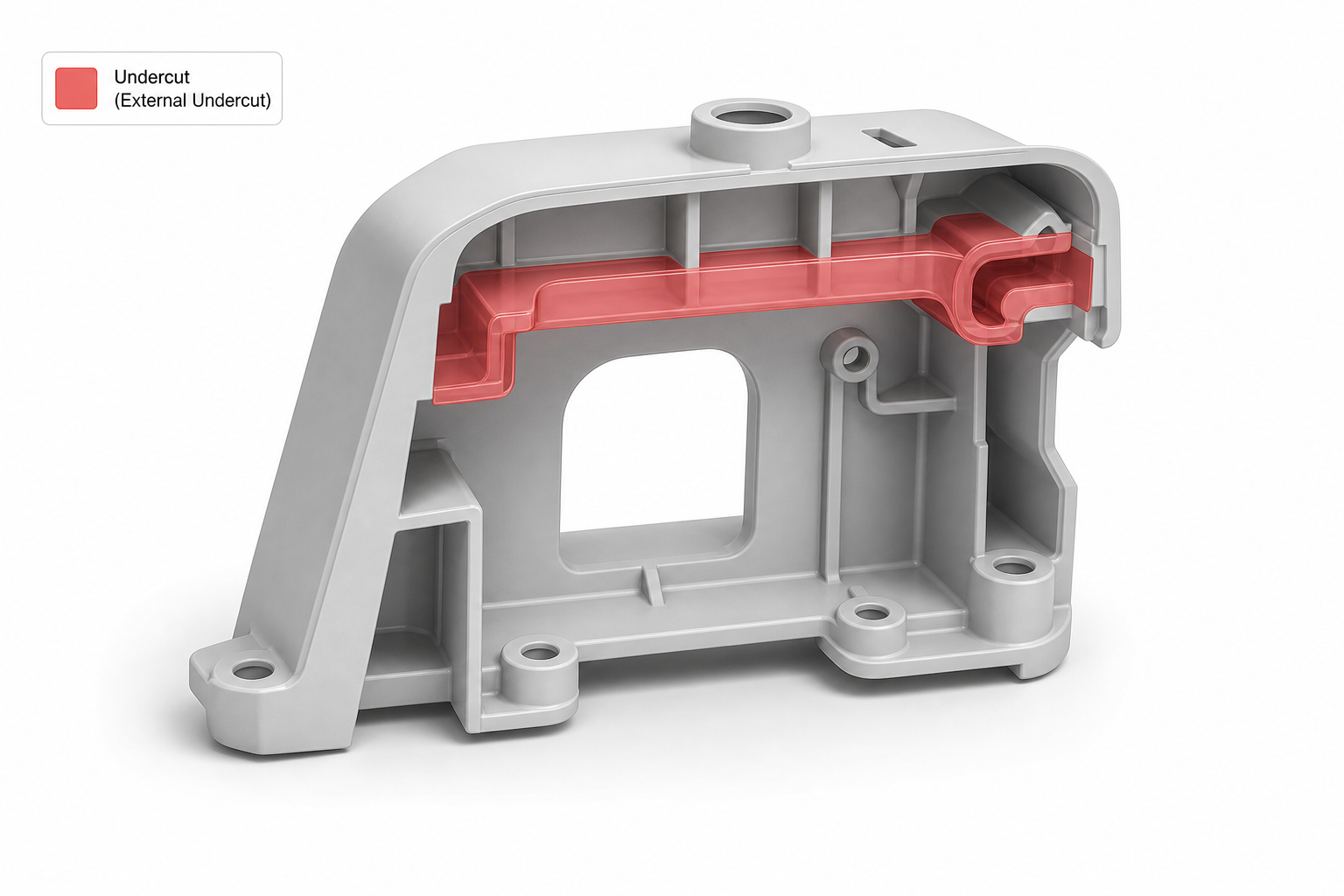
ある アンダーカット 成形品上のくぼみ、突起、または幾何学的形状のうち、金型の開方向へのスムーズな排出を妨げるものを指します。 単純な2プレート金型では、コアとキャビティの各半身は単一の軸に沿って分離します。スナップフィット用のフック、側面の穴、凹んだ溝、内ネジなど、部品の形状がどちらかの半身に噛み合い、その直線的な動きを妨げる場合、アンダーカットが発生し、金型製作を複雑にし、コストを押し上げます。.
アンダーカットは、大きく分けて以下の2つの種類に分類されます:
| タイプ | 説明 | よくある例 |
|---|---|---|
| 外側アンダーカット | 分割線に対して垂直にロックする、部品の外面にある形状 | サイドホール、スナップアーム、バヨネットタブ、クロスドロー仕様の外側リブ |
| 内部アンダーカット | コア側に向かってロックされる、内面または空洞部の構造 | めねじ、スナップ突起、アンダーカットクリップ、凹み付きボス |
アンダーカットへの適切な対応は、射出成形設計において最も大きな影響を与える決定事項の一つです。機械的な解決策(スライド、リフター、折りたたみ式コア)と部品の再設計のどちらを選ぶかによって、金型コストは $1,000 ~ $30,000 また、金型の生産寿命全体を通じて、サイクルタイム、金型のメンテナンス、および部品の品質に影響を及ぼします。.
ソリューションの概要:アンダーカットの種類に応じたマッチングメカニズム
以下の表では、主なアンダーカットの種類ごとに、標準的な工具ソリューション、相対的なコスト、代表的な用途、および主な制限事項をまとめています。.
| メカニズム | 最適 | アンダーカットの種類 | 相対コスト | 典型的なサイクルによる影響 | 主な制限事項 |
|---|---|---|---|---|---|
| スライド/サイドアクション | 部品の外側にあるアンダーカット、側面の穴、部品の外側に設けられたスナップ構造 | 外部 | スライド1枚あたり$1,000~$3,000 | 中程度(作動により0.5~2.0秒追加) | 金型ベースに十分なスペースが必要。冷却レイアウトに支障をきたす可能性がある。 |
| リフター | リブ、ボス、部品内部のスナップボタンにある内側のアンダーカット | 内部 | リフター1人あたり $800~$2,500 | 低~中程度 | 最大角度は約15度まで。高サイクルでは摩耗しやすい。 |
| 折りたたみ式コア | めねじ、全径アンダーカット、閉鎖部 | 内部 | コアあたり $3,000~$8,000 | 中程度(引き戻しストローク) | 最小直径:約12 mm。浅い凹みには適しません。 |
| 手装用インサート | 少量生産(5,000ショット未満)、複雑な外形および内形 | 両方とも | $500~$1,500(インサート1セットあたり) | 高(手動での積み下ろし:1サイクルあたり10~60秒) | 人手がかかるため、中規模または大規模の生産には不向き |
| バンプオフ/強制排出 | 浅く、丸みを帯びたアンダーカットのある柔軟な材料(TPE、無充填PP、LDPE) | 両方とも | 無視できる | なし | 材料は、永久変形を生じることなくたわむ必要がある。最大たわみ深さは、直径の1%未満であること。 |

スライドとサイドアクション:外部アンダーカットの主力モデル
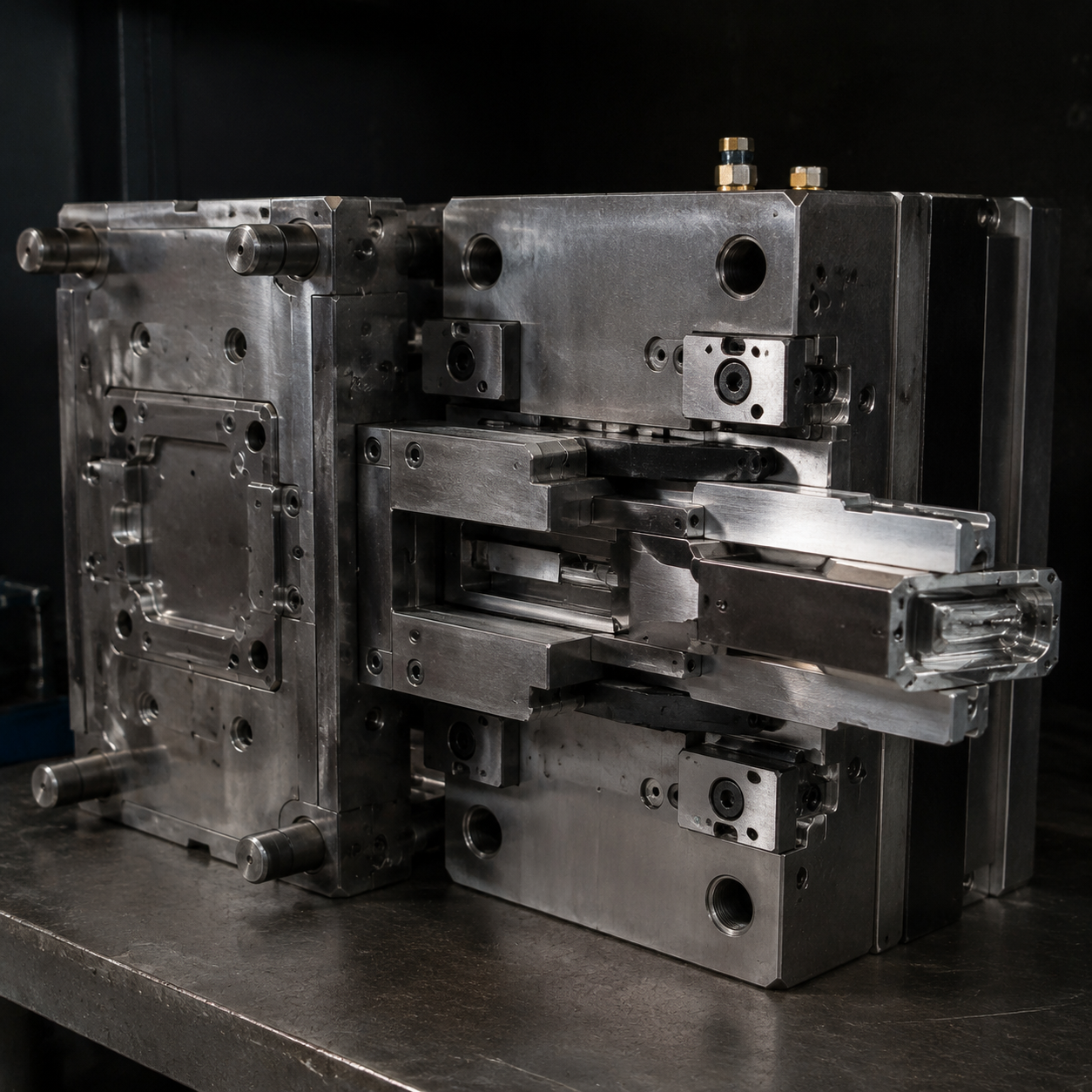
スライド(サイドアクションとも呼ばれる)は、外部アンダーカットに対する最も一般的な解決策です。この機構では、金型が開く際にカムピンまたは油圧シリンダーを用いてスチール製インサートを横方向に駆動させ、成形品の取り出し前にアンダーカットをクリアします。 スライドは金型の開口軸に対して垂直に移動し、通常、部品の形状に応じてキャビティ側(Aプレート)またはエジェクタ側(Bプレート)に組み込まれます。.
スライド作成のガイドライン:
- Minimum slide travel = undercut depth + 1 mm (safety clearance). For example, a 3.2 mm deep side hole requires at least 4.2 mm of slide stroke. Always add clearance beyond the feature depth to account for thermal expansion and minor alignment drift.
- Draft angle on all slide faces: Apply a minimum of 0.5 degrees to surfaces parallel to slide motion, and 3 degrees on faces that contact the part. Without draft, galling and drag marks appear within the first 5,000 cycles.
- Wear plates are mandatory: Slides rub against the mold base every cycle. Use hardened wear plates (D2 or H13 at 52-56 HRC) under every slide, and specify grease grooves on plates wider than 40 mm.
- Locking heel angle: The heel block must engage before the cam pin to prevent slide blowback during injection. Heel angle should be 3-5 degrees steeper than the cam pin angle.
Lifters: Internal Undercuts Without Side Splits
Lifters resolve internal undercuts by moving at an angle during ejection. As the ejector plate advances, the lifter travels upward and inward simultaneously, peeling away from the undercut feature. This elegant mechanism eliminates the need for additional mold splits and is standard for features like internal snap ledges and rib undercuts.
Lifter Design Rules:
- Maximum lifter angle: 15 degrees. Angles steeper than 15 degrees create excessive side thrust that wears guide bushings and can fracture lifter heads. At 20 degrees, failure probability rises sharply.
- Lifter rod diameter: Minimum 8 mm for short strokes (under 25 mm); scale to 12 mm or larger for strokes beyond 40 mm. Undersized rods flex and bind.
- Two-stage ejection may be required: On deep undercuts, ejector stroke alone may not provide enough angular travel. Plan for a two-stage system or increase ejector plate stroke.
- Cooling conflicts: Lifters occupy space in the ejector half that would otherwise hold cooling channels. Work with your mold maker to route water lines between lifter pockets or specify conformal cooling if budgets allow.
Collapsible Cores and Specialized Mechanisms
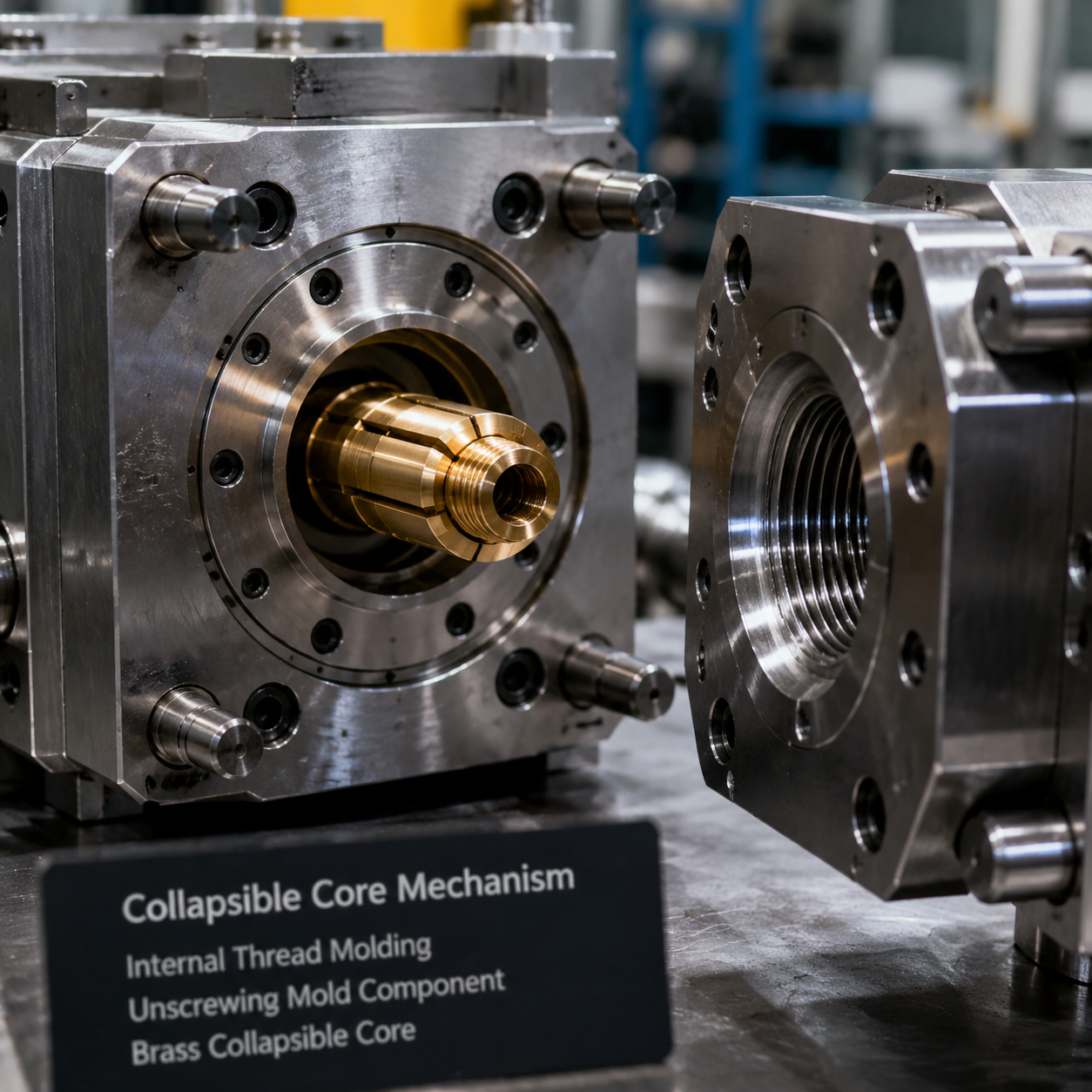
Collapsible cores – sometimes called collapsing cores or retractable cores – are purpose-built for internal threads and full-circumference undercuts. The core consists of multiple segments that collapse inward on retraction, reducing the effective diameter enough to clear the undercut. They are widely used for bottle closures, threaded caps, and any part requiring a continuous internal thread.
Collapsible cores are expensive ($3,000-$8,000 per unit) but often cheaper than the alternative of a rotating unscrewing mechanism, which can add $10,000-$25,000 to mold cost when you factor in the rack-and-pinion drive, motor, and controls. For threads deeper than 2 full turns, however, unscrewing cores become necessary because collapsible segments lose registration beyond that point.
Hand-Loaded Inserts: Low-Volume Pragmatism
When annual volumes are under 5,000 parts, hand-loaded inserts can be the most cost-effective solution. An operator places a shaped steel insert into the mold before each shot; after ejection, the insert is removed along with the part and separated manually. The insert forms the undercut geometry without any moving mold components.
The trade-off is cycle time: manual load and unload adds 10 to 60 seconds per cycle, depending on part complexity. In high-wage regions, labor cost can quickly overtake the savings from a simpler mold. Hand-loaded inserts make the most sense for prototyping, bridge tooling, and short-run production where the insert tooling cost of $500-$1,500 dominates the decision.
Bump-Offs: When Material Flexibility Saves Money
Bump-off ejection – also called forced ejection or snap-through – works by exploiting the elastic deformation of the material. A shallow, smoothly rounded undercut allows the part to flex and “bump” off the core during ejection without requiring any moving mold elements. This is the cheapest solution possible, but it only works under strict conditions:
- Material must be flexible: TPE, unfilled PP, LDPE, or similar elastomer-capable grades
- Undercut depth must not exceed approximately 1% of the part diameter at the undercut location
- Feature must have generous radii – sharp corners concentrate stress and cause tearing
- Ejection temperature matters: parts ejected too hot may permanently deform; too cold and they may crack
Cost Impact: What Each Slide and Lifter Adds to Your Mold
Every moving mechanism in a mold adds cost – not just the initial tooling investment, but ongoing maintenance and risk of downtime. Here are the realistic financial impacts based on current mold-making costs for steel production tools:
| メカニズム | Upfront Tooling Cost (Per Unit) | 年次点検 | Risk of Unscheduled Downtime |
|---|---|---|---|
| Slide (cam-actuated) | $1,000-$3,000 | $200-$500 (wear plates, lubrication, pin replacement) | Moderate – cam pins bend; lubrication failures cause galling |
| Slide (hydraulic) | $2,500-$5,000 | $400-$800 (seal replacement, hose inspection, cylinder rebuild) | Higher – hydraulic leaks and solenoid failures |
| Lifter | $800-$2,500 | $150-$400 (head wear, rod straightness check) | Low to moderate – gradual wear; sudden failures rare with proper PM |
| Collapsible Core | $3,000-$8,000 | $500-$1,200 (segment alignment, wedge replacement) | Moderate – segments jam if not cleaned regularly |
A mold with four slides (one per side) and two lifters can easily add $8,000 to $17,000 to the base tooling cost. Multiply that across a multi-cavity mold, and the numbers grow fast. This is why redesigning the part to eliminate undercuts is always worth evaluating before committing to mechanical solutions.
When to Redesign Instead of Mechanizing
Sometimes the best undercut solution is no undercut at all. Before adding slides or lifters, evaluate these redesign strategies:
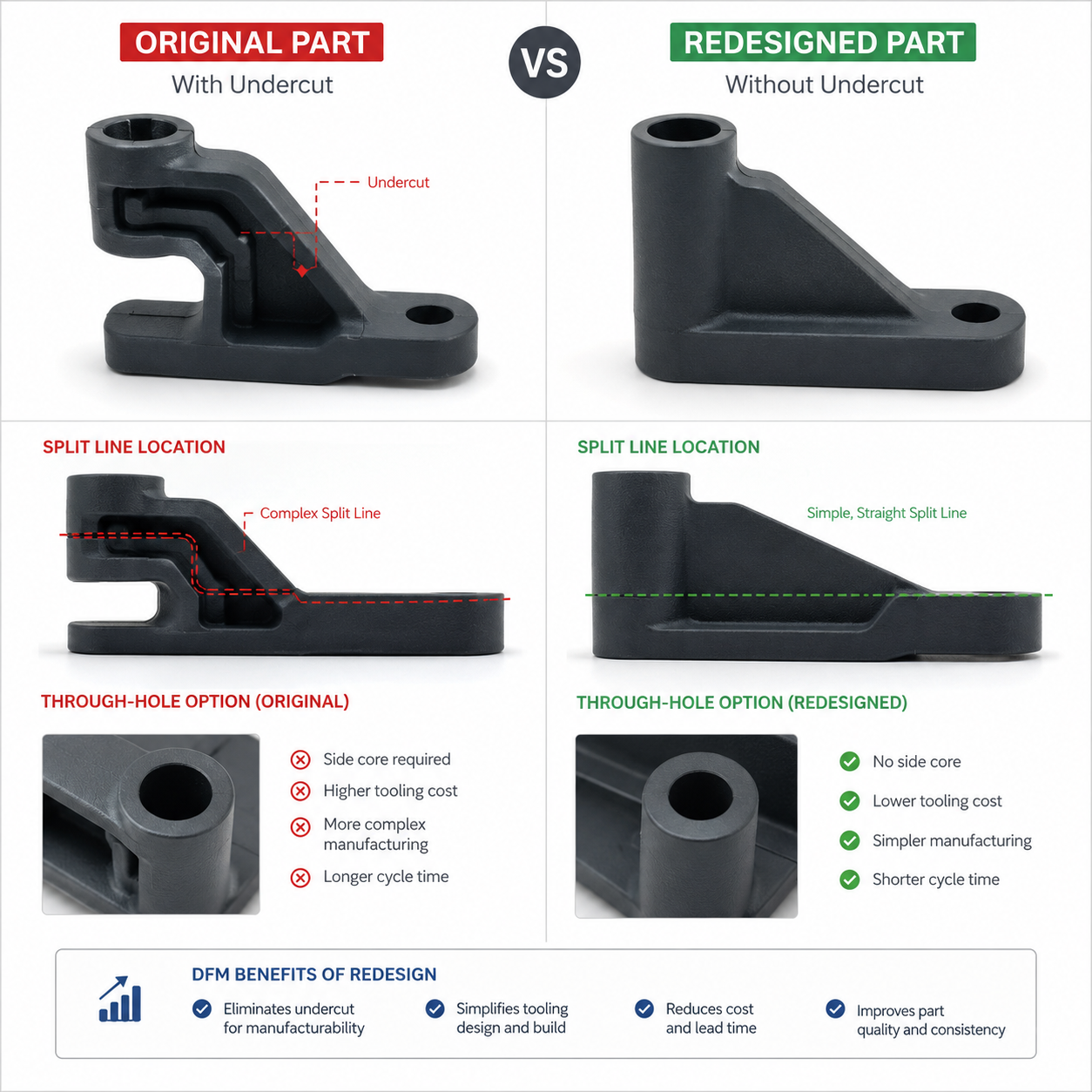
Add a Through-Hole
A side hole that requires a slide can often be replaced by a through-hole along the mold-open axis. If the hole does not need to be blind, run it straight through and use a core pin instead of a slide. This eliminates a moving mechanism entirely. For snap features, consider whether a window or cutout can expose the snap from the draw direction.
Split the Part into Two Components
Adding a parting line and splitting a complex undercut part into two simpler shells can eliminate expensive side actions. The two halves are then joined – via ultrasonic welding, snap fits, or mechanical fasteners – in a secondary operation. The secondary operation cost should be weighed against the tooling savings, but for parts with multiple undercuts on different planes, splitting often wins.
Change the Draft Direction
Rotating the part orientation in the mold – sometimes called changing the draw direction – can convert an undercut into a straight-pull feature. This works when undercuts are clustered on one face. By reorienting the parting line, those features become draw-compatible, leaving clean geometry on the opposite face. Mold flow analysis should confirm that the new gate location remains viable.
Replace Snap Fits with Alternative Joining
If the undercut exists solely to create a snap-fit assembly feature, evaluate whether screws, adhesives, or press-fits can serve the same function without undercut geometry. A threaded brass insert molded post-mold is often cheaper than adding two slides for snap arms.
Summary: The Decision Framework
When you encounter an undercut in your part design, work through this sequence before sending the design to your mold maker:
- Can the undercut be eliminated? Evaluate through-holes, part splitting, and draw-direction changes first. A redesign that costs zero tooling dollars is always the best option.
- Can a bump-off work? If the material is flexible and the undercut is shallow and rounded, forced ejection is free. Test with a prototype shot if possible.
- Is volume low enough for hand-loaded inserts? Under ~5,000 parts annually, manual inserts beat mechanical tooling cost. Above that, labor costs tip the scale.
- Match mechanism to undercut type: Slides for external, lifters for internal, collapsible cores for threads. Size each mechanism per the design rules in this article.
- Budget realistically: Account for upfront tooling, annual maintenance, and expected downtime. A $1,500 slide that saves $15,000 in part redesign effort is a smart investment. Four slides that together add $10,000 when a split-part redesign costs $2,000 in assembly labor annually – not so much.
Undercuts are not inherently problematic. They are a design reality for most injection molded parts. The skill is in knowing which undercuts to mechanize, which to redesign away, and how to execute each solution efficiently.
よくある質問
スライドが対応できる最大アンダーカット深さはどれくらいですか?
There is no fixed maximum, but practical limits are governed by slide stroke, mold base size, and cam pin length. External slides can routinely handle undercuts up to 50 mm deep on large molds. Hydraulic slides can go deeper since they are not constrained by cam pin geometry. For cam-actuated slides, the maximum stroke is limited by the sine of the cam angle multiplied by the mold opening stroke. A 20-degree cam pin with 150 mm of mold opening yields roughly 51 mm of slide travel – enough for a 50 mm undercut plus clearance. Beyond that, consider a hydraulic side core or part redesign.
リフターはどのくらいの頻度でメンテナンスや交換が必要ですか?
Lifter maintenance intervals depend on material, cycle count, and lubrication, but a good baseline: inspect every 100,000 cycles, replace wear components at 250,000 to 500,000 cycles. Lifters running in glass-filled materials wear faster – the abrasive filler accelerates head and guide wear, sometimes cutting service life by 40-50%. Key inspection points: lifter head for galling or rounding, rod straightness (run-out should be under 0.02 mm), and guide bushing clearance. A well-maintained lifter in unfilled ABS or PP can exceed 1 million cycles before replacement.
3Dプリント製のインサートは、アンダーカット部分の機械加工された鋼材に取って代わることができるか?
Yes, for prototyping and ultra-low-volume production (under 500 shots), 3D-printed inserts – typically in Markforged Onyx, glass-filled nylon, or metal-filled SLA resins – can function as hand-loaded inserts to form undercuts. They are not suitable for production tooling: printed inserts degrade rapidly under injection pressures above ~5,000 psi, have poor thermal conductivity (extending cycle times), and lose dimensional accuracy after 50-200 cycles depending on material. For bridge tooling, printed inserts can buy time while production steel is being cut, but they are never a production substitute.
What costs more over the tool’s life: slides or lifters?
On a per-unit basis, slides cost more upfront but lifters cost more over the full tool life. A typical cam-actuated slide adds $1,000-$3,000 to tooling, with annual maintenance under $500. A lifter adds $800-$2,500 upfront, but lifter heads are wear items that must be replaced periodically – and accessing them for replacement requires partial mold disassembly, adding labor cost. Over a 1-million-cycle tool life, a slide typically accumulates $3,000-$8,000 in total ownership cost, while a lifter accumulates $4,000-$12,000 when you factor in replacement parts and maintenance labor. Slides are the better long-term bet; lifters win on upfront cost and internal-feature access.