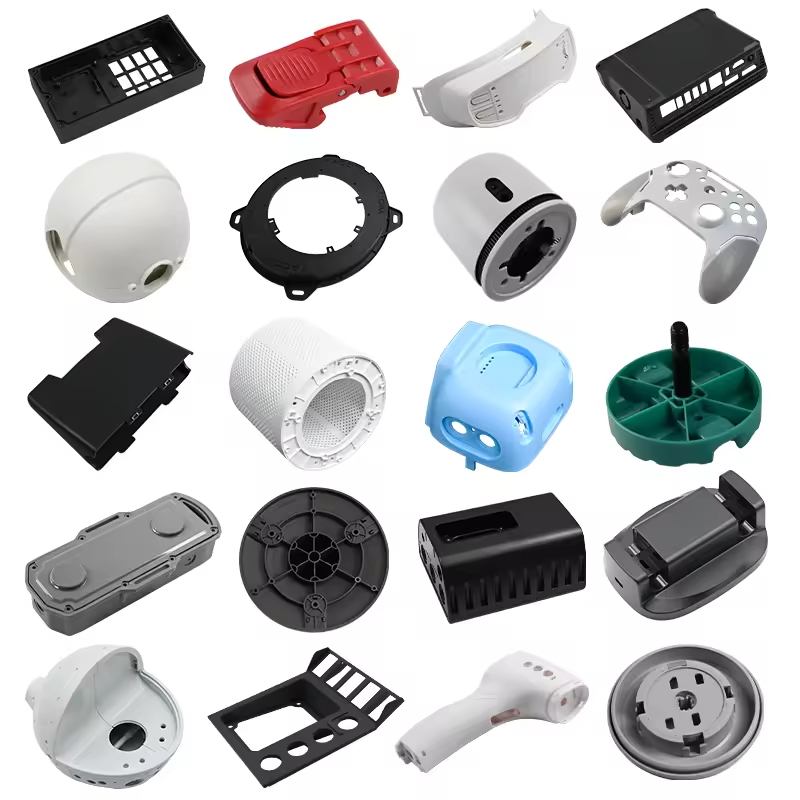
この「ねじ込み式インサート(プラスチック製)」に関するガイドでは、材料選定、設計検討、製造、および調達に関する実務上の考慮事項について解説しています。.
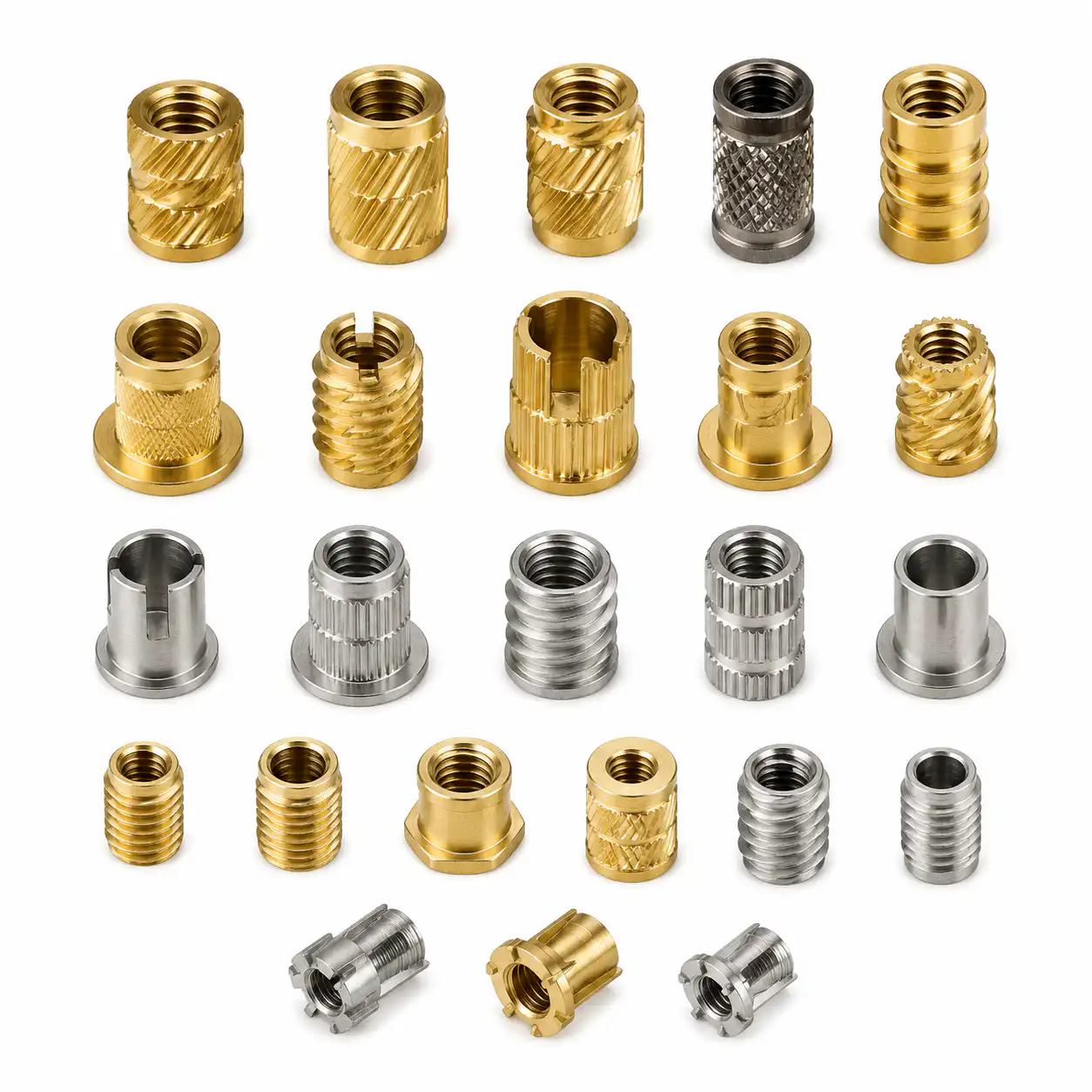
はじめに:プラスチック組立においてねじ込みインサートが重要な理由
プラスチック部品は軽量で、コストパフォーマンスに優れ、成形性も高いですが、ファスナーを繰り返し使用する際に必要な機械的強度に欠けています。プラスチックに直接ネジを締め込むと、ねじ山の破損、ボス部の亀裂、組み立て不良などが生じることがよくあります。ねじインサートは、プラスチック部品内部に耐久性の高い金属製のねじ山を埋め込むことでこの問題を解決し、信頼性が高く、メンテナンス可能なボルト接合を実現します。.
例えば、定期的なメンテナンスが行われている医療機器の筐体では、以下を使用することができます。 真鍮製ローレット加工インサート 性能を損なうことなく、数百回の分解・組み立てを繰り返すことに耐える。自動車のボンネット内での用途においては、, ステンレス製インサート 振動下でもクランプ荷重を維持しつつ、腐食に耐える。民生用電子機器では、その利点が活かされている。 ヒートセットインサート 低コストの金型で数秒で取り付けが可能であり、大量生産における単価を抑えることができます。.
プラスチック部品用のねじインサートの種類
適切なインサートの種類を選ぶには、引き抜き強度の要件、トルク耐性、取り付け方法、および予算を考慮する必要があります。以下に、プラスチック射出成形および二次組立で最も一般的に使用される7種類のねじインサートの比較を示します。.
| 挿入タイプ | 引き抜き強度 | トルク耐性 | 一般的なコスト | 最優秀アプリケーション |
|---|---|---|---|---|
| 真鍮製 ローレット加工(拡張型) | ミディアム | ミディアム | 低い | 熱可塑性樹脂製ハウジング、汎用締結部品 |
| ステンレス鋼 | 高い | 高い | 中~高 | 自動車、航空宇宙、耐薬品性アセンブリ |
| ヒートセット(ヒートステーキング) | 高い | 高い | 低~中 | 3Dプリント部品、熱可塑性プラスチック、ラピッドプロトタイピング |
| 超音波インサート | 非常に高い | 非常に高い | ミディアム | 大量生産、公差の厳しいボス |
| 圧入(ストレートローレット) | 低~中 | 低い | 非常に低い | 低負荷用途、軽量エンクロージャー |
| セルフタッピング | ミディアム | ミディアム | 低い | 現場での修理、重要度の低いアセンブリ |
| 一体成形 | 非常に高い | 非常に高い | 最高(金型) | 最大の強度が求められる、高応力の構造接合部 |
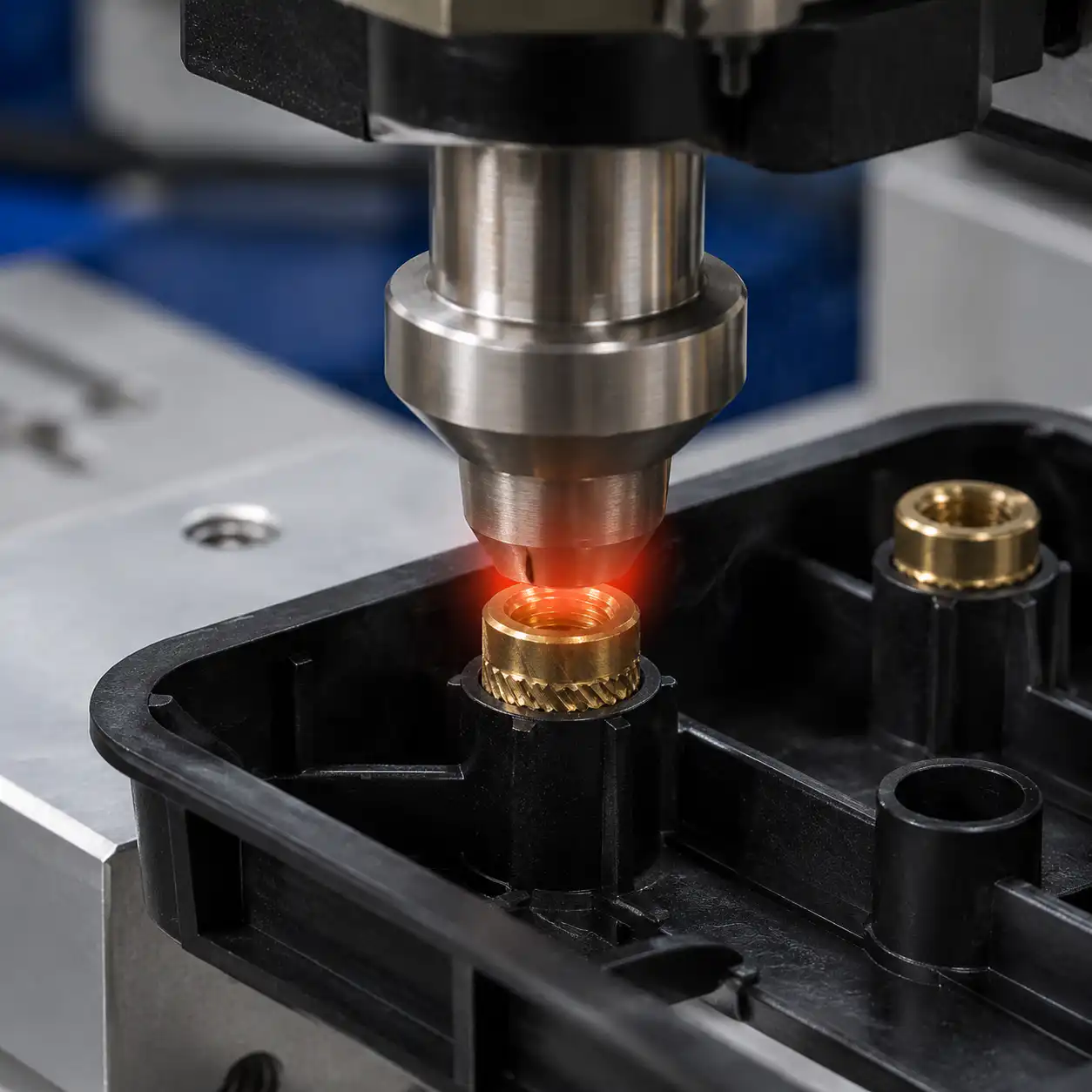
ヒートステーキング用インサート:工程とガイドライン
ヒートステーキング(ヒートセット挿入とも呼ばれる)は、加熱した工具を用いて、あらかじめ成形または穿孔された穴にインサートを圧入する工法である。穴の周囲のプラスチックが局所的に軟化し、インサートのローレットやアンダーカット部分に流れ込む。冷却されると、プラスチックが再固化してインサートを所定の位置に固定する。.
処理手順:
- ネジ付きインサートを穴またはボスに装着します。.
- 加熱したステーキングチップを、推奨される温度と圧力で当ててください。.
- インサートが面一になるか、わずかに沈み込むまで押し込んでください。.
- しばらく圧力をかけたままにしてから、火から下ろします。3~5秒間冷まします。.
| プラスチック素材 | 推奨温度 | 融点 |
|---|---|---|
| ナイロン(PA6、PA66) | 260~290°C | 220~265°C |
| ポリカーボネート(PC) | 270~300°C | 230~260°C |
| ABS | 200~240°C | 190~230°C |
| ポリプロピレン(PP) | 160~190°C | 130~170°C |
必要な機材: 温度調節機能付きはんだごて、またはインサートのサイズに合わせた交換可能な先端部を備えた専用のヒートステーキングプレス。.
ヒートステーキングの長所と短所
メリット: 設備コストが低く、サイクルタイムが短い(インサート1個あたり5~10秒)、試作や小~中規模の生産に適しており、圧入法に比べてプラスチックへの応力が最小限に抑えられます。.
デメリット: Operator skill affects consistency, risk of overheating and degrading the plastic, not ideal for thin-wall sections below 0.8mm.
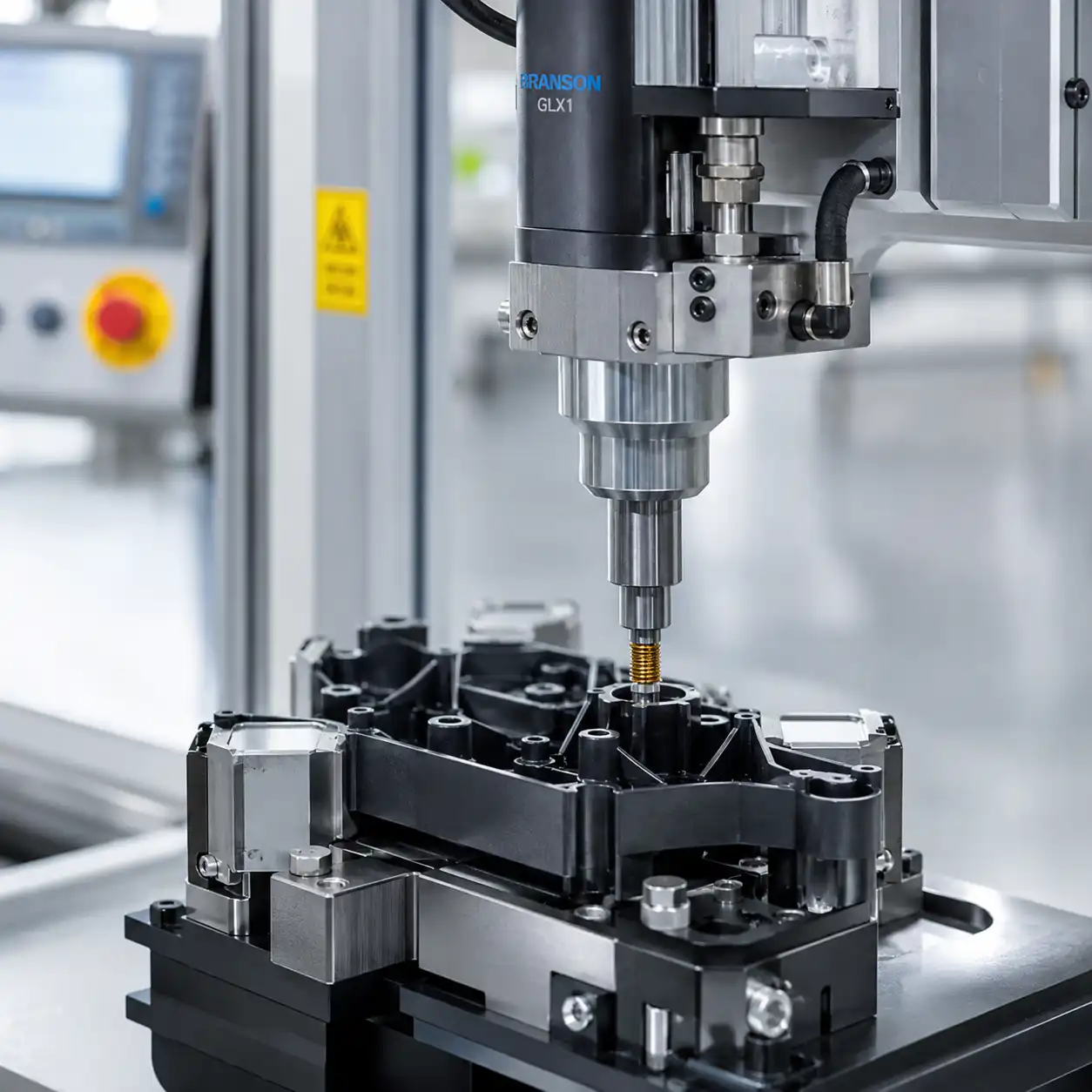
Ultrasonic Insertion: High-Speed Assembly
Ultrasonic insertion uses high-frequency mechanical vibrations (typically 20-40 kHz) to generate frictional heat at the interface between the metal insert and the plastic wall. The plastic melts in milliseconds and flows around the insert geometry, creating an extremely strong bond upon solidification.
How it works: An ultrasonic horn contacts the insert, transmitting vibrational energy. The metal insert vibrates against the plastic hole wall, creating localized friction that melts a thin layer of plastic. The insert sinks into the melt zone under controlled pressure. When vibration stops, the plastic solidifies instantly, locking the insert.
Typical cycle time: 0.5–2.0 seconds per insert, making it ideal for automated high-volume production lines.
Advantages Over Heat Staking
- Faster cycle times: 5-10x faster than heat staking (sub-1-second insertion).
- Better consistency: Process parameters (amplitude, pressure, time) are precisely controlled, eliminating operator variability.
- Lower thermal stress: Heat is generated only at the insert-plastic interface, not throughout the boss.
- Stronger bond: More uniform melt flow into knurls and undercuts yields higher pull-out and torque strength.
- Automation-ready: Easily integrated into robotic assembly cells and inline production systems.
Molded-In Inserts: Maximum Strength Through Integration
Molded-in inserts are placed directly into the injection mold cavity before the plastic is injected. The molten plastic flows around and through the insert geometry, creating a mechanical interlock that cannot be achieved through any post-molding installation method.
Positioning in the mold: Inserts are loaded onto core pins or locating features in the mold. Precise positioning is critical—misalignment of just 0.1mm can cause flash, short shots, or pinched inserts. Use stepped or threaded core pins to positively locate each insert during the injection cycle.
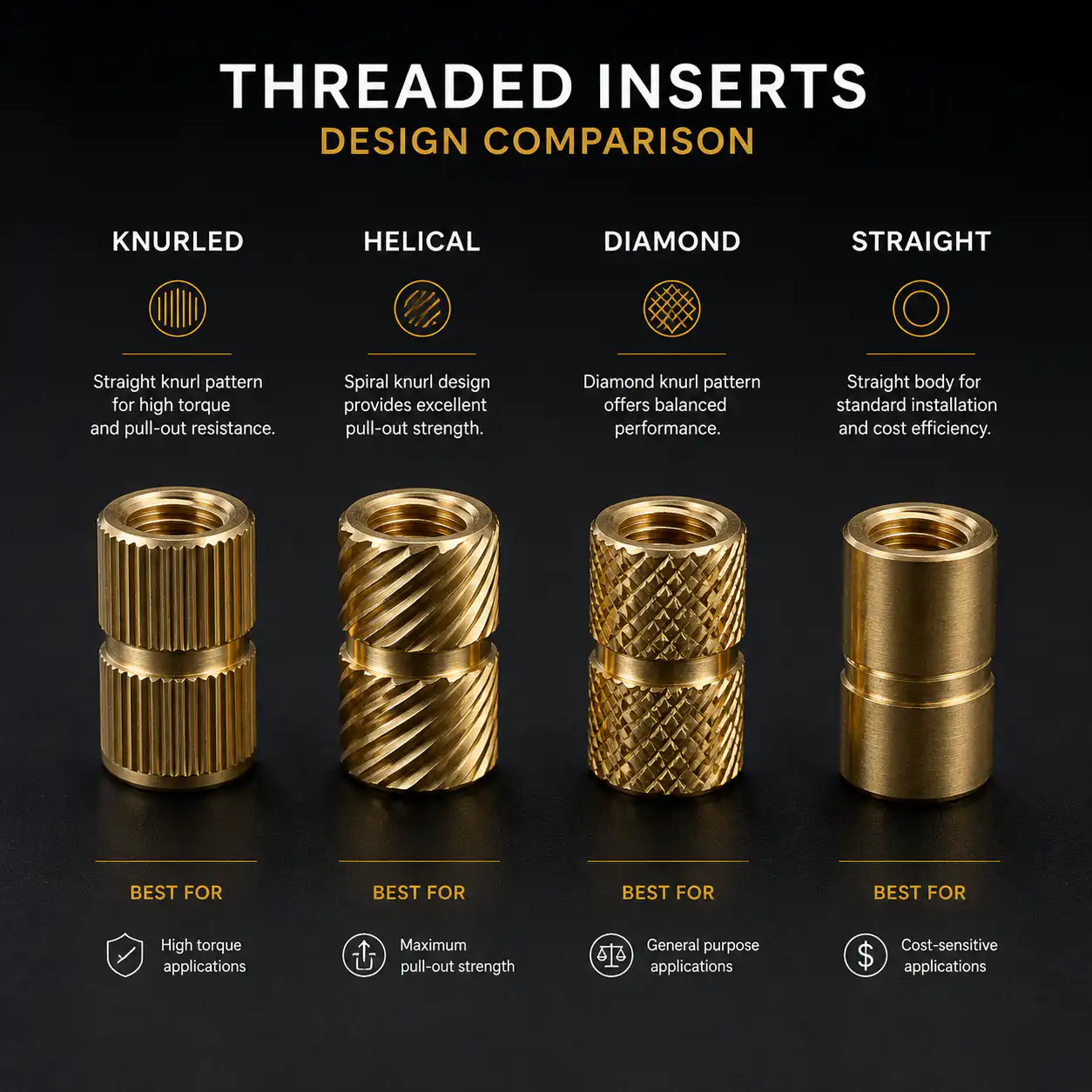
Undercut risk: The insert must have external geometry (knurls, flats, or undercuts) that the plastic can flow into and lock onto. However, the insert must not create mold undercuts that prevent part ejection. Design the insert profile with draft angles or use collapsible core pins for complex internal geometries.
Tooling cost tradeoff: Molded-in inserts add significant cost to the injection mold—manual insert loading requires an operator and extends cycle time by 10-30 seconds per shot. Automated insert loading systems exist but add capital expense. ROI analysis typically favors molded-in inserts only when the part demands maximum joint strength that cannot be achieved through secondary installation, such as load-bearing structural components in automotive chassis or industrial machinery.
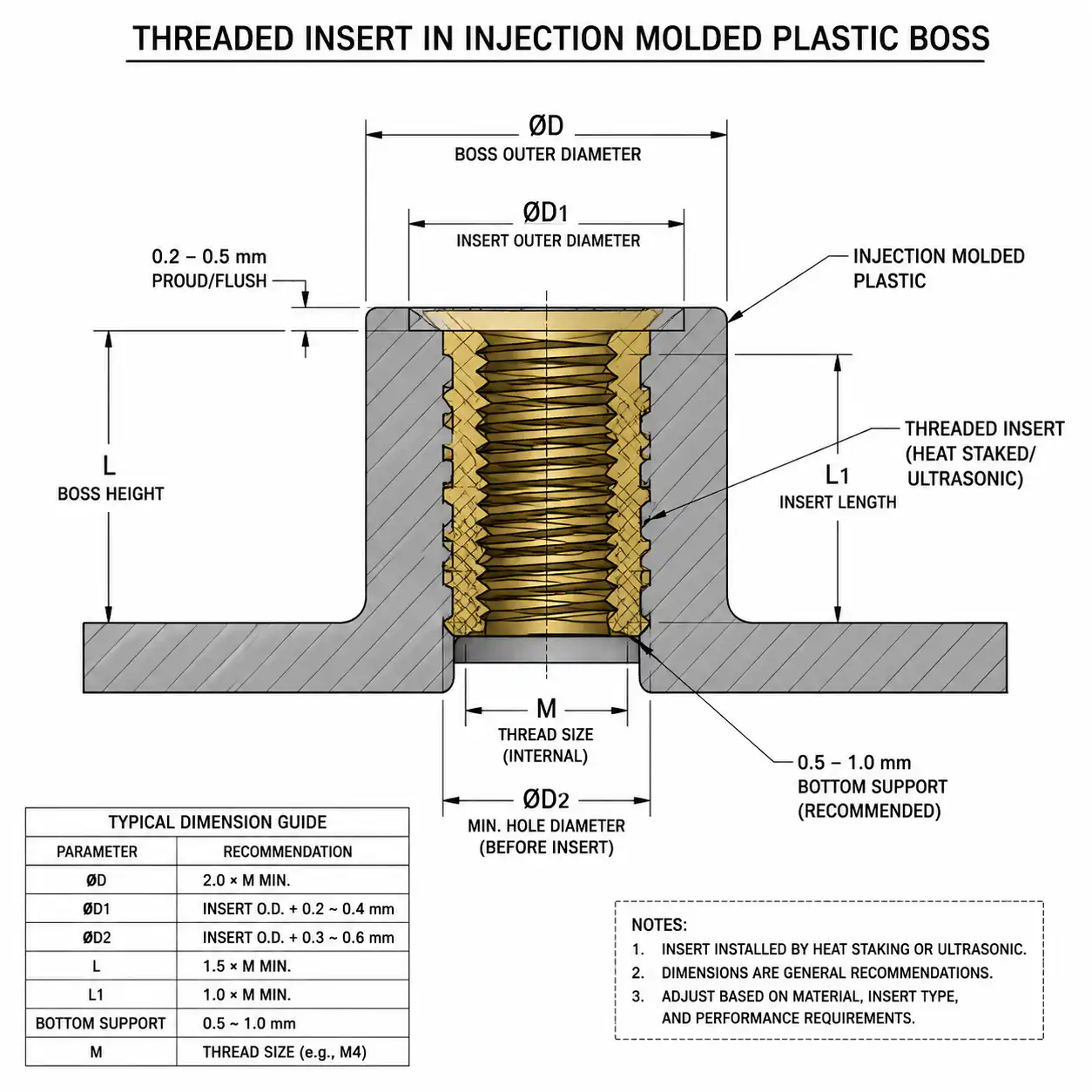
Design Guidelines for Threaded Insert Bosses
Proper boss design is the most important factor in insert performance. Following these dimensional guidelines ensures maximum strength and prevents cracking, sink marks, and pull-out failures.
Boss Diameter and Wall Thickness Ratios
The outer diameter of the boss should be approximately 2.0–2.5× the insert outer diameter. For example, an M4 insert with a 6mm OD requires a boss OD of 12–15mm. The wall thickness—the difference between the boss inner hole diameter and outer diameter—should be at least 60% of the insert wall thickness to prevent cracking during installation.
Insert Hole Size Tolerance Chart
| Insert OD (mm) | Hole Diameter (mm) | Tolerance (mm) | Interference (mm) |
|---|---|---|---|
| 4.0 | 3.8–3.9 | ±0.05 | 0.1–0.2 |
| 5.0 | 4.8–4.9 | ±0.05 | 0.1–0.2 |
| 6.0 | 5.7–5.8 | ±0.05 | 0.2–0.3 |
| 8.0 | 7.6–7.8 | ±0.08 | 0.2–0.4 |
| 10.0 | 9.5–9.7 | ±0.08 | 0.3–0.5 |
Minimum Wall Around Insert
For general-purpose assemblies using brass or steel inserts, the minimum wall thickness from the insert OD to the nearest part edge or feature should be 1.5mm for unfilled thermoplastics そして 2.0mm for glass-filled materials. These values apply to the thinnest cross-section, which is typically the boss wall itself. For structural applications, increase these minimums by 50%.
Stack Height Calculation
Calculate the minimum boss height to fully seat an insert:
Boss Height = Insert Length + (2 × Insert Pitch) + Clearance
Where clearance is typically 1-2mm to ensure the insert tip does not bottom out in a blind hole. For through-holes, the insert should extend at least one full thread beyond the plastic surface on the exit side.
Installation Quality Checks
Verify insert installation quality with three standard tests to ensure the assembly meets design specifications.
Pull-Out Test
Install a bolt into the insert to the recommended thread engagement depth (minimum 1.5× bolt diameter). Apply an axial tensile force using a universal testing machine at a rate of 5mm/min. The insert should withstand the specified pull-out force without displacement exceeding 0.25mm before the ultimate failure point. For brass inserts in unfilled nylon, typical M4 pull-out strength is 300-500 N.
Torque Test
Thread a bolt into the insert and apply increasing rotational torque. The insert should resist rotation up to the specified torque value. Use a calibrated torque wrench and measure the torque at which the insert begins to rotate in the plastic. For M4 heat-set inserts in PC, typical acceptable torque resistance is 3-5 Nm before rotation.
Cross-Section Inspection
Cut through the center of the installed insert (perpendicular to the axis) using a precision saw. Polish the cut surface and examine under magnification. Verify that plastic has fully flowed into the knurls, undercuts, or ribs with no visible voids, gaps, or cracks. The plastic should make intimate contact with at least 80% of the knurl surface area for optimal strength.
よくある質問
See our polypropylene vs nylon comparison for detailed grade selection and property data.
ヒートステーキングと超音波接合――ナイロンにはどちらが適しているか?
ナイロン(PA6/PA66)の場合、超音波挿入は一般的に優れた結果をもたらします。ナイロンは融点が比較的明確で、溶融粘度が低いため、超音波エネルギーが加わると迅速かつ均一に流動します。 ナイロンにおいて、超音波挿入は、ローレット溝への充填がより完全に行われるため、ヒートステーキングよりも20~30%高い引き抜き強度を実現します。ただし、生産量が少ない場合(月間1,000個未満)や、超音波装置への設備投資が採算に合わない場合には、ヒートステーキングも依然として有効な選択肢となります。 ナイロンにヒートステーキングを採用する場合は、インサートを120~150°Cに予熱して、熱衝撃を軽減し、プラスチックの局所的な劣化を防ぐようにしてください。.
成形後にネジ付きインサートを取り付けることはできますか?
はい、そしてほとんどの場合、そうあるべきです。ヒートセット式、圧入式、セルフタッピング式、超音波式インサートは、いずれも成形後の取り付けを想定して設計されています。これらの方法を用いることで、成形一体型インサートに伴う金型の複雑化、サイクルタイムの長期化、および金型コストの増加を回避できます。 唯一の例外は、部品の形状により成形後にボスにアクセスできない場合(例えば、深いブラインドキャビティなど)、あるいは絶対的な最大強度が要求される場合です。大多数の用途において、成形後のインサート挿入の方が、より費用対効果が高く、柔軟性のあるアプローチとなります。.
What’s the minimum wall thickness around a brass insert?
The minimum wall thickness around a brass insert depends on the plastic material and the insert size. For unfilled thermoplastics like ABS, PC, and unreinforced nylon, the minimum wall is 1.5mm for inserts up to M4 size and 2.0mm for M5-M8 sizes. For glass-fiber-reinforced plastics (e.g., PA66-GF30), increase minimum wall to 2.0mm for M4 and 2.5mm for M5-M8 because the glass fibers reduce elongation at break, making thin walls more prone to cracking during insertion. Always perform validation testing on production-intent materials, as fillers, regrind content, and colorants can affect brittleness.
ガラス繊維強化ナイロンにおけるインサートの抜け出しを防ぐには?
Glass-filled nylon (e.g., PA66-GF30) presents a challenge because the glass fibers make the material stiffer and stronger but also more brittle. Three strategies effectively prevent pull-out: (1) Select inserts with aggressive knurl patterns—diamond or helical knurls with deep undercuts provide better mechanical interlock than straight knurls. (2) Increase the interference fit by reducing the hole diameter by an additional 0.1-0.2mm compared to unfilled nylon. (3) Use ultrasonic insertion instead of press-in methods, as ultrasonic energy creates a more uniform melt layer that encapsulates the knurls without generating micro-cracks. Additionally, avoid sharp internal corners in the boss design—use generous radii (minimum 0.5mm) at the base of the boss where it meets the main wall to distribute stress and prevent crack initiation during thermal cycling.