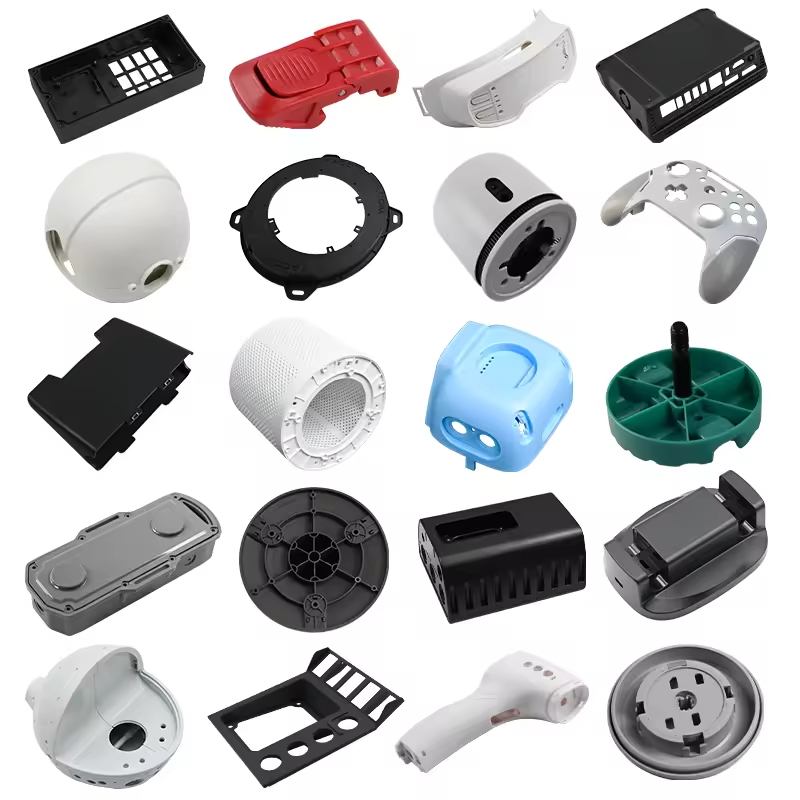
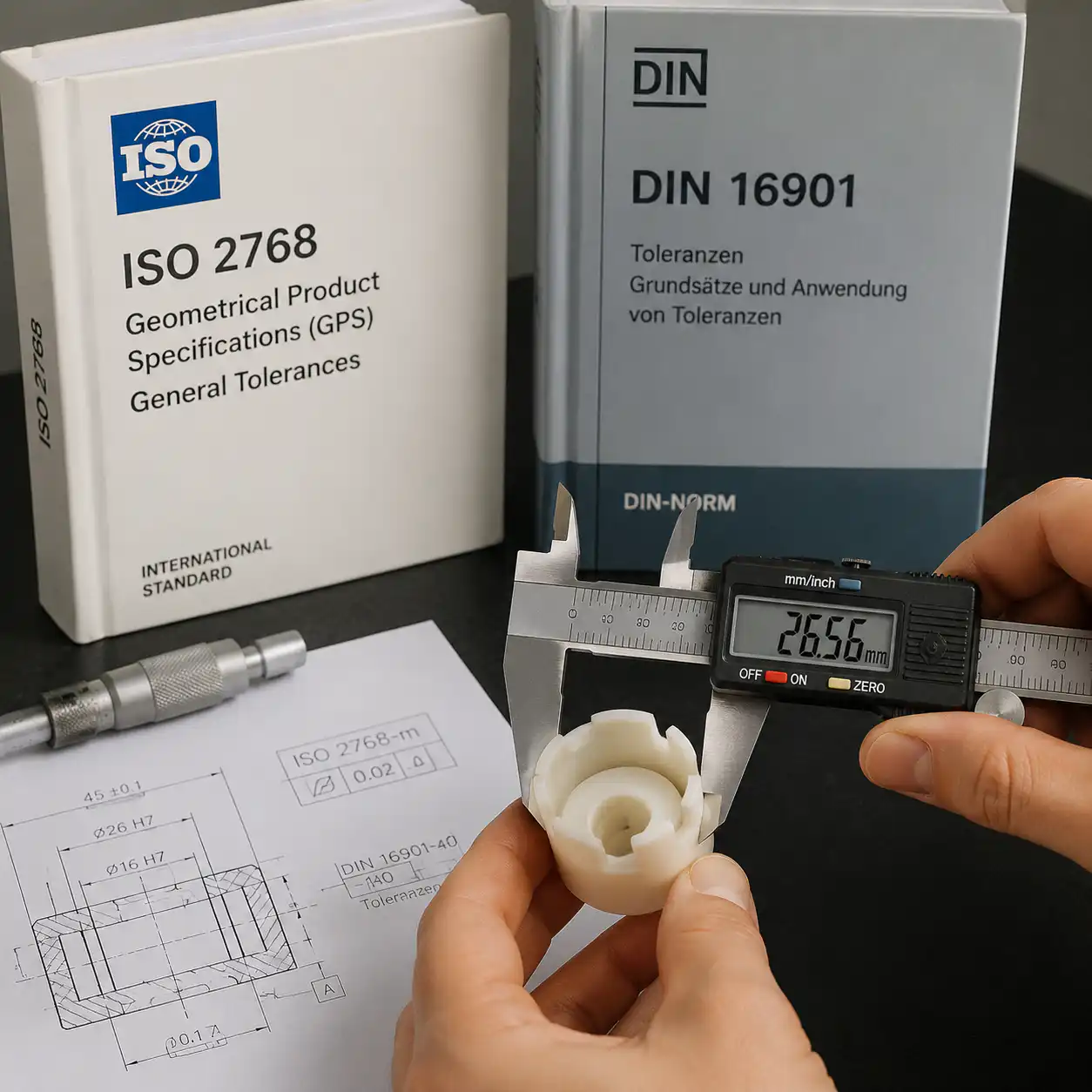
寸法公差は、あらゆるプラスチック射出成形プロジェクトにおいて、表には現れないが成否を左右する重要な要素です。 0.05mmの誤差は肉眼では確認できないかもしれませんが、スナップフィットが「カチッ」と完璧に嵌まるか、それともガタついて緩んでしまうかの分かれ目となる可能性があります。この包括的なガイドでは、ISO 2768、DIN 16901、およびエンジニアリングプラスチックを用いて厳密な公差を実現するための実践的なノウハウについて解説します。.
寸法公差は、あらゆるプラスチック射出成形プロジェクトにおいて、表には現れないが成否を左右する重要な要素です。 0.05mmの誤差は肉眼では確認できないかもしれませんが、スナップフィットが「カチッ」と完璧に嵌まるか、それともガタついて緩んでしまうかの分かれ目となる可能性があります。この包括的なガイドでは、ISO 2768、DIN 16901、およびエンジニアリングプラスチックを用いて厳密な公差を実現するための実践的なノウハウについて解説します。.
プラスチック部品において公差が重要な理由
金属とは異なり、熱可塑性プラスチックは冷却中に収縮します。しかも、その収縮は異方性であり、流れ方向と横流れ方向で収縮の仕方が異なります。さらに、ガラス繊維の配向、金型の温度勾配、壁厚のばらつきなどが加わると、寸法管理は極めて複雑な課題となります。公差を適切に管理することは、組み立て時の嵌合、シール性能、外観品質に影響を与え、ひいては不良率や総コストにも影響を及ぼします。.
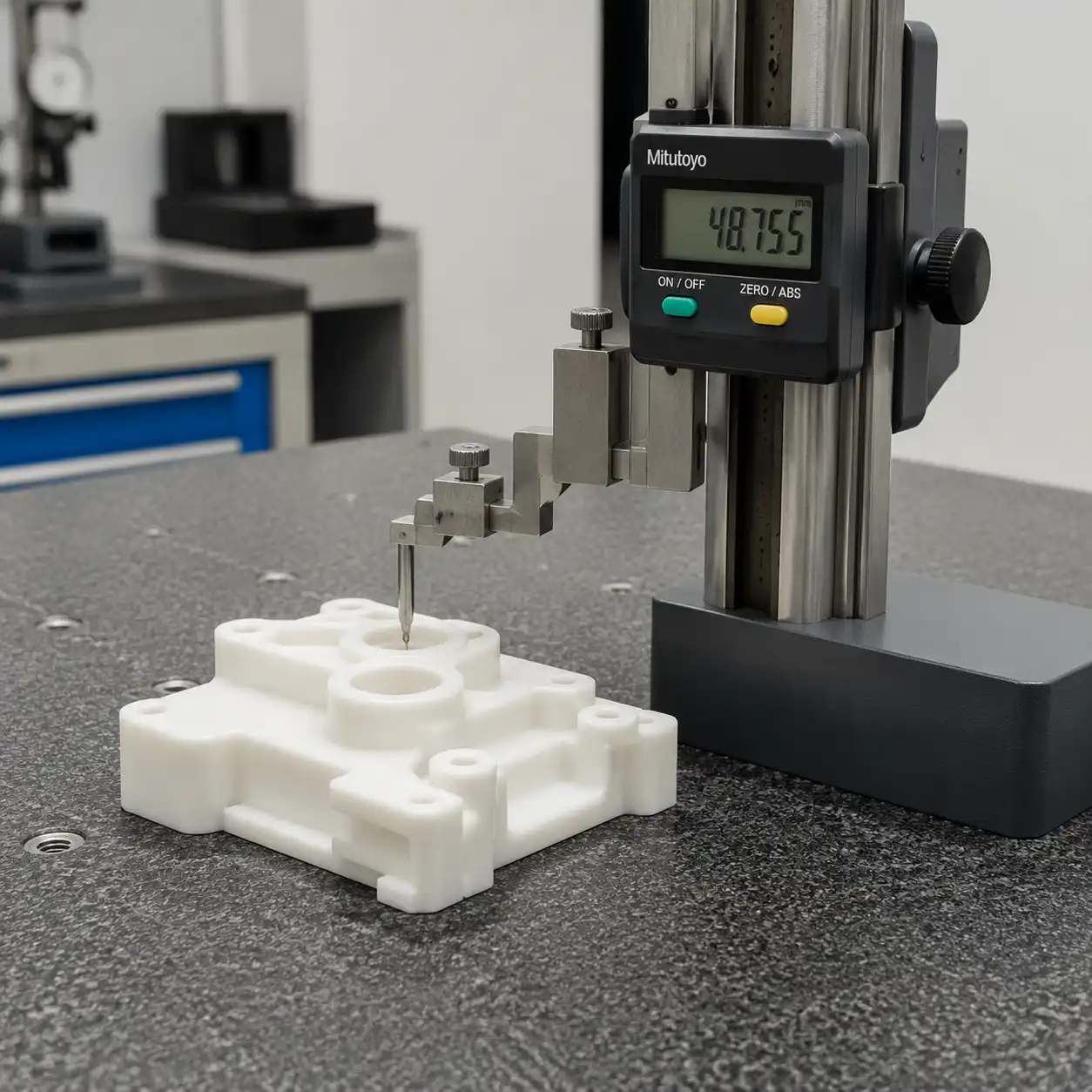
ISO 2768 プラスチックの一般公差
ISO 2768 は、図面に特定の公差が指定されていない場合の直線寸法および角度寸法に対する一般的な公差クラスを規定しています。プラスチック部品については、関連規格として ISO 2768-1(直線寸法および角度寸法)が適用され、通常は mK 公差クラスが用いられます。.
| 寛容クラス | 0.5~3mm | 3~6mm | 6~30mm | 30~120mm | 120~400mm | 代表的な用途 |
|---|---|---|---|---|---|---|
| f(良好) | ±0.05 | ±0.05 | ±0.1 | ±0.15 | ±0.2 | 精密歯車、光学用 |
| m(中) | ±0.1 | ±0.1 | ±0.2 | ±0.3 | ±0.5 | ほとんどの射出成形部品 |
| c(粗) | ±0.2 | ±0.3 | ±0.5 | ±0.8 | ±1.2 | 低精度ハウジング |
| v(非常に粗い) | ±0.5 | ±1.0 | ±1.5 | ±2.0 | ±3.0 | 大型の重要でない部品 |
ほとんどのエンジニアリングプラスチック部品については、ISO 2768-mが妥当な出発点となります。ISO 2768-fを達成するには、入念な金型設計、安定した加工、および収縮率が予測可能な材料が必要です。.
DIN 16901 — 射出成形における公差規定
DIN 16901は、射出成形の公差に関する最高基準です。ISO 2768とは異なり、この規格では熱可塑性プラスチックを収縮のカテゴリーごとに分類することで、材料ごとの収縮特性を考慮しています。このため、金型メーカーや品質管理技術者にとっては、はるかに実用的な規格となっています。.
| 素材 | 収縮グループ | 一般的な収縮率 | A級(締まりが良い) | B級(標準) | C級(緩い) |
|---|---|---|---|---|---|
| PA6/PA66(充填剤なし) | グループ2 | 1.0–2.0% | ±0.1% | ±0.2% | ±0.4% |
| PA66 GF30 | グループ1 | 0.3–0.7% | ±0.05% | ±0.1% | ±0.2% |
| POM(アセタール) | グループ2 | 1.8–2.5% | ±0.1% | ±0.2% | ±0.4% |
| PC(ポリカーボネート) | グループ1 | 0.5–0.7% | ±0.05% | ±0.1% | ±0.2% |
| ABS | グループ1 | 0.4–0.7% | ±0.05% | ±0.1% | ±0.2% |
| PP(充填剤なし) | グループ3 | 1.5–2.5% | ±0.2% | ±0.4% | ±0.6% |
主なポイント: Glass fiber reinforcement dramatically improves dimensional stability. PA66 GF30 (Group 1) can achieve tolerances nearly as tight as unfilled PC, while unfilled PA66 (Group 2) needs wider tolerance allowances due to higher and more variable shrinkage.
How Shrinkage Affects Achievable Tolerance
Shrinkage is the single largest variable in plastic part tolerances. Here is how different materials compare:
- Nylon 6/66 unfilled: 1.0–2.0% shrinkage. A 100mm dimension can vary by 1–2mm just from the material alone, before considering mold and process variation.
- Nylon 66 GF30: 0.3–0.7% in flow direction, 0.7–1.0% cross-flow. The glass fiber constrains shrinkage but creates anisotropy — dimensions differ depending on fiber orientation.
- POM: 1.8–2.5% — the highest shrinkage of common engineering plastics, which is why tight-tolerance POM parts need very precise mold compensation.
- PC: 0.5–0.7% — excellent dimensional stability, making it a preferred choice for optical and precision applications.
The mold maker must calculate cavity dimensions as: Nominal Dimension × (1 + Shrinkage Rate), then fine-tune after first-shot samples. Modern Moldflow simulation predicts shrinkage within ±0.1% accuracy when properly calibrated.
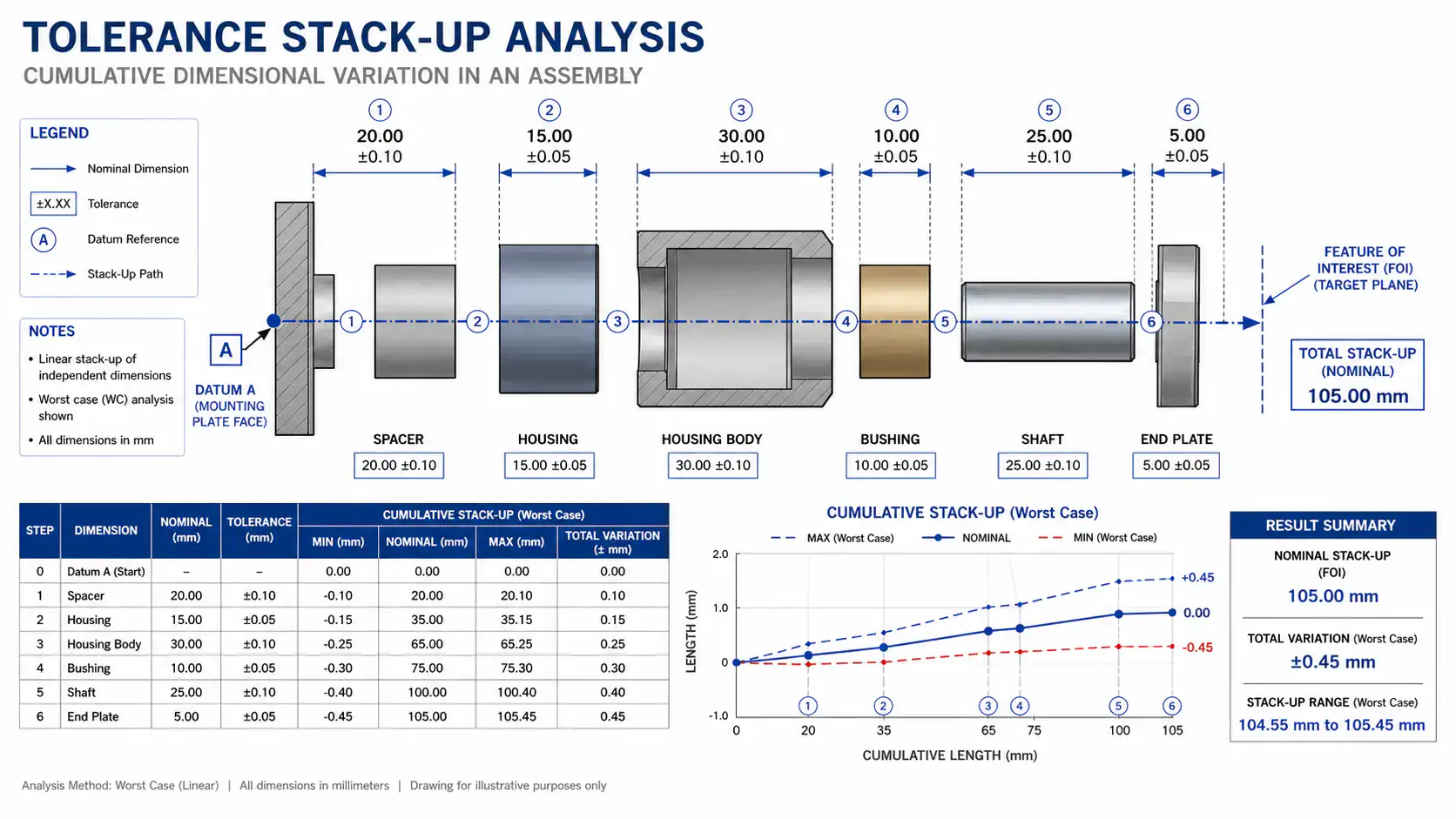
Tolerance Stack-Up Analysis
When multiple toleranced features interact in an assembly, their individual tolerances accumulate. The practical formula for worst-case stack-up is:
Ttotal = T1 + T2 + … + Tn
For statistical (RSS) stack-up, which is more realistic for production volumes:
Ttotal = √(T1² + T2² + … + Tn²)
Common mistakes include forgetting to account for the mold split line tolerance, ignoring thermal expansion differences between assembled materials, and treating shrink rates as constants rather than ranges. Always run a tolerance analysis before finalizing mold steel — it is far cheaper than discovering interference at first-shot inspection.
Design for Tolerance — Best Practices
Uniform wall thickness: The single most effective way to improve dimensional control. Thick-to-thin transitions cause differential cooling and warpage.
Gate location: Position the gate so the melt front fills the cavity uniformly, minimizing anisotropic shrinkage. A poorly placed gate creates asymmetric flow patterns that warp the part.
Mold steel selection: For tight tolerances (±0.02mm or better), use hardened tool steel (H13, S136) rather than P20. Hardened steel holds dimensions longer and provides better surface finish, reducing the need for post-molding compensation.
Draft angles and ejection: Ejector pin placement affects flatness. Uneven ejection force distorts the part while it is still warm, creating permanent dimensional errors.
Measurement Methods for Plastic Parts
| 方法 | 精度 | 最適 | Cost Level |
|---|---|---|---|
| Caliper | ±0.02mm | Quick checks, simple features | $ |
| Micrometer | ±0.001mm | Wall thickness, precision diameters | $ |
| Gauge pins | ±0.005mm | Hole diameters, go/no-go | $$ |
| Optical comparator | ±0.005mm | Profiles, radii, 2D geometry | $$$ |
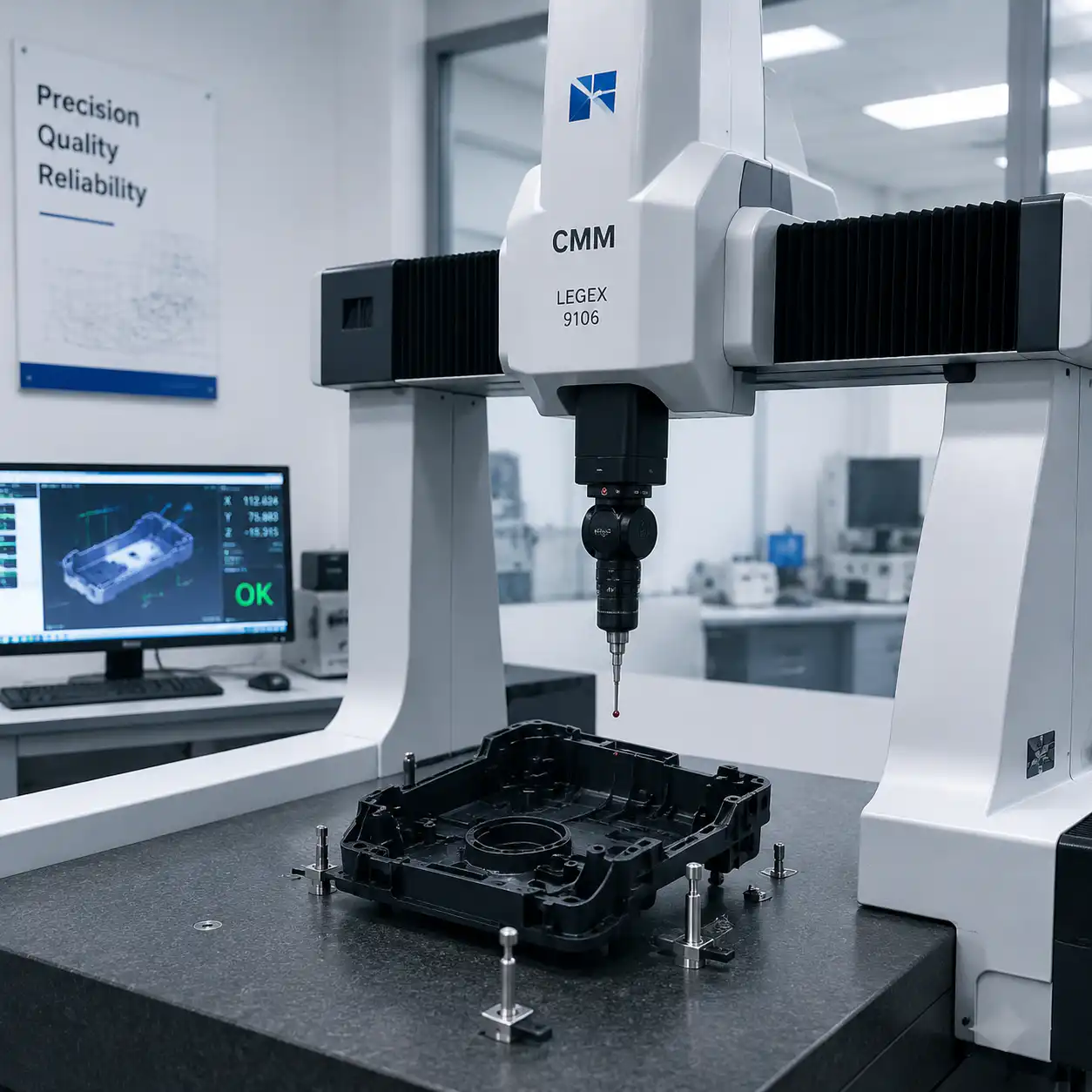
| CMM (Coordinate Measuring Machine) | ±0.001mm | Full 3D dimensional inspection | $$$$ |
| 3D scanning | ±0.02–0.05mm | Complex freeform surfaces, comparison to CAD | $$$ |
For production QC, a combination of gauge pins (fast go/no-go for critical bores) and periodic CMM inspection (full dimensional report for PPAP/ISIR) is the industry standard.
The Cost of Tighter Tolerances
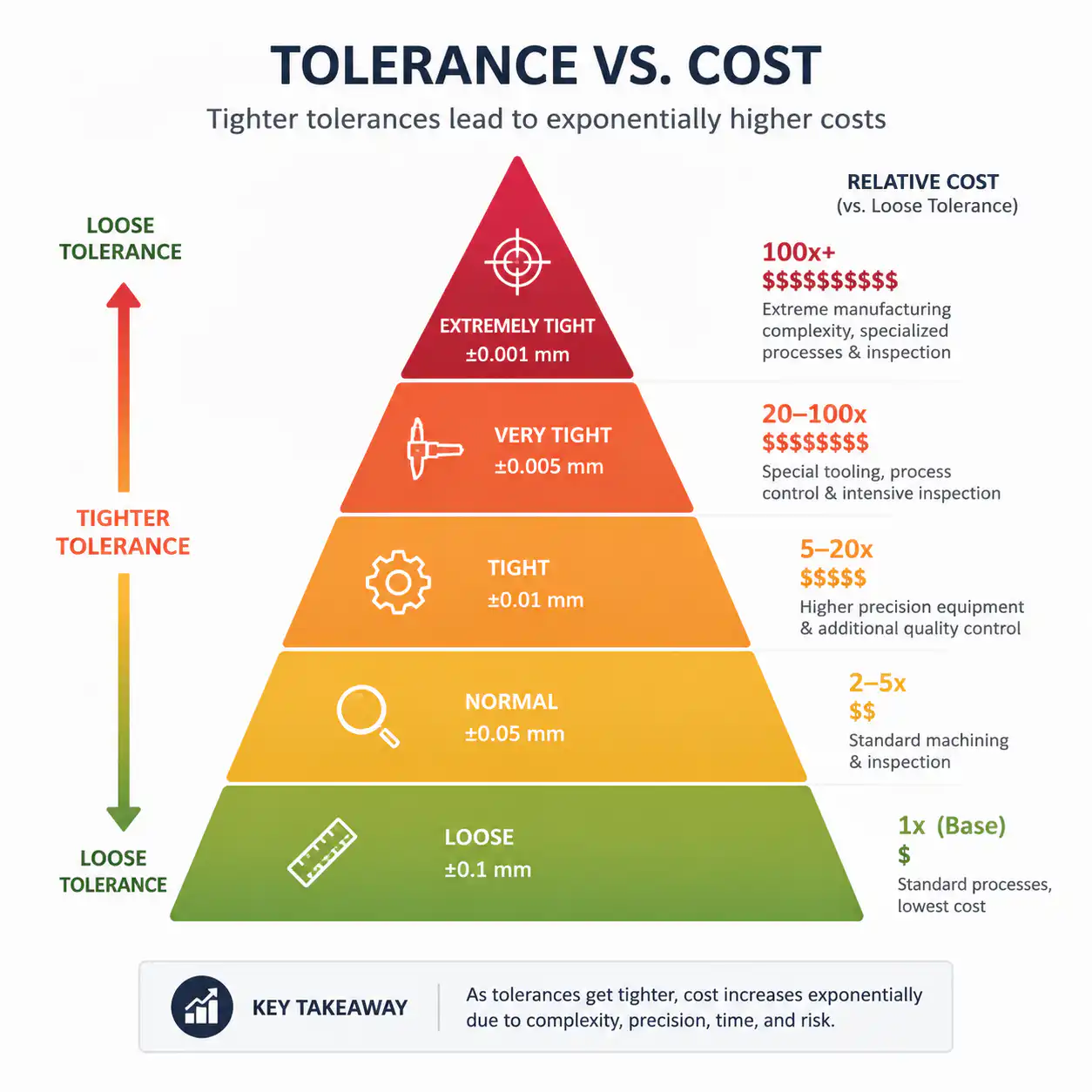
Every decimal place in your tolerance specification increases cost. Here is a practical cost pyramid for injection molded nylon parts:
| Tolerance Band | Mold Cost Premium | Part Cost Premium | Rejection Rate |
|---|---|---|---|
| ±0.5mm | ベースライン | ベースライン | 0.5–1% |
| ±0.2mm | +5–10% | +3–5% | 1–3% |
| ±0.1mm | +15–25% | +10–15% | 3–5% |
| ±0.05mm | +30–50% | +20–30% | 5–10% |
| ±0.02mm | +60–100% | +40–60% | 10–20% |
The premium is not just financial: tighter tolerances also increase mold lead time (additional EDM and polishing) and require more frequent QC inspection during production.
結論と提言
Specifying tolerances for injection molded plastic parts requires balancing functional requirements with manufacturing reality. For nylon parts, the sweet spot is typically DIN 16901 Grade B (standard) — it provides adequate precision for most mechanical applications without excessive cost premiums. Glass-filled grades can reliably achieve Grade A tolerances thanks to their lower and more predictable shrinkage. Always involve your mold maker early in the tolerance specification process: their experience with your specific material and geometry is worth more than any general standard.
よくある質問
射出成形されたナイロンにおいて、達成可能な最も厳しい公差はどれくらいですか?
For unfilled nylon (PA6/PA66), practical tight tolerance is ±0.05mm for dimensions under 10mm, and approximately ±0.1% of the nominal dimension for larger features. With PA66 GF30, you can reliably achieve ±0.03mm for small features due to the glass fiber’s shrinkage-constraining effect. Achieving tighter than ±0.02mm requires post-molding CNC machining.
プラスチック部品の図面において、公差をどのように指定すればよいですか?
一般的な公差基準としてISO 2768-mKを参照し、重要寸法については個別に、より厳しい公差を指定してください。特に射出成形部品については、DIN 16901を参照し、公差等級(A/B/C)と材料の収縮グループを併せて指定してください。 ナイロンは吸湿により寸法が変化するため、公差が成形時のものであるか、24時間のコンディショニング後のものかを必ず明記してください。.
ガラス繊維は寸法公差を改善するのか、それとも悪化させるのか?
ガラス繊維は、収縮を低減・安定化させることで、寸法公差を大幅に改善します。PA66 GF30の収縮率は0.3~0.7%であるのに対し、充填剤を含まないPA66では1.0~2.0%となります。 しかし、ガラス繊維は異方性の収縮(流れ方向と横流れ方向で異なる収縮)を引き起こすため、金型設計者はゲートの位置決めやキャビティ寸法の調整を通じてこれを補正する必要があります。その結果、寸法管理には極めて好ましい効果が得られます。.
What does ‘free tolerance’ mean in plastic manufacturing?
「自由公差」とは、図面上でその寸法に対して個別の公差が指定されていないことを意味し、したがって、参照される規格(通常、プラスチック部品の場合はISO 2768-m)で規定された一般的な公差が適用されることを指します。 ISO 2768-mに基づく50mmの寸法の場合、フリー公差は±0.3mmとなります。フリー公差は図面の煩雑さを軽減し、製造コストを削減しますが、機能や嵌合に関係のない寸法にのみ使用すべきです。.