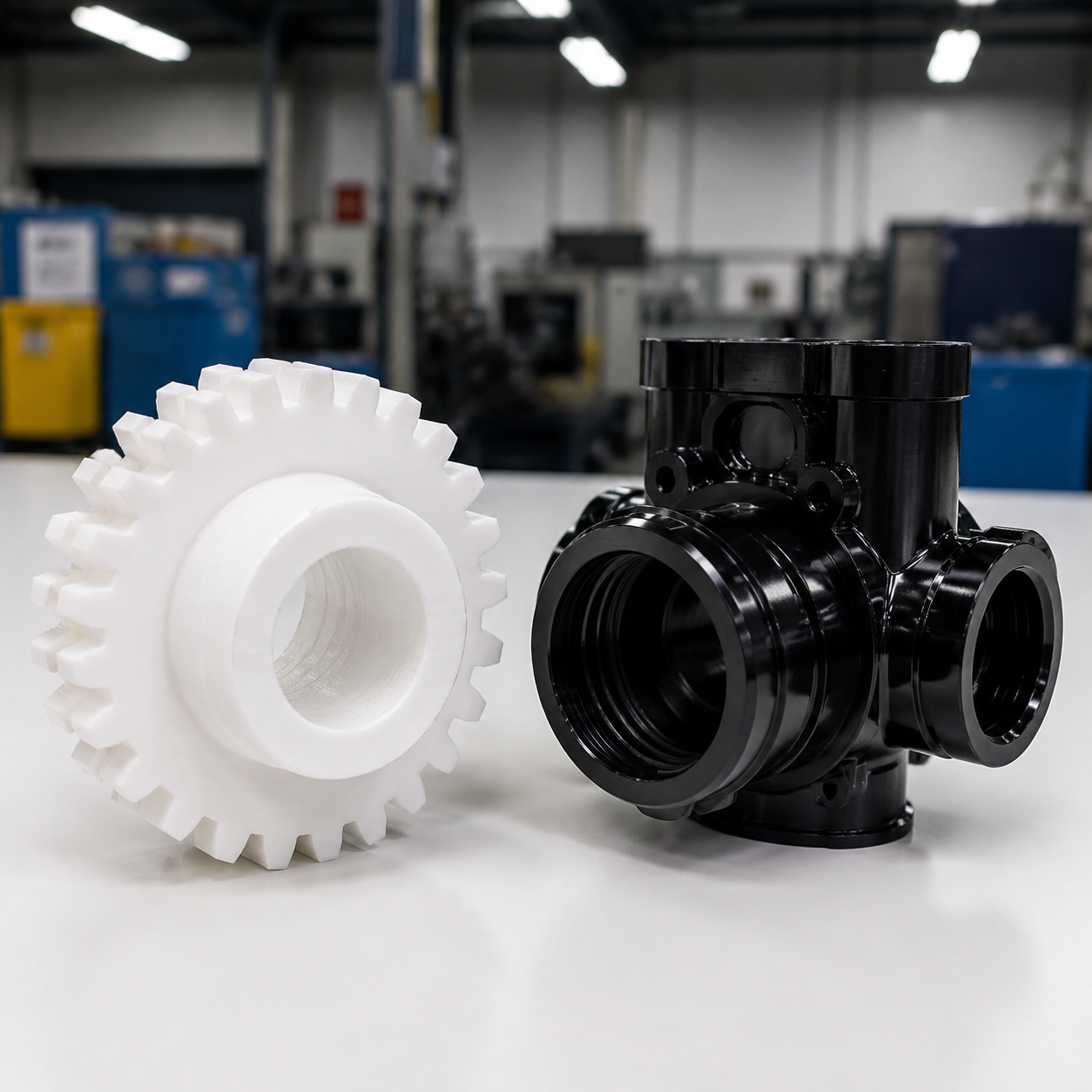
エンジニアや調達チーム向けの簡単な回答: デルリン(Delrin)は、アセタールホモポリマー(POM-H)のデュポン社の登録商標です。図面に特に指定がないまま「アセタール」と記載されている場合、サプライヤーはホモポリマーまたはコポリマー(POM-C)のいずれかを供給する可能性があります。これら2つの材料は特性が十分に異なるため、現場での故障を引き起こす恐れがあります。 公差の厳しいCNC用歯車、高サイクル疲労が想定される用途、および機械加工で最高の表面仕上げが求められる部品には、デルリンホモポリマーを選択してください。熱水や酸性環境が関与する用途、あるいは中心線方向の気孔が問題となる大径の旋削部品には、アセタールコポリマーを選択してください。.
このガイドは、以下の必要があるエンジニアを対象に作成されています。 発注書(PO)に適切な材料を明記してください, 、単に化学的性質を理解するだけではありません。当社は、自社施設で製造された500点以上の工業用アセタール部品に関する加工データを、グレードや3つの製造プロセスを横断して活用しています。.
材料の基礎:ホモポリマーとコポリマー — 現場では何が変化するのか
どちらのグレードもポリオキシメチレン(POM)の仲間ですが、その分子構造は、下流工程のすべてに影響を及ぼすほど異なります:
- デルリン(POM-H): 均一に繰り返される -CH2O- 単位。結晶度が高いほど(約75~85%)、硬さや剛性が高まり、耐疲労性も向上しますが、その一方で、機械加工後の残留応力も高くなります。.
- アセタール共重合体(POM-C): 結晶性を妨げる-CH2CH2O-共重合単位が散在している。これにより剛性はわずかに低下するが、耐薬品性および加工後の寸法安定性が劇的に向上する。.
物件の直接比較
| プロパティ | デルリン(POM-H) | アセタール共重合体(POM-C) | なぜ重要なのか |
|---|---|---|---|
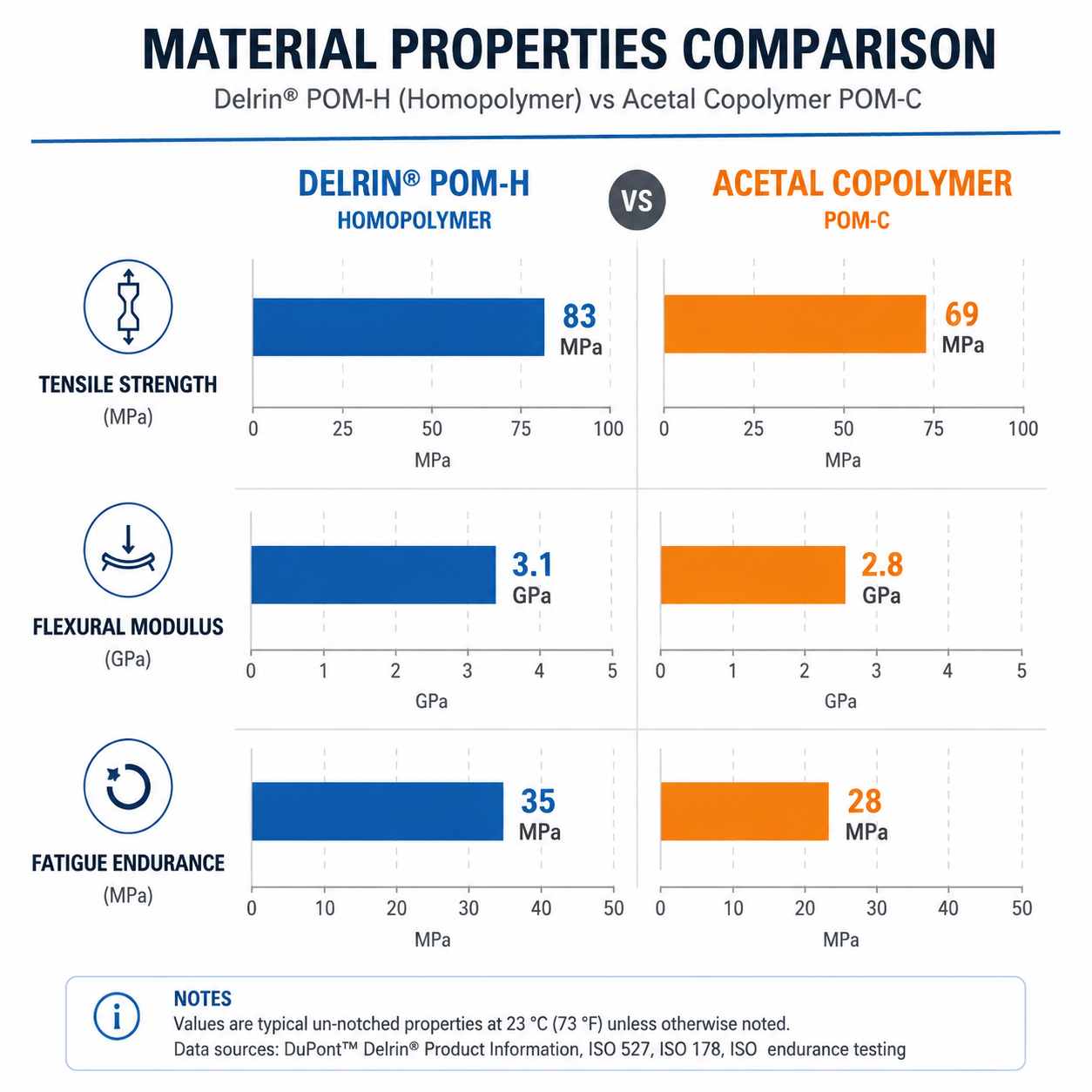
| 引張強さ (MPa) | 70-83 | 60-69 | デルリンは、降伏点に達するまでの静的荷重が約20%高い |
| 曲げ弾性率 (GPa) | 2.8-3.1 | 2.4-2.8 | より硬い感触 — スナップフィットによる保持力にとって極めて重要 |
| 10⁶サイクルにおける疲労耐久性 (MPa) | 35 | 28 | 歯車とばねの主な差別化要因 |
| アイゾット衝撃強度(ノッチ付き)(J/m、23°C) | 69-122 | 53-163 | コポリマーは用途の幅が広い。グレード選びが重要だ |
| 吸水率、24時間(%) | 0.25 | 0.22 | 室温では類似しているが、60°Cを超えると異なる |
| 連続使用温度(最高)(°C) | 90-100 | 100-110 | 高温環境下で優れた性能を発揮するコポリマー |
| 23°C、10MPa条件下での1000時間後のクリープひずみ(%) | ~0.5 | ~0.8 | デルリンは、一定の荷重がかかっている状態でも寸法安定性に優れている |
| 摩擦係数(乾燥状態対鋼) | 0.2-0.35 | 0.25-0.40 | デルリンは滑りやすさがやや高いため、ベアリングに適しています |
デルリンおよびアセタール製部品の設計規則
これらのルールは、当社のCNC加工セルで直接策定されたものであり、試作段階から量産段階まで同様に適用されます。成形加工に適用する際は、抜き勾配(両素材とも最低1~2°)を追加して調整してください。.
アセタール部品の設計ルール(現場からの知見)
当社施設で製造された500点以上の工業用アセタール製部品(2026年第1四半期)の加工データに基づいています。これらのデータをCAD図面に直接適用してください。.
| パラメータ | デルリン(POM-H) | アセタール共重合体(POM-C) |
|---|---|---|
| 最小肉厚 | 1.0 mm | 0.8 mm |
| 推奨コーナー半径 | R ≥ 0.5 mm | R ≥ 0.3 mm |
| 穴径の公差(CNC) | ±0.025 mm | ±0.05 mm |
| 最大アスペクト比(奥行き/直径) | 6:1 | 5:1 |
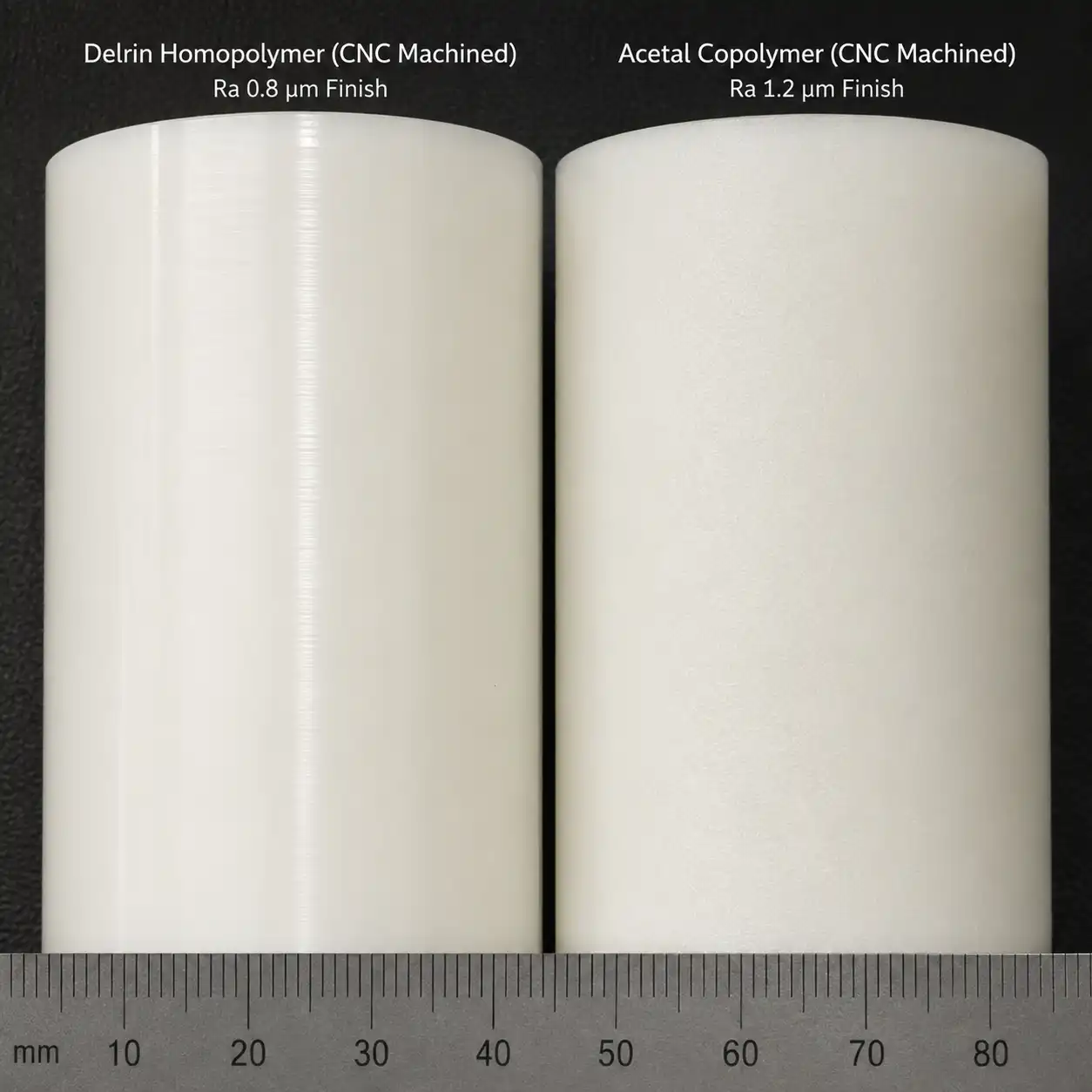
| 機械加工後の表面粗さ(Ra) | 0.8 μm | 1.2 μm |
| 加工後の反りのリスク | 中程度(ストレス解消をお勧めします) | 低(寸法安定性に優れる) |
These values assume standard machining conditions at 20°C, sharp carbide tooling, and dry cutting. For injection molding design rules, refer to our engineering team consultation.
Why Centerline Porosity Changes Part Design
One of the least-discussed differences between the two materials is centerline porosity in Delrin extruded rod. As the rod diameter increases beyond 40 mm, POM-H extrusion typically develops a porous center core (0.5-2 mm diameter) due to shrinkage during cooling. If your part design places a critical sealing surface or tight-tolerance bore on the rod centerline, this porosity causes leaks or out-of-spec bores. Copolymer does not have this problem — the co-monomer disrupts crystallization enough to eliminate centerline voids.
Practical rule: If your part has a through-hole or sealing surface passing through the rod center and the rod diameter exceeds 40 mm, specify acetal copolymer. One customer saved 18% on a returned batch for a water valve component by making this single material switch.
産業用途:各グレードが真価を発揮する場面
| 産業 | 代表的な部品 | 推奨グレード | 選定の理由 |
|---|---|---|---|
| 自動車 | Fuel system valves, seat belt components, window regulator gears | デルリン(POM-H) | Higher fatigue strength for 100k+ cycle durability; low fuel permeability |
| 医療機器 | Inhaler mechanisms, insulin pen bodies, surgical instrument handles | アセタール共重合体(POM-C) | Better resistance to sterilization chemicals; lower extractables |
| 産業機械 | Conveyor rollers, bearing cages, pump impellers, wear strips | デルリン(POM-H) | Superior wear resistance and low friction (self-lubricating); higher hardness |
| コンシューマー・エレクトロニクス | Keyboard mechanisms, printer gears, camera lens barrels | アセタール共重合体(POM-C) | Better hot water resistance for dishwasher-safe applications; lower creep under constant spring load |
| Plumbing & Fluid Handling | Valve seats, shower mixer components, water meter internals | アセタール共重合体(POM-C) | Lower hot water swelling; avoids centerline porosity issues that can cause leaks in POM-H |
| Food Processing | Filling nozzles, conveyor guides, cutting board liners | Both (FDA-compliant grades) | Use homopolymer for dry-contact apps; copolymer for wet/hot-contact per NSF 51 |
The pattern is clear: Delrin dominates in dynamic mechanical applications (gears, bearings, springs) where fatigue life and low friction are primary requirements. Acetal copolymer dominates in applications involving fluids, chemicals, or sterilization — and anywhere the part geometry makes centerline porosity risky.
Tolerance Comparison by Manufacturing Process
The achievable tolerance depends as much on the manufacturing process as the material choice. Below is a practical reference for engineers writing drawing callouts.
| Manufacturing Process | Delrin (POM-H) Tolerance | Acetal Copolymer (POM-C) Tolerance | 最適 |
|---|---|---|---|
| CNC加工 | ±0.025 mm | ±0.05 mm | Prototypes, low-mid volume (<1,000 pcs), tight-tolerance parts |
| 射出成形 | ±0.10 mm | ±0.08 mm | High volume (>5,000 pcs); copolymer molds more consistently |
| 3D Printing (FDM) | ±0.20 mm | ±0.15 mm | Rapid prototypes only; not recommended for functional testing |
Tolerances are achievable under standard shop conditions. Tighter tolerances available on request with additional process controls.
Note that copolymer’s lower post-machining stress relaxation gives it a slight tolerance advantage in injection molding — the part comes out of the mold closer to its final dimensions and drifts less over the first 72 hours.
Cost Decision Framework: When to Pay for Delrin
Cost Decision Framework: Delrin vs Acetal Copolymer
Material cost is only ~15-20% of total part cost for machined components. The real difference is in process efficiency and rejection rate:
- Raw material price: Delrin rod is typically 10-15% more expensive than generic acetal copolymer rod at the same diameter.
- Machining time: Delrin cuts cleaner and faster — expect 8-12% shorter cycle time per part vs. copolymer at equivalent tolerance.
- Rejection rate (internal data): Copolymer parts have higher visual defects (center porosity streaks) — 3-5% rejection vs. ~1% for Delrin in CNC turning operations.
- Break-even point: If your annual volume exceeds 2,000 parts, the reduced rejection rate of Delrin offsets the raw material premium. Below 2,000, generic copolymer is more cost-effective.
- Hidden cost: Copolymer proposed for dimensional-critical assemblies may accumulate 1-2% scrap from dimensional drift post-machining due to residual stress release over the first 72 hours.
The cost decision often comes down to a simple question: “What happens if this part fails?” For non-critical cosmetic or spacing components, copolymer saves money. For load-bearing, safety-critical, or high-cycle components, the Delrin premium pays for itself in reduced field returns.
Common Defects and How to Fix Them
When an acetal part fails or is rejected at incoming QC, the root cause is often a material mismatch. Here are the four most frequent issues we see when customers bring parts to us for rework:
| 問題 | Likely Material Cause | 修正 |
|---|---|---|
| Gear tooth wear after < 50k cycles | Copolymer used where homopolymer needed (28 MPa vs 35 MPa fatigue limit) | Switch to Delrin 100 or 150 grade for gears; add PTFE-filled grade (Delrin 500AF) if unlubricated |
| Surface cracking after 6+ months in service | Environmental stress cracking from acidic environment (common in POM-H) | Switch to POM-C; verify chemical compatibility with your process fluid |
| Dimensional growth in hot water application | POM-H absorbs more water at elevated temperature (~0.8% at 80°C) | Use POM-C (0.6% absorption); pre-condition parts by soaking in 60°C water for 24h before final QC |
| Porosity visible on turned surfaces | Centerline porosity — inherent to POM-H extrusion process | Specify POM-C for parts with large turned diameters (>50 mm); request “low-porosity” grade from supplier |
Specifying Acetal Correctly on Your Purchase Order
Avoid the most common procurement mistake: writing “Acetal” on the PO without specifying the grade. A correctly specified PO should include:
- Material family and type: “Acetal Homopolymer (Delrin 150)” or “Acetal Copolymer (equivalent to Celcon M90)”
- Form: “Extruded rod, diameter 50 mm” or “Injection molding pellets”
- Tolerance requirement: “Per ISO 2768-m” or specific callout
- Any special grade requirements: “FDA-compliant,” “UV-stabilized (Delrin 527),” “PTFE-filled (Delrin 500AF)”
This level of specificity prevents the supplier from substituting copolymer for homopolymer when the drawing only says “acetal” — a practice that is more common than most engineers realize.
結論と提言
The Delrin vs acetal decision is not about which material is “better” — it is about matching the right grade to the right application. Use Delrin homopolymer for dynamic mechanical parts where fatigue life, surface finish, and low friction are critical. Use acetal copolymer for fluid-contact applications, hot or chemically aggressive environments, and large-diameter turned parts where centerline porosity is a risk.
Still unsure which grade fits your design? Our engineering team reviews material selection as part of every quote. Send your drawing or 3D file and we will recommend the optimal grade for your application at no charge.
精密製造
CNC tolerance ±0.01mm across 50+ engineering plastics
ISO 9001 Certified
Full QC with CMM reports per order
15-25 Day Delivery
Prototype to production, global shipping
国際配送
DDP available to US, EU, Asia-Pacific
Get the Complete Engineering Plastics Machining Handbook (PDF)
Covers design rules, tolerance tables, and material selection guides for Delrin, Nylon, PEEK, ABS, PTFE, and 8 more engineering plastics. Based on 15+ years of machining data from our factory floor.
No registration required. Updated Q1 2026.
関連記事
よくある質問
既存のギア設計において、寸法を変更せずにデルリンの代わりにアセタール共重合体を使用することは可能でしょうか?
Yes, with caveats. Copolymer has approximately 20% lower fatigue endurance (28 MPa vs 35 MPa at 10&sup6; cycles) and slightly higher creep under constant load. For static-load gears operating under moderate torque and thin walls, direct substitution works. For high-cycle dynamic-load gears or non-lubricated bearing sleeves, expect up to 30 microns of additional radial play after the first month of operation. Dimensionally, identical tooling can be used — but if switching from homopolymer to copolymer, consider increasing wall thickness by 8-10% to compensate for lower stiffness.
CNC加工したデルリン製の部品が、棚に1週間置いておいただけでなぜ反ってしまうのでしょうか?
これは残留応力の解放であり、アセタールホモポリマーの既知の特性です。押出成形の際、ロッドの外表面は芯部よりも速く冷却されるため、応力勾配が生じます。材料を非対称に切削すると、この応力の不均衡により、24~72時間以内に反りが生じます。 これに対する解決策は3つあります:(1) まず粗加工を行い、部品を24時間放置してから仕上げ加工を行う;(2) 加工前に、ロッドを厚さ25 mmあたり160°Cで1時間アニール処理する; (3) 著しい非対称な材料除去を伴う部品については、アセタール共重合体に切り替える。通常、平坦度や円筒度が0.05 mm以内に収まる必要があるデルリン製部品については、焼鈍処理を推奨しています。.
高温の水や蒸気の環境下では、どちらのグレードの方が優れた性能を発揮しますか?
アセタール共重合体(POM-C)は、60°Cを超える熱水環境において、デルリン(POM-H)よりも優れた性能を発揮します。 コポリマーは高温下での吸水率が低く(80°Cで約0.6% 対 約0.8%)、膨潤も少なく、水によるポリマー鎖の化学的分解である加水分解に対する耐性が著しく高い。 シャワーミキサーの部品、食器洗浄機の部品、コーヒーメーカーの内部部品などの用途では、コポリマーが標準的な選択肢となります。用途によってFDA準拠も求められる場合は、セルコンM25(Celcon M25)または同等の食品グレードのコポリマーを指定してください。.
デルリンおよびアセタール共重合体製の部品には、どのような表面仕上げがありますか?
加工直後のデルリンは、最高の自然な仕上げ(5,000~8,000 RPMで鋭利な超硬工具を使用した場合、Ra 0.8 μm)を実現します。 アセタール共重合体の切削仕上げ面は、通常Ra 1.0~1.2 μmとなります。いずれの材料も表面エネルギーが低いため、塗装やメッキの密着性は良くありません。ビーズブラスト処理を行うと、両材料とも均一なマット仕上げ(Ra 2.0~3.0 μm)が得られ、これが最も一般的な二次仕上げです。 光沢のある外観を得るには、両グレードとも火炎研磨が有効ですが、表面の溶融を防ぐために温度管理を慎重に行う必要があります。いずれの材料も、アクリルで一般的な蒸気研磨は行ってはなりません。使用される溶剤がアセタールを侵食してしまうためです。.