Nylon fuel resistance is one of the main reasons polyamides are used in fuel-system parts, quick connectors, tubing, and under-hood components. But fuel compatibility is not uniform across every nylon grade, fluid blend, or service temperature.
If you are selecting a nylon for fuel contact, compare more than dry strength. Fluid composition, ethanol content, temperature, pressure, moisture history, and long-term stress all affect whether PA6, PA66, PA11, or PA12 will stay dimensionally stable and mechanically reliable.

Why Fuel Compatibility Varies Across Nylon Grades
Short-chain nylons such as PA6 and PA66 generally perform well in oils, hydrocarbons, and many automotive fluids, but they absorb more moisture and can show larger property shifts when heat, water, and chemical exposure combine. Long-chain nylons such as PA11 and PA12 absorb less moisture and are often preferred when dimensional stability and low-temperature ductility matter more.
The practical takeaway is simple: if the part is near the tank, line, pump, vapor circuit, or filler neck, chemical resistance should be checked together with permeability, moisture uptake, and assembly stress.
How Common Fuels Interact with Nylon
Conventional gasoline is usually well tolerated by nylon in dry, room-temperature conditions. The challenge rises when oxygenated fuels, ethanol blends, hot soak conditions, and residual stress enter the picture.
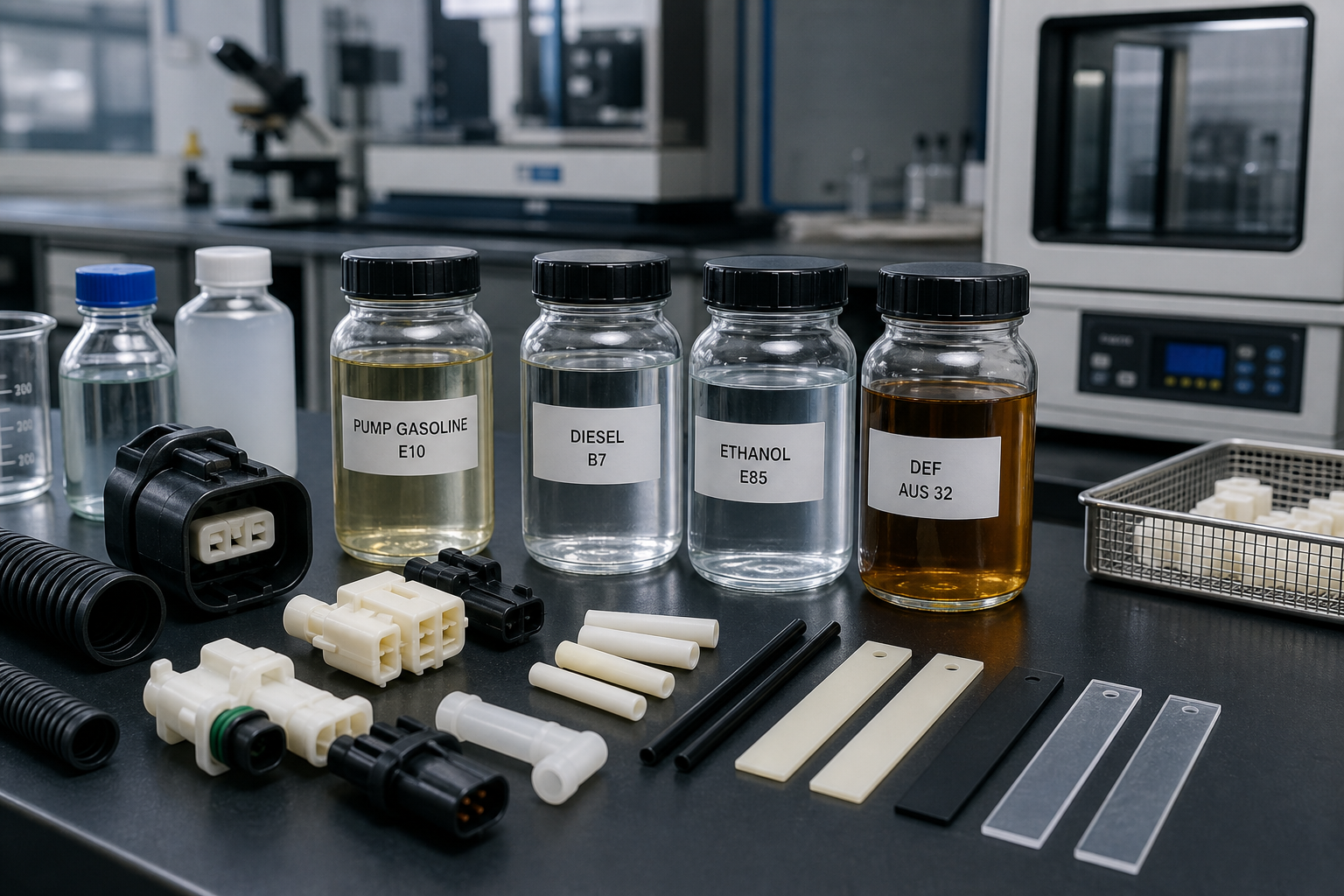
Diesel and engine oils are often less aggressive than polar solvents, but temperature, additive package, and service interval still matter. DEF introduces a different concern because urea solution and elevated temperature can shift the material-selection logic away from the nylon grade that looks best on a dry datasheet.
| 流体 | Typical Nylon Response | Main Selection Risk | Grades Often Considered |
|---|---|---|---|
| Gasoline | Generally good | Swelling and long-term dimensional drift | PA66, PA11, PA12 |
| E10-E20 Ethanol Blends | Application-specific | Stress cracking and permeability | PA12、PA11 |
| Diesel | Usually good | Heat aging and assembly stress | PA66, PA11, PA12 |
| Engine Oil / ATF | Usually good | Long-term temperature exposure | PA6, PA66, PA12 |
| DEF / Urea Solution | Needs validation | Hydrolysis and heat | Specialized grades or alternate resins |
When PA11 and PA12 Beat PA6 and PA66
PA11 and PA12 are commonly chosen for tubing and connector systems because they combine fuel resistance with lower moisture absorption, better flexibility, and improved dimensional retention. That matters in multilayer fuel lines, quick-connect assemblies, and clips that must stay predictable after thermal cycling.
If your part must survive road salt, cold impact, and fuel contact at the same time, long-chain nylons often justify the higher material cost.
Procurement Checklist Before You Approve a Grade
Request fluid-specific validation, not just a general statement that the resin is fuel resistant. Ask which fuel blend was tested, at what temperature, for how long, and under what stress condition.
For assemblies with seals, inserts, or snap features, confirm that dimensional stability after immersion is acceptable for the mating stack, not only for standalone tensile bars.
- Check the exact fuel blend and additive package
- Review test temperature and exposure duration
- Ask whether the data is for dry-as-molded or conditioned material
- Validate burst, creep, and retention performance under real assembly load
Planning a Fuel-Contact Nylon Part?
Send the exact fuel blend and additive package, service temperature and exposure time, part drawing or current grade, load or pressure conditions, and target quantity. Our team can review grade-family and manufacturing-route fit and flag the application-specific compatibility checks needed. Final compatibility must be confirmed for the exact grade and service conditions.
Ask about material or grade fit · Discuss a custom part
関連記事
よくあるご質問
Can nylon be used with gasoline or diesel?
Nylon can be used in some fuel-contact applications, but gasoline blends, ethanol, biodiesel and DEF exposure require grade-specific review and testing.
What should be checked after fuel exposure?
Check swelling, mass change, cracking, surface softening, dimensional drift and mechanical strength after exposure to the exact fuel or fluid.
Does part stress affect fuel resistance?
Yes. Chemical exposure combined with load, molded-in stress, sharp corners or elevated temperature can increase cracking risk.
材料の選別から生産段階に移行される場合は、当社の ナイロン系エンジニアリングプラスチック 成績評価の選択肢に関するページ、, ナイロン射出成形サービス 成形部品については、, ナイロン CNC加工サービス 機械加工部品については、および ナイロン3Dプリントサービス 試作品や少量生産の機能部品向け。.