耐薬品性プラスチックの選定にあたっては、実際の流体、濃度、温度、曝露時間、応力状態、洗浄方法、および製造工程に合致するものでなければなりません。 適合性表は候補を絞り込むのに役立ちますが、「耐性あり」または「耐性なし」という単一のラベルだけでは、あらゆる用途を予測することはできません。プラスチックは、重量に大きな変化がなくても、膨潤、軟化、ひび割れ、強度の低下、流体の吸収、あるいは環境応力亀裂による破損を起こす可能性があります。.
購入者は、部品を発注する前に、グレードごとの性能証明を求め、受入条件を明確にしておく必要があります。同じポリマーであっても、ガラス充填された場合、炭素充填された場合、残留応力を帯びた状態で成形された場合、素材から機械加工された場合、鋭いノッチが設けられた場合、あるいは一定のクランプ荷重が加えられた場合などでは、その性能が異なってくることがあります。.
樹脂を選ぶ前に、化学物質への曝露状況を把握しておく
| 被ばく変数 | 何を記録すべきか | その重要性 |
|---|---|---|
| 流体 | 正確な化学物質、混合物、純度および添加物 | 同じファミリーに属する2つの流体は、その攻撃メカニズムが大きく異なる場合がある |
| 濃度 | 公称濃度および最悪ケース濃度 | 水の希釈、溶媒含有量、およびpHによって、膨潤やひび割れが生じることがあります |
| 温度 | 通常試験、ピーク試験、および熱サイクル試験 | 拡散速度および反応速度は、一般的に温度の上昇とともに増加する。 |
| 連絡先 | 浸漬、飛沫、蒸気、浸透、洗浄、または断続的な接触 | 持続時間や表面の再生により、破壊様式が変わる可能性がある |
| ストレス | 組立荷重、圧力、たわみ、ねじ、インサート、および成形残留応力 | 全体的な浸漬状態が問題ないように見えても、環境応力亀裂が発生する可能性があります |
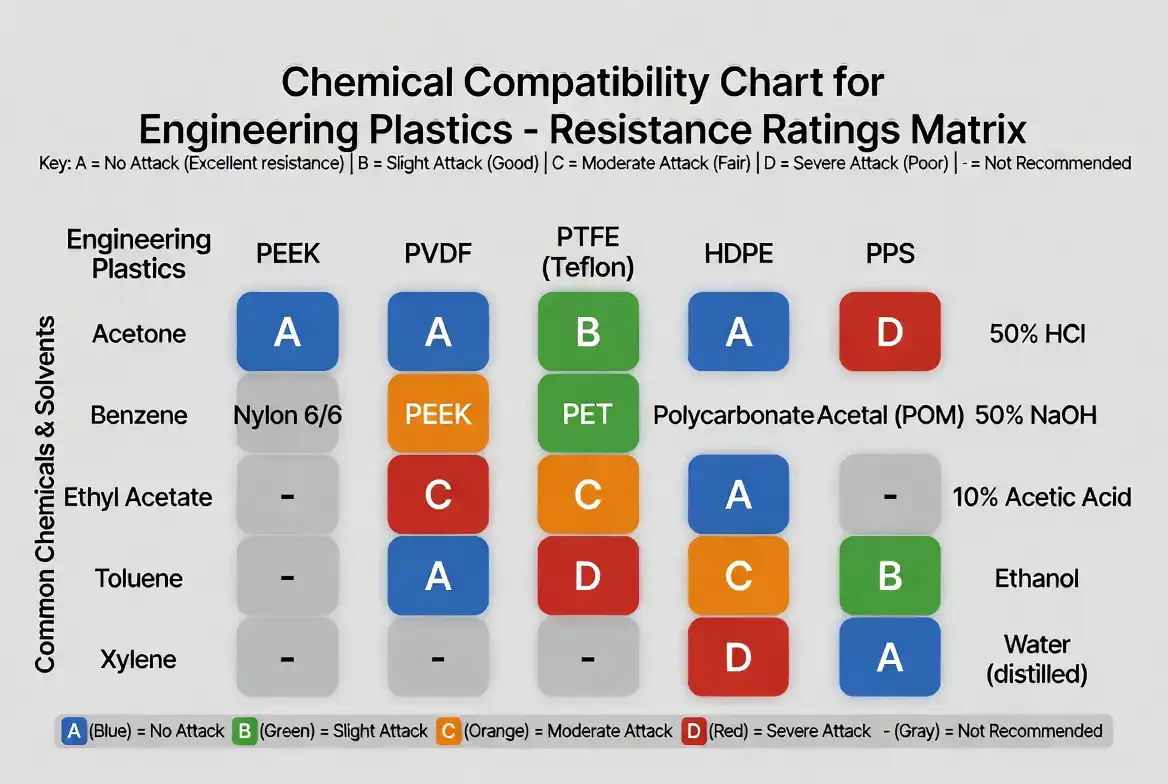
ポリマーファミリー別の適合性に関する指針
| ポリマーファミリー | よく検討されるのは | 重要な注意事項 |
|---|---|---|
| 覗き見 | 広範囲にわたる化学物質への曝露、熱、摩耗、および過酷な条件にさらされるシールや部品 | 強力な酸化剤、濃酸、高温、およびコストについては、引き続き検討が必要である |
| PPS | 酸、塩基、溶剤、および高温の産業環境 | 補強、脆性、溶接線、および正確な鋼種が性能に影響を与える |
| PEI | 熱および中程度の化学物質にさらされる電気部品および構造部品 | 一部のケトン、塩素系溶剤、および強塩基は、ひび割れを引き起こす可能性があります |
| PVDF | 酸、ハロゲン、塩、および化学物質取り扱いシステム | 温度、クリープ、浸透、および接合方法を確認する必要があります |
| PP/HDPE | 多くの水性化学薬品、タンク、ライナー、および低コストの流体接触部品 | 温度、クリープ、酸化、および浸透により、長期的な使用に制限が生じる可能性がある |
| PA/ナイロン | 中程度の環境下において、強度と耐摩耗性が重要な機械部品 | 湿気、強酸、熱湯、および寸法変化がデザインに影響を与える可能性があります |
このマトリックスを使用して材料を絞り込んだ後、正確なグレードと用途を確認してください。当社の ナイロンの耐薬品性ガイド は、この「ファミリー横断」の選択ページよりも範囲が狭く、一方、 耐熱プラスチックガイド 熱と化学のトレードオフを一体として扱っています。.
主な故障メカニズムを理解する
腫れと軟化 これは、流体がポリマー内に拡散し、分子間力が弱まることで生じます。その結果、部品の質量が増加したり、剛性が低下したり、クリアランスが変化したり、変形しやすくなったりすることがあります。. 加水分解 高温下、特に熱水や蒸気中で、湿気に敏感なポリマーの分子量を低減させることがある。. 酸化または化学的腐食 時間の経過とともに、表面が脆くなったり、強度が低下したりする可能性があります。. Environmental stress cracking occurs when a chemical and tensile stress combine to initiate cracks, often at threads, sharp corners, weld lines, press fits or molded-in inserts.
Fillers and additives introduce additional questions. Glass fiber can expose an interface that allows fluid ingress, while carbon fiber, mineral fillers, pigments and flame packages may change the surface or chemical response. A coating, adhesive, lubricant or cleaning residue can be the weakest link even when the base resin is compatible.
Validation for molded, machined and assembled parts
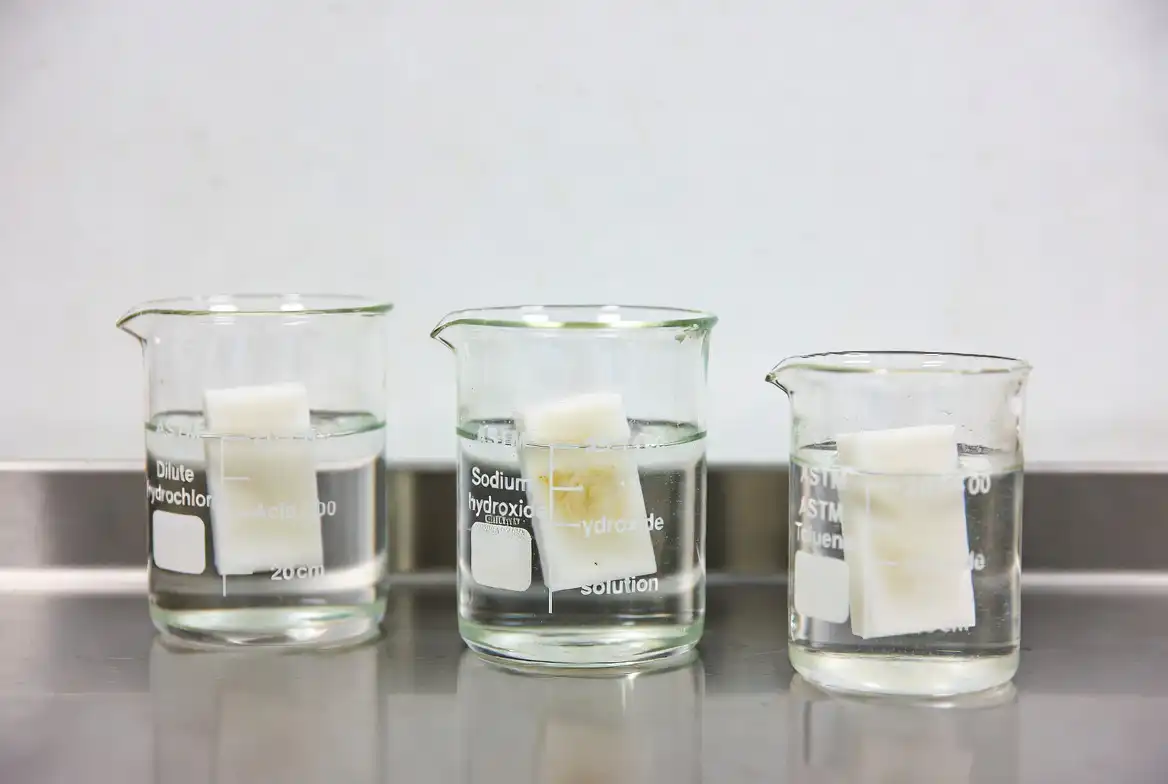
Test representative production material in the final geometry whenever risk is high. Record initial mass, dimensions, hardness or modulus, appearance and critical assembly features. After exposure, repeat the same measurements and inspect for cracks, whitening, blistering, swelling, softening, delamination and loss of seal compression. If a part is under load, test it under the actual or conservatively representative stress rather than using an unloaded coupon only.
- Use the exact resin grade, reinforcement and color planned for production.
- Condition specimens before exposure and control fluid temperature and concentration.
- Include molded weld lines, machined surfaces, threads, inserts and bonded joints.
- Measure both immediate change and change after a recovery or drying period.
- Repeat exposure cycles when the application is intermittent rather than continuous.
- Define failure as a functional, dimensional, visual or mechanical limit.
Design and supplier RFQ checklist
Provide the CAD model, drawing, polymer target, fluid list, concentration, temperature, pressure, exposure cycle, stress condition, quantity and process route. Identify sealing surfaces, threads, snap-fits, transparent windows, inserts and cosmetic zones. State the required life, allowable swelling, clearance, torque, leak rate, mass change or retained strength.
Ask the supplier to identify the proposed grade, compatibility evidence, drying or conditioning requirement, manufacturing risks and validation sample plan. For a new chemical or temperature combination, request a pilot lot and agree who will perform the exposure test and approve the final acceptance report.
How to plan a useful chemical exposure test
A good test reproduces the variables that drive failure. Use production material, production thickness and representative surfaces. Include molded corners, weld lines, threads, press fits and bonded joints when they will be present in the final part. Expose one group without load to measure bulk compatibility and another group under representative strain or pressure to identify environmental stress cracking. Keep an unexposed control group from the same material lot.
Measure before exposure, during the planned interval and after the part has been allowed to recover or dry when recovery is possible. Useful measurements include mass, thickness, critical clearances, hardness, tensile or flexural retention, seal compression, leak rate and visual cracking. Photograph the same locations and record whether the failure began at a surface, weld line, insert, machined edge or adhesive. A pass/fail decision should be tied to product function, not only to a percentage change in mass.
For intermittent cleaning or splash applications, a repeated cycle can be more informative than one long immersion. Include temperature changes, drying, pressure pulses, cleaning concentration and the time between exposures. If the chemical is proprietary or varies by site, define an approved equivalent and a change-control rule so a new cleaner does not silently invalidate the material selection.
Supplier data is most useful when it identifies grade, specimen condition, test temperature, exposure duration, stress state and the property measured. A chart that only says “good” without those conditions should be treated as a screening reference. If the cost of failure is high, combine supplier data with a pilot part and an application-specific test performed by an agreed laboratory or qualified internal team.
Also review the interfaces around the plastic. A compatible housing can still fail because a gasket swells, an adhesive loses bond, a metal insert creates stress or a cleaner attacks a coating. Include the full contact stack in the qualification plan and document any approved substitutes so procurement changes do not introduce an untested chemical combination.
Where exposure is long term, define an inspection interval and a replacement or maintenance rule. Early visual changes may be acceptable in a hidden component but unacceptable on a seal or transparent cover. Agree these boundaries before testing so the supplier, quality team and end user evaluate the same evidence.
Also record acceptable changes in color, odor, surface gloss and mass when those signals affect cleanliness, leak prevention or release of the finished assembly.
For fluid-handling assemblies, include permeation and pressure retention in addition to visual compatibility. A part can remain intact while allowing a fluid or vapor to migrate through a wall, soften a neighboring seal or contaminate an enclosed space. Wall thickness, temperature gradient and pressure differential should therefore be recorded in the qualification plan.
Do not approve an equivalent resin until its additive package, processing history and intended exposure are reviewed.
Chemical-resistant plastics still require grade-specific validation because concentration, temperature, stress and exposure time can change the result.
よくある質問
どのプラスチックが最も耐薬品性に優れていますか?
PEEK、PPS、PVDF、PTFE、および一部のフッ素樹脂は優れた耐薬品性を発揮しますが、最適な材料の選択は、流体、濃度、温度、応力、透過性、およびプロセス経路によって異なります。あらゆる条件に耐える万能なポリマーは存在しません。.
適合性チャートは試験に代わるものとなり得るでしょうか?
チャートはスクリーニングツールであり、完全な適合判定基準ではありません。候補を絞り込むために活用し、温度、応力、圧力、または耐用年数によって重大なリスクが生じる場合は、正確なグレードを確認し、代表的な部品について試験を行ってください。.
なぜプラスチック部品は化学薬品にさらされるとひび割れてしまうのでしょうか?
亀裂は、環境応力亀裂、成形残留応力、圧入応力やインサート応力、鋭利な形状、不適切な洗浄剤、あるいはポリマーや添加剤パッケージを侵食する流体によって生じることがあります。.
耐薬品性は温度によって変化しますか?
はい。通常、拡散速度や反応速度は温度の上昇とともに増加し、機械的強度や耐クリープ性は低下する可能性があります。常に、最悪のケースとなる温度と暴露時間を評価してください。.
耐薬品性プラスチックの見積依頼書には、どのような内容を盛り込むべきでしょうか?
具体的な流体とその濃度、温度、曝露サイクル、圧力、機械的負荷、寿命、グレード目標、製造工程、重要寸法、シール要件、およびバリデーション方法を明記してください。.