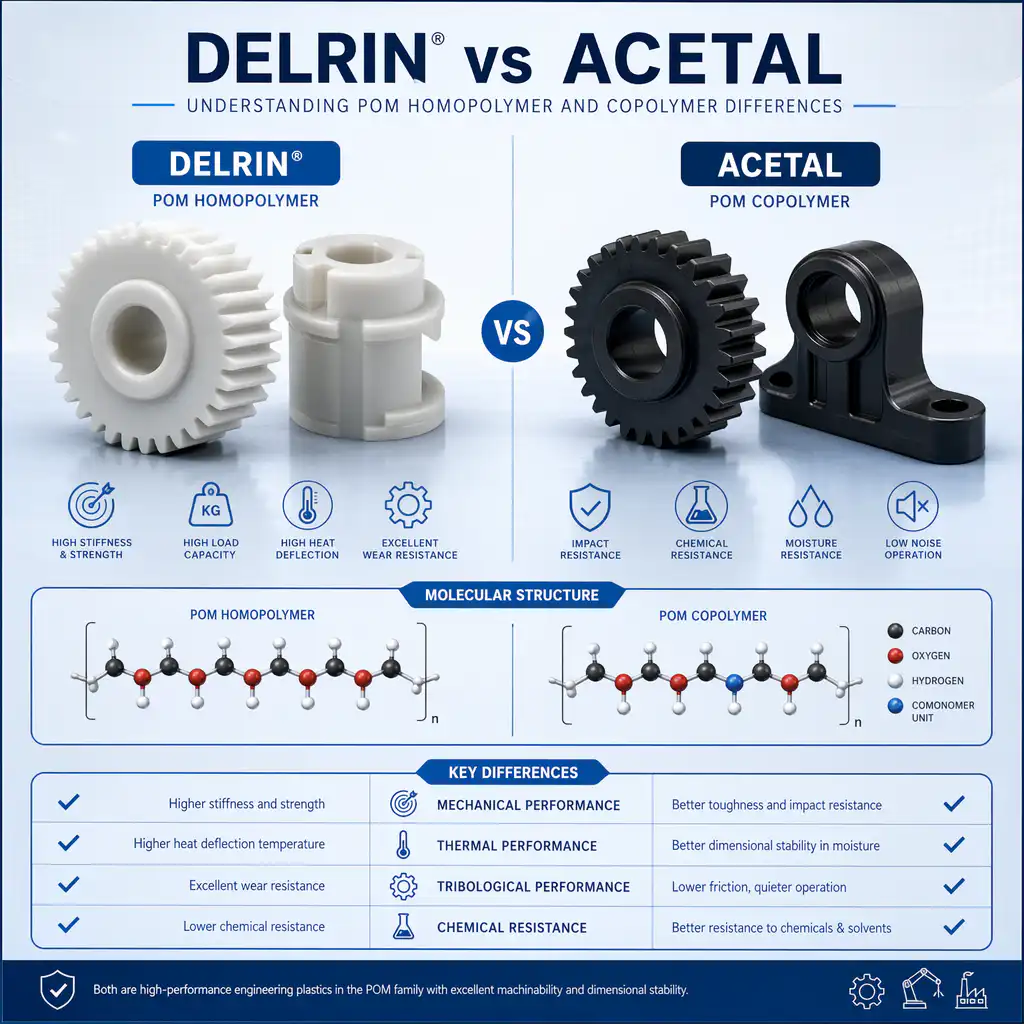
This delrin acetal pom guide explains practical considerations for material selection, design review, manufacturing, and sourcing decisions.
Stringing (also called oozing or cobwebbing) occurs when molten filament leaks from the nozzle during non-printing travel moves, creating thin plastic threads between different parts of your print.
Primary Causes of Stringing
The most common cause is insufficient retraction, where filament continues flowing during travel. Temperature too high results in lower viscosity and easier flow. Material characteristics matter—PETG, TPU, and nylon are naturally prone to stringing. Wet filament creates steam bubbles forcing material out. Slow travel speed allows more time for oozing.
Optimal Retraction Settings
For PLA, use 4-6mm at 25-45mm/s. PETG works best at 3-5mm at 20-30mm/s. ABS needs 5-8mm at 35-50mm/s. Nylon requires 3-5mm at 25-35mm/s with thorough drying first. Our PA6-CFフィラメント is optimized for clean printing.
Slicer Settings That Help
Enable coasting to stop extrusion before travel. Use wipe to clean nozzle on printed surfaces. Activate combing to route travels through printed areas. Increase travel speed to 100-150mm/s for less time to ooze.
Source Quality Filaments
As a specialized source manufacturer, we supply filaments with tight diameter tolerance (±0.03mm) for consistent printing. お問い合わせ for samples.
よくあるご質問
「デルリンとアセタール――POMのホモポリマーとコポリマーの違いを理解する」が、その部品に適しているかどうかは、どのように判断すればよいのでしょうか?
デルリン対アセタール — POMホモポリマーとコポリマーの違いを理解する:部品の耐荷重、使用温度範囲、湿気への耐性、摩耗特性、および加工方法が実際の使用条件に合致する場合、その部品は適している。.
デルリンとアセタールの比較において、どのような特性を確認すべきか――POMのホモポリマーとコポリマーの違いを理解する
強度、剛性、耐衝撃性、耐熱性、吸湿性、寸法安定性、摩擦、摩耗、および化学的適合性を確認する。.
デルリンとアセタールの最大の選定リスクとは?――POMのホモポリマーとコポリマーの違いを理解する
最大のリスクは、実際の使用環境、加工方法、部品の形状、および長期使用を考慮せずに、データシートの数値だけで選定してしまうことです。.
「デルリンとアセタール――POMのホモポリマーとコポリマーの違いを理解する」は、生産前にいつ試験すべきか?
部品が荷重、熱、化学物質、湿気、厳しい公差、規制要件、あるいは新たな動作環境にさらされる場合は、試験を行うことをお勧めします。.