
Laser Cutting: How It Works
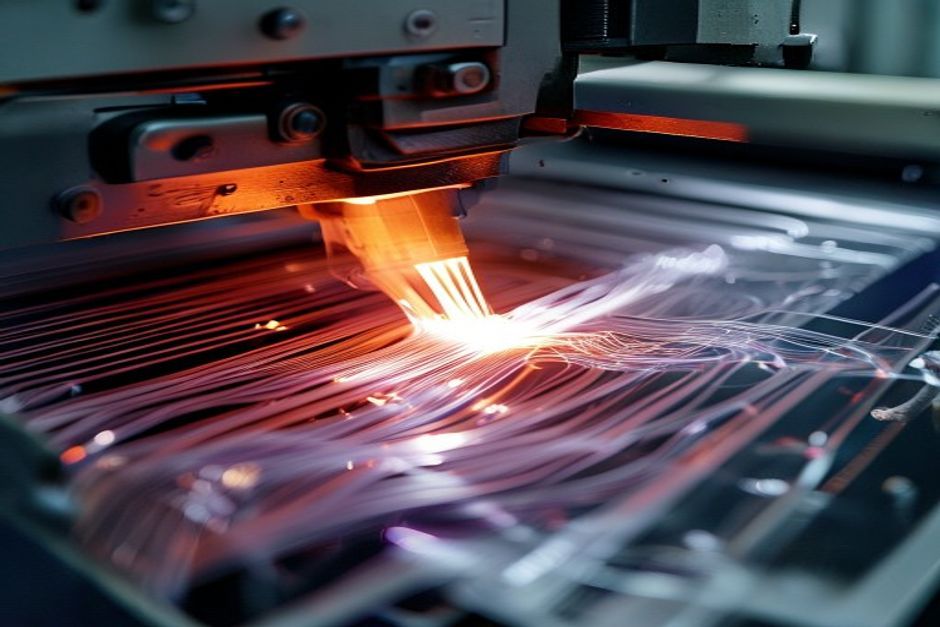
Laser cutting systems focus a high-power laser beam (CO2, fiber, or Nd:YAG) through optics and mirrors to a focal point 50-200 microns in diameter. The concentrated energy density — often exceeding 10 million watts per square centimeter — rapidly heats the material to its melting or vaporization point. A coaxial assist gas (oxygen, nitrogen, or compressed air) blows the molten material through the cut, creating a smooth kerf.
Laser Cutting Types
- CO2 Laser (10.6 µm wavelength): Best for non-metals — wood, acrylic, plastics, fabric, rubber. Also cuts thin metals but requires higher power. Widely used in fabrication shops and sign-making.
- Fiber Laser (1.06 µm wavelength): Superior for metal cutting — steel, aluminum, brass, copper. Higher wall-plug efficiency than CO2 (30% vs. 10%). Faster cutting in thin-to-medium metals. No mirrors to align; lower maintenance.
- Nd:YAG Laser: Used primarily for welding, marking, and specialized micromachining applications.
直接比較
| ファクター | レーザー切断 | CNC加工 |
|---|---|---|
| プロセスタイプ | Thermal (non-contact) | Mechanical (contact) |
| Material Capability | 2D profiling primarily | Full 3D |
| Materials (Metals) | Up to 1 inch (steel), 0.5 inch (aluminum) | Unlimited thickness (multiple passes) |
| Materials (Plastics) | Cuttable but may discolor or melt | Excellent — clean cuts, no thermal effect |
| 公差 | ±0.003-0.010 inches | ±0.0005-0.002 inches |
| 切り込み幅 | 0.004-0.020 inches | Tool diameter (0.031+) |
| Heat-Affected Zone | Present — 0.004-0.020 inches | Minimal (frictional heating only) |
| 運営コスト | Low (minimal consumables) | Moderate (tooling, coolant) |

Material-Specific Considerations
金属
Laser cutting is the preferred process for thin-to-medium sheet metal profiling (0.020-1.0 inch steel, 0.020-0.5 inch aluminum). It is typically faster than CNC machining for 2D part profiles and produces less material waste. However, laser-cut edges have a heat-affected zone (HAZ) that may require post-processing for fatigue-critical aerospace or medical components.
プラスチック
CNC machining is strongly preferred for engineering plastics. Laser cutting produces thermal effects in plastics — melting, discoloration, toxic fumes, and dimensional distortion — that CNC machining completely avoids. Materials like Nylon, POM (acetal), PEEK, and polycarbonate machine cleanly with appropriate feeds and speeds. For engineering plastic components requiring 3D features or tight tolerances, CNC machining is the clear choice.
Wood and Composites
Laser cutting excels for wood, plywood, and MDF — materials that would dull CNC cutting tools. The laser produces clean, dark edges with no tool marks. For carbon fiber composites, both processes can work: fiber lasers cut without delamination common in mechanical routing, but CNC routing is preferred for thick laminates (over 0.25 inches).
Choosing Between Laser Cutting and CNC Machining
- Choose Laser Cutting for: 2D sheet metal profiles, enclosures and panels, thin material with complex contours, non-metal materials (wood, acrylic, fabric), high-volume sheet metal production where speed dominates
- CNC加工が適しているのは、次のような場合です: 3D parts with pockets, holes, and stepped profiles, plastic components (no thermal degradation), tight-tolerance metallic or plastic parts (±0.001 inch), thick materials (over 1 inch in metal), threaded holes and reamed bores
- Consider Both Together: Laser cut the 2D profile from sheet stock, then CNC machine the 3D features in a subsequent operation
よくあるご質問
When is Laser Cutting vs CNC Machining: Complete Process Comparison the right choice?
Laser Cutting vs CNC Machining: Complete Process Comparison is the right choice when the part requires machined accuracy, controlled surfaces, repeatable features, and a material that can be cut reliably.
What should be confirmed before ordering Laser Cutting vs CNC Machining: Complete Process Comparison?
製造開始前に、図面のバージョン、材料等級、公差、数量、重要寸法、表面仕上げ、検査要件を確認する。.
What usually drives cost in Laser Cutting vs CNC Machining: Complete Process Comparison?
コストは通常、材料、段取り時間、機械時間、公差の難易度、治具、工具アクセス、仕上げ、検査、注文数量によって左右される。.
How can quality risk be reduced in Laser Cutting vs CNC Machining: Complete Process Comparison?
重要なフィーチャーを明確にマーキングし、不必要な厳しい公差を避け、製造可能性を早期に確認し、重要な寸法の検査データを使用することで、品質リスクを低減します。.