
Custom machine building — also called special-purpose machinery or bespoke manufacturing systems — transforms unique production requirements into purpose-designed, purpose-built machines that perform specific tasks. Unlike standard machine tools (CNC mills, lathes, presses) designed for general flexibility, custom machines are optimized for a single product or process, often achieving dramatically higher throughput, tighter tolerances, or lower operating costs than adapting general-purpose equipment.
When Is Custom Machine Building the Right Approach?
Custom machines are justified when:
- No off-the-shelf solution exists: The specific process, part geometry, or throughput requirement cannot be met by standard equipment available on the market
- Throughput multiplication: A custom assembly or test machine processes 5-10× faster than manual alternatives, paying for itself in labor savings within 12-24 months
- Quality requirements exceed manual capability: Automated assembly, , and testing consistently achieve quality levels that manual processes cannot sustain across shifts
- Integration advantage: Multiple discrete processes (machining, assembly, , packaging) can be integrated into a single automated system, eliminating work-in-process inventory and material handling
- Proprietary process: The manufacturing method is a competitive advantage and embedding it in custom equipment provides IP protection
The Custom Machine Building Process
Phase 1: Requirements Definition (2-4 weeks)
- Document detailed functional requirements: what the machine must do, not how
- Define throughput targets (cycles per minute, parts per hour)
- Document operator interface requirements (safety, ergonomics, HMIs)
- Define facility constraints (floor space, utilities, environmental conditions)
Phase 2: Conceptual Design and Feasibility (3-6 weeks)
- Develop 2-3 concept alternatives with different cost/performance tradeoffs
- Identify enabling technologies (vision systems, robots, precision actuators) and verify feasibility
- Create preliminary 3D CAD models showing machine envelope, material flow, and key subsystems
- Estimate development cost, production machine cost, and commissioning timeline
Phase 3: Detailed Engineering (6-12 weeks)
- Complete mechanical design: frames, actuators, pneumatics, hydraulics, guarding
- Complete electrical design: control panel, PLC, HMI, sensors, safety circuits
- Specify all purchased components (bearings, linear guides, motors, sensors, pneumatics)
- Generate fabrication drawings for all custom-manufactured components
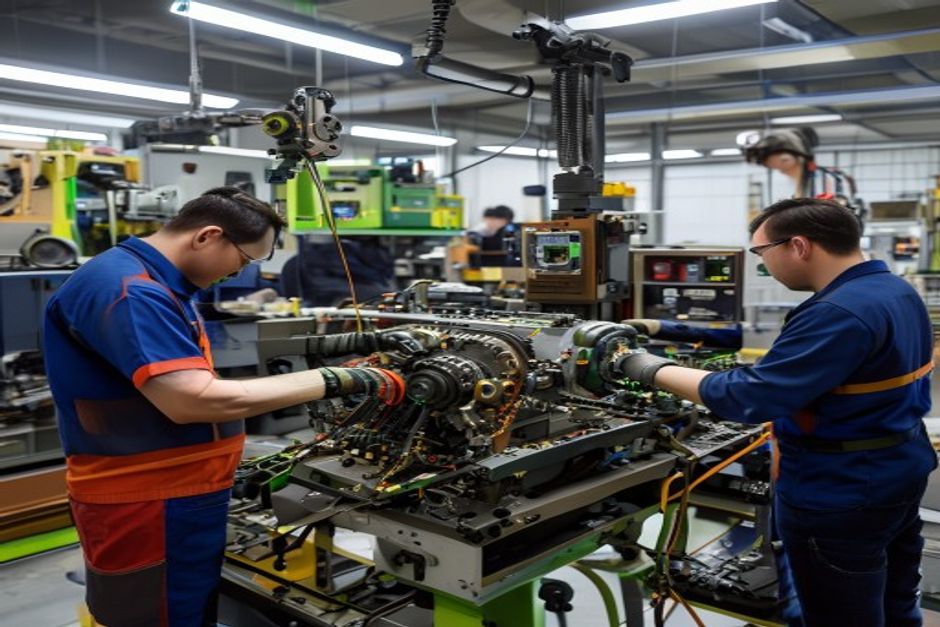
Phase 4: Component Manufacturing (4-8 weeks)
- CNC machine all custom frame components, brackets, and mounts
- Fabricate structural weldments (frames, bases, guards)
- Procure purchase parts (bearings, drives, sensors, pneumatics, electrical) — typically the longest-lead-time items
Phase 5: Assembly, Integration, and Debug (4-8 weeks)
- Mechanical assembly on leveling mounts with laser-aligned structural components
- Pneumatic and electrical integration with point-to-point verification
- Controls debug — verify every sensor reading, actuator command, and safety interlock
- Dry-cycle testing (no product) to verify timing, motion, and interlocks
- Product testing with controlled conditions to verify quality and throughput
Phase 6: Factory Acceptance and Commissioning (2-4 weeks)
- Factory Acceptance Testing (FAT): customer witnesses the machine operating with production parts, achieving throughput and quality specifications
- Disassembly, shipping, reassembly at customer facility
- Site Acceptance Testing (SAT): identical performance verification at customer facility
- Operator and maintenance technician training
- Release to production with 90-day warranty support
Materials in Custom Machine Building
Custom machines demand engineering material selection optimized for each subsystem:
- Structural Frames: Welded steel, normalized and Blanchard ground, with precision-machined mounting surfaces for rails and actuators
- Tooling Inserts: Hardened tool steel (D2, A2) or engineered plastic (Nylon 6/6, POM) for wear part interfaces
- Guarding: Aluminum extrusion framing with polycarbonate windows and interlocked doors
- Precision Mechanisms: CNC-machined aluminum (6061 or 7075), stainless steel (303/304), and engineering plastic (PEEK, Nylon) for lightweight, guided, or low-friction applications
Cost Drivers in Custom Machine Building
- 複雑さ: Number of axes of motion, sensors, and actuators — roughly $2,000-5,000 per axis for precision linear drives
- Controls Development: Complex PLC s with vision integration and data collection add 20-40% to engineering cost
- Material Specialization: Food-grade (304 SS, FDA seals), cleanroom, and explosive-environment machines carry significant material and documentation premiums
- Schedule Compression: Accelerating timelines by 25% typically adds 15-30% to cost due to overtime, expedited procurement, and concurrent-phased engineering
よくあるご質問
What is the practical value of Custom Machine Building: Design, Engineering, and Manufacturing Process?
Custom Machine Building: Design, Engineering, and Manufacturing Process helps connect material choice, process limits, cost, and application risk before committing to production.
What should be checked first for Custom Machine Building: Design, Engineering, and Manufacturing Process?
まず、実際のアプリケーション要件、想定される環境、生産数量、公差要件、および品質管理に関する要件から検討を開始してください。.
What usually causes problems in Custom Machine Building: Design, Engineering, and Manufacturing Process?
問題は通常、要件が不明確であること、材料の不適合、非現実的な公差、検査基準の欠如、あるいは設計変更の遅れに起因します。.
How can buyers reduce risk with Custom Machine Building: Design, Engineering, and Manufacturing Process?
購入者は、見積りを依頼する前に、図面、使用条件、重要寸法、目標数量、品質要件などを共有することで、リスクを軽減することができます。.