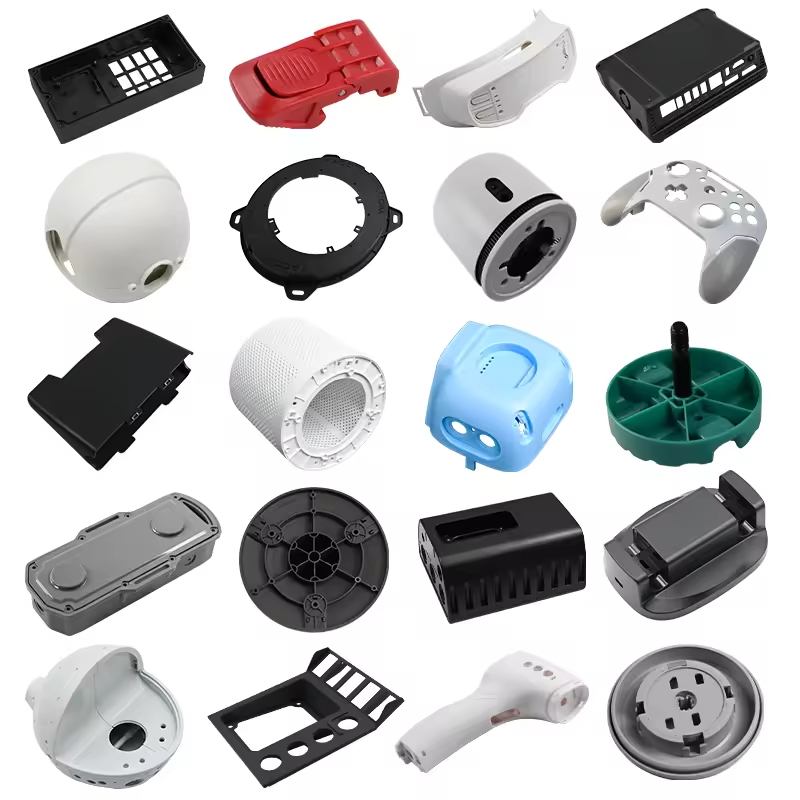


Design for Manufacturing (DFM) Overview
Design for Manufacturing considers production requirements early in the design phase. For injection molding, DFM prevents costly mold modifications, improves part quality, and reduces production costs.
Wall Thickness Design
Uniform Walls
- Consistent thickness prevents warpage and sink marks
- Target 2-3mm for typical parts
- Transitions should be gradual (3:1 ratio)
Material-Specific Guidelines
| 素材 | Min (mm) | Recommended (mm) | Max (mm) |
|---|---|---|---|
| ABS | 1.0 | 2.0-2.5 | 4.0 |
| PP | 0.8 | 2.0 | 5.0 |
| PC | 1.0 | 2.0-3.0 | 4.5 |
| PA(ナイロン) | 0.8 | 1.5-2.5 | 3.5 |
| POM | 1.0 | 2.0 | 3.5 |
Ribs and Bosses
Rib Design
- Thickness: 50-70% of adjacent wall
- Height: Maximum 3× wall thickness
- Draft: 0.5-1° minimum
- Spacing: 2× wall thickness minimum
ボス・デザイン
- Wall thickness: 60-70% of nominal wall
- Core hole depth: 2-3× diameter
- Include radii at base
- Consider draft for ejection
Corners and Radii
ドラフトの視点
- Standard surfaces: 0.5-1° minimum
- 質感のある表面: 2-5° depending on texture
- 深い特徴がある: Increase draft proportionally
- 縮む: Account for material shrinkage in draft
Undercuts and Side Actions
Designing Without Undercuts
- Reduces mold complexity
- Lower tooling cost
- Simpler maintenance
When Undercuts Are Necessary
- Use side actions (slides)
- Consider lifters for internal undercuts
- Design for proper release angles
Gating Considerations
- Position gates in non-visible areas
- Consider gate vestige requirements
- Account for weld line locations
- Design for automated degating when possible
Common Design Errors
- Sharp internal corners causing stress
- Insufficient draft causing ejection issues
- Thick sections causing sink marks
- Undercuts without proper mechanisms
- Ignoring shrinkage tolerances
DFM Checklist
- ☐ Uniform wall thickness throughout
- ☐ Adequate draft angles specified
- ☐ Radii on all internal corners
- ☐ Ribs properly proportioned
- ☐ Bosses designed for function
- ☐ Undercuts identified and addressed
- ☐ Gate locations proposed
- ☐ Material shrinkage accounted
結論
DFM for injection molding prevents costly iterations and ensures manufacturable designs. Involve manufacturing engineers early in the design process.
関連リソース
よくあるご質問
When does Plastic Part Design for Manufacturing — DFM Guidelines for Injection Molding make sense?
Plastic Part Design for Manufacturing — DFM Guidelines for Injection Molding makes sense when the part volume, material choice, geometry, and repeatability needs justify mold design and tooling investment.
What design factors matter most for Plastic Part Design for Manufacturing — DFM Guidelines for Injection Molding?
肉厚、リブ、ボス、抜き勾配、ゲート位置、収縮、パーティングライン、およびエジェクションは、いずれも成形品の品質に影響を与えます。.
金型製作の前に、どのような情報が必要ですか?
サプライヤーは、3Dモデル、材質、予想年間生産数量、外観要件、公差要件、および組み立てや機能試験に関する要件を確認する必要があります。.
What is the biggest risk in Plastic Part Design for Manufacturing — DFM Guidelines for Injection Molding?
最大のリスクは、実際の用途において、材料の挙動、収縮、流動性、および部品の機能が十分に確認される前に、金型を承認してしまうことです。.