
Why RoHS and REACH Compliance Matters for Plastic Part Export
For any manufacturer exporting plastic components to the European Union, RoHS (Restriction of Hazardous Substances) and REACH (Registration, Evaluation, Authorisation and Restriction of Chemicals) compliance are not optional best practices — they are legal requirements with direct market access consequences. A shipment of plastic parts that fails to meet RoHS or REACH requirements can be detained at EU customs, resulting in demurrage charges, disposal costs, and customer penalties that can exceed the value of the goods. Repeated non-compliance can trigger the EU’s Rapid Alert System for dangerous non-food products (Safety Gate/RAPEX), effectively barring the manufacturer from the European market.
Beyond the legal imperative, major OEMs and Tier 1 suppliers in the automotive, medical device, electronics, and consumer goods industries impose their own substance restrictions that extend beyond regulatory minimums. Compliance documentation — including Declarations of Conformity, test reports, and full material disclosures — is now a standard deliverable in procurement contracts. Buyers increasingly require suppliers to demonstrate RoHS and REACH compliance before accepting a first purchase order, not as a post-shipment checkbox exercise.
RoHS Directive: Restricted Substances and Scope
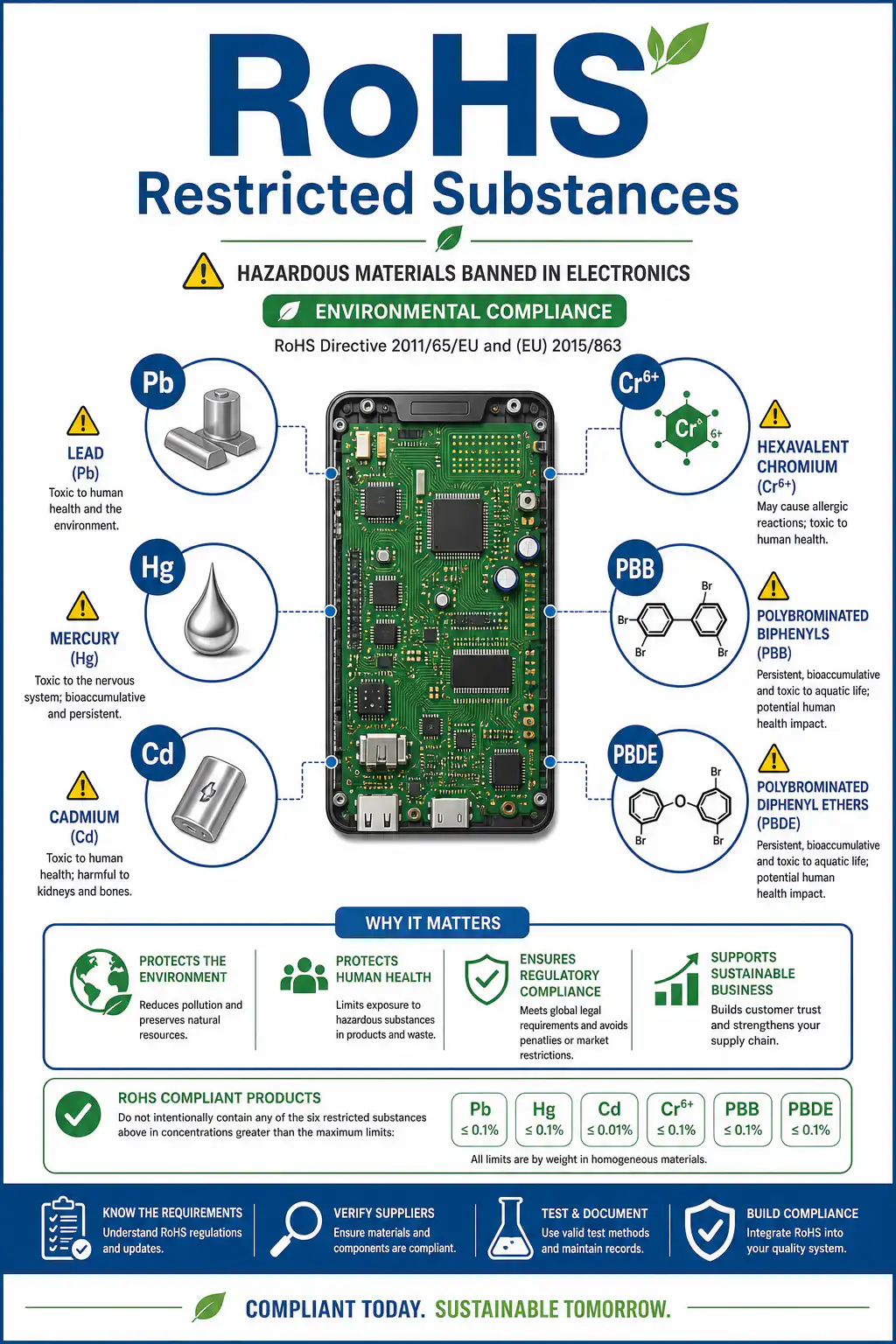
RoHS 3 — formally Directive 2011/65/EU as amended by Directive (EU) 2015/863 — restricts the use of ten hazardous substances in electrical and electronic equipment (EEE). While RoHS originated as legislation targeting electronics, its scope extends to all components and subassemblies incorporated into EEE, including plastic housings, structural components, connectors, wire insulation, and internal mechanical parts. The ten restricted substances and their maximum concentration values (MCV) by weight in homogeneous materials are:
| Substance | MCV (% by weight) | Relevant to Plastics | Common Sources in Plastic Parts |
|---|---|---|---|
| Lead (Pb) | 0.1% | 高い | PVC heat stabilizers, pigments (lead chromate yellows/reds), solder on inserts |
| Mercury (Hg) | 0.1% | 低い | Rare in plastics; possible in biocidal additives |
| Cadmium (Cd) | 0.01% | 高い | PVC stabilizers, certain pigments (cadmium red/orange/yellow), plating on metal inserts |
| Hexavalent Chromium (Cr6+) | 0.1% | 中程度 | Chromate conversion coatings on metal inserts and fasteners |
| Polybrominated Biphenyls (PBB) | 0.1% | 高い | Brominated flame retardants in PA, PBT, ABS, PC/ABS, and PP |
| Polybrominated Diphenyl Ethers (PBDE) | 0.1% | 高い | Brominated flame retardants — historically common in electronic enclosures |
| DEHP | 0.1% | 高い | PVC plasticizer, flexible PVC components, cable insulation |
| BBP | 0.1% | 中程度 | PVC plasticizer, certain polymer processing aids |
| DBP | 0.1% | 中程度 | PVC plasticizer, adhesives and coatings on plastic assemblies |
| DIBP | 0.1% | 中程度 | PVC plasticizer, nitrocellulose-based coatings |
For injection-molded engineering plastic components, the highest-risk substances are brominated flame retardants (PBB and PBDE), phthalate plasticizers (DEHP, BBP, DBP, DIBP), and lead or cadmium from pigment systems used to color the plastic. The risk profile varies dramatically by material family and application:
For flame-retarded nylon (PA6 and PA66) used in electrical and electronic applications, brominated flame retardants are the primary concern. Many legacy flame retardant systems based on PBDEs — particularly decaBDE, historically the most widely used brominated flame retardant — are now restricted under both RoHS and the Stockholm Convention on Persistent Organic Pollutants. Modern compliant alternatives include halogen-free flame retardant systems based on phosphorus (red phosphorus, organophosphinates), nitrogen (melamine cyanurate), and inorganic synergists (aluminum diethyl phosphinate combined with melamine polyphosphate). When specifying any flame-retarded grade, the manufacturer must confirm that the flame retardant package does not contain restricted PBDE or PBB compounds and should provide documentation identifying the specific flame retardant chemistry.
For PVC and flexible PVC components, phthalate plasticizers and heavy metal stabilizers create dual compliance risks. DEHP, BBP, DBP, and DIBP — all RoHS-restricted phthalates — have been the dominant PVC plasticizers for decades. Cadmium- and lead-based heat stabilizers remain in use in some regions despite widespread phase-out. Procurement from Chinese PVC compounders requires explicit verification that phthalate-free plasticizer systems and calcium-zinc or organotin stabilizer systems are employed.
For colored plastic parts — regardless of base polymer — pigment systems represent a persistent compliance risk. Cadmium sulfoselenide pigments (red, orange, yellow) and lead chromate pigments (yellow, orange, red) provide excellent color fastness and heat stability at low cost, making them attractive in regions with less stringent environmental regulation. These pigments can introduce cadmium and lead concentrations well above RoHS thresholds, even at pigment loading levels as low as 0.5% to 2% by weight. Organic and complex inorganic pigment alternatives exist for most color requirements but may increase pigment cost by a factor of 2 to 5.
REACH Regulation: SVHC and Article 33 Obligations
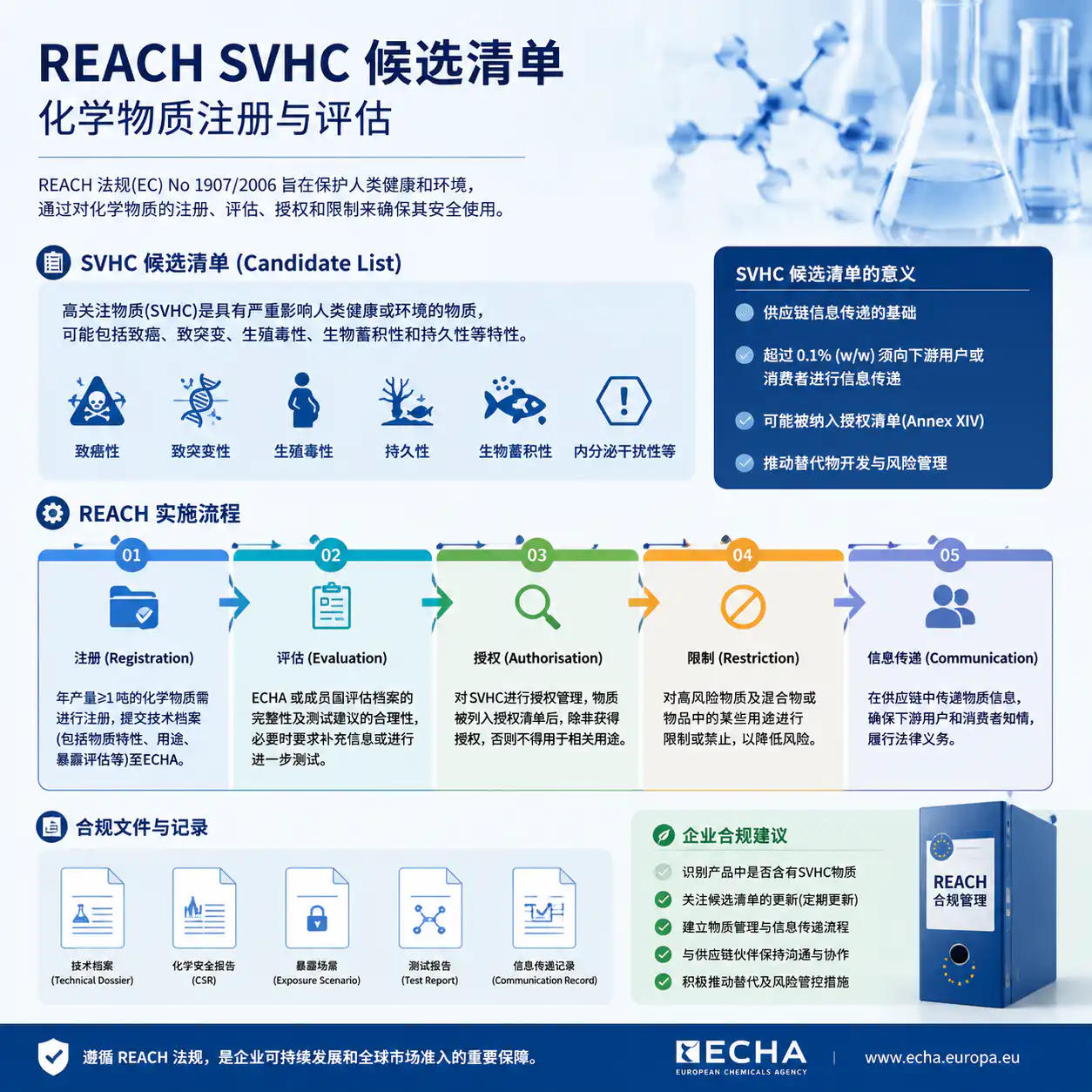
REACH (EC 1907/2006) operates on a fundamentally different regulatory model than RoHS. Rather than restricting a fixed list of substances in a specific product category, REACH requires that any substance manufactured in or imported into the EU at more than 1 tonne per year be registered with the European Chemicals Agency (ECHA) with a comprehensive safety data package. Additionally, substances identified as Substances of Very High Concern (SVHC) are listed on the Candidate List, which is updated every six months — typically adding 10 to 30 new substances per update. As of mid-2025, the Candidate List contains over 240 SVHC entries.
For plastic part manufacturers, the REACH requirement with the most direct impact is Article 33: the “duty to communicate information on substances in articles.” If a plastic component contains any SVHC at a concentration above 0.1% weight by weight, the supplier must provide the recipient with sufficient information to allow safe use, including — as a minimum — the name of the substance. This obligation applies at the article level, meaning each individual component (the molded plastic housing, the metal insert, the rubber seal) must be evaluated separately.
SVHC entries particularly relevant to plastic parts include certain phthalates (DEHP, DBP, BBP, DIBP — which overlap with RoHS restrictions), brominated flame retardants beyond RoHS scope (HBCDD, TBBPA in some interpretations), boric acid and borates used as flame retardant synergists, specific UV stabilizers and antioxidants (2,4-di-tert-butyl-6-(5-chlorobenzotriazol-2-yl)phenol or UV-327, various benzotriazole UV absorbers), formaldehyde (relevant to POM and amino resins), and various solvents and processing aids that may be present in additive masterbatches as residual impurities.
A critical difference between RoHS and REACH: REACH applies to all articles placed on the EU market, not only EEE. A plastic gear for industrial machinery, a nylon bushing for automotive suspension, or a PEEK medical device component — all fall within REACH scope regardless of end use. This broader applicability means REACH compliance is relevant even for plastic parts that have no connection to electrical or electronic equipment.
Testing Standards and Methods
| 標準 | 方法 | Substances Detected | Typical Detection Limit |
|---|---|---|---|
| IEC 62321-5 | ICP-OES or ICP-MS after acid digestion | Lead, Cadmium, Mercury | 2 – 10 mg/kg |
| IEC 62321-4 | ICP-OES after water extraction | Hexavalent Chromium (Cr6+) | 1 – 5 mg/kg |
| IEC 62321-6 | GC-MS after solvent extraction | PBB, PBDE | 10 – 50 mg/kg |
| IEC 62321-8 | GC-MS after solvent extraction | Phthalates (DEHP, BBP, DBP, DIBP) | 20 – 50 mg/kg |
| EN 14582 | Oxygen bomb combustion + IC | Total halogens (screening for BFRs) | 50 – 100 mg/kg |
| XRF Screening | Handheld or benchtop X-ray fluorescence | Total Br, Pb, Cd, Hg, Cr (screening only) | 10 – 50 mg/kg (element-dependent) |
Testing strategy for plastic parts typically follows a tiered approach. XRF screening is used as a rapid, non-destructive first pass to identify samples requiring confirmatory analysis. The XRF provides total element concentrations — total bromine rather than specific PBB/PBDE identification, and total chromium rather than specific Cr6+ quantification. If XRF screening shows element concentrations below the RoHS threshold, the material is considered low-risk and may not require further testing. If XRF results approach or exceed threshold concentrations, wet chemistry confirmatory testing per the relevant IEC 62321 method is required.
The laboratory should be accredited to ISO/IEC 17025 for the specific test methods employed. Test reports must clearly identify the homogeneous material tested — a composite test of an entire assembly can produce misleading results because restricted substances concentrated in one component may be diluted below detection limits by the bulk of clean material in the composite sample.
Documentation Requirements
The EU compliance documentation package for exported plastic parts should include, at minimum:
A Declaration of Conformity (DoC) per RoHS requirements, identifying the manufacturer, the product, the referenced directive (2011/65/EU as amended), and the standards applied to demonstrate conformity (IEC 62321 series). The DoC must be signed by an authorized representative of the manufacturer.
A Certificate of Compliance (CoC) can supplement the DoC and is often preferred by downstream customers as a simpler, transaction-specific document confirming that a specific lot or shipment complies with applicable requirements.
Test reports from an ISO/IEC 17025-accredited laboratory for each homogeneous material or material family, with reports dated within a reasonable period (typically 12 to 24 months, with frequency depending on the risk profile and stability of the material supply chain).
For REACH, an SVHC disclosure statement — either a positive disclosure listing the SVHC present above 0.1% with substance names and safe-use information, or a negative declaration confirming that no SVHC is present above the 0.1% threshold. This can be combined with the REACH Article 33 communication template published by industry associations.
A Full Material Declaration (FMD) following IPC-1752A or IEC 62474 standards, increasingly required by electronics and automotive customers. FMD provides substance-level disclosure at the homogeneous material level, typically reporting all intentionally added substances and any impurities above defined reporting thresholds (commonly 1,000 ppm).
Penalties, Liability, and Business Risk
Non-compliance with RoHS carries significant consequences. EU member states are responsible for enforcement through national market surveillance authorities, and penalties vary by member state but typically include fines (up to hundreds of thousands of euros per violation), compulsory product withdrawal from the market, customs detention and destruction of non-compliant shipments, and criminal liability in cases of knowing or negligent non-compliance.
Beyond government enforcement, the commercial consequences are often more severe than the regulatory penalties. A major OEM discovering non-compliance in purchased components will typically: recall all affected products at the supplier’s expense, de-source the supplier from all active and future programs, pursue contractual damages for recall costs, brand damage, and business interruption, and report the non-compliance to market surveillance authorities. The total cost of a compliance failure — combining recall logistics, legal fees, damages, and lost business — can exceed $500,000 for even a moderate-volume program and can effectively terminate a supplier’s relationship with an entire industry sector.
China Exporter Compliance Checklist
- Map every raw material in the plastic part — base resin, filler (glass fiber, mineral), flame retardant, heat stabilizer, UV stabilizer, colorant, processing aid, mold release, and any other additive — to a specific commercial product with documented composition.
- Obtain RoHS and REACH compliance declarations from each raw material supplier. These should be substance-specific, not generic “our products are RoHS compliant” statements. For high-risk additives (flame retardants, PVC stabilizers, pigments), request full substance disclosure of the additive package.
- Screen production samples by XRF for total bromine, lead, cadmium, mercury, and total chromium. Maintain XRF screening records for each material lot as part of production quality records.
- Commission annual confirmatory testing per the full IEC 62321 suite on representative production samples through an ISO/IEC 17025-accredited laboratory. Retest whenever a raw material source or formulation changes.
- Monitor ECHA SVHC Candidate List updates every six months (January and July). Review whether any newly listed SVHC may be present in your products and update REACH disclosures accordingly.
- Prepare and maintain a compliance documentation package — DoC, CoC, test reports, SVHC disclosure — organized by product and available for immediate customer request.
- Implement supply chain change management: any change in raw material source, grade, or formulation triggers a compliance review before the change is implemented in production.


よくある質問
プラスチック部品に関して、RoHSとREACHの違いは何ですか?
RoHSは、電気・電子機器に含まれる10種類の特定物質を規制しており、均質材料ごとに濃度制限を定めています。 REACHは、より広範な化学物質規制であり、すべての製品(電子機器に限らず)に適用され、年間1トンを超えて製造または輸入される物質の登録を義務付け、製品中に0.1%を超えるSVHCが含まれる場合はその旨を通達する義務を課しています。 実務上、プラスチック部品の場合、RoHSへの準拠とは、指定された閾値に基づいて10種類の規制物質の検査を行うことを意味しますが、REACHへの準拠とは、240種類以上のSVHC物質のうち、0.1%を超えるものが含まれているかどうかを把握し、その情報を顧客に開示することを意味します。 ある部品がRoHSに準拠していても、REACHの開示閾値を超えるSVHCを含んでいる場合があります。例えば、 0.3%の濃度でSVHCリストに掲載されている紫外線安定剤を含むプラスチック部品は、RoHSに準拠している(紫外線安定剤はRoHSの規制対象物質ではない)ものの、REACH第33条に基づく開示が必要となります。.
REACHでは、すべての材料ロットについて試験を行うことが義務付けられていますか?
いいえ。REACHでは、具体的な試験頻度は規定されていません。その代わりに、製造業者に対し、自社製品に何が含まれているかを把握し、SVHCの含有状況を報告する義務を課しています。 業界の標準的なアプローチはリスクベースであり、製品の初期認定時および原材料や配合が変更されるたびに包括的な分析試験を実施し、サプライヤーの申告や定期的なXRFスクリーニングを通じて継続的な監視を行い、リスク評価に基づいて年1回または2年に1回の確認試験を実施するものです。 一貫した原材料供給源と文書化されたコンプライアンス実績を持つ安定したサプライチェーンは、試験頻度の低減を可能にします。一方、複数の代替可能な材料供給源を持つ動的なサプライチェーンでは、より徹底した検証が求められます。.
CNC加工されたプラスチック部品は、射出成形部品と同じRoHSおよびREACHの要件の対象となりますか?
はい、製造プロセスによる区別はありません。RoHSおよびREACHは、射出成形、CNC加工、押出成形、あるいはその他のいかなるプロセスによって製造されたかに関わらず、市場に投入される製品に適用されます。 CNC加工部品についても、同様の原材料の適合性確認が適用されます。つまり、素材の形状(棒材、板材、管材)は、成形用樹脂と同じ制限物質要件を満たさなければなりません。 機械加工部品において重要な考慮事項は、切削液の残留物です。規制物質を含むハロゲン系切削液が使用され、洗浄によって十分に除去されなかった場合、残留汚染物質によって理論上は部品が適合基準値を超えてしまう可能性があります。ただし、現代の切削液を使用している限り、実際にはこのようなケースは稀です。.
How can I verify that my Chinese supplier’s compliance claims are legitimate?
Verification should involve multiple, independent evidence sources. Request and review the full test reports — not just summary compliance certificates. Test reports should identify the specific laboratory, the test methods, the samples tested, and the quantitative results. Verify that the laboratory holds ISO/IEC 17025 accreditation for the specific test methods and confirm this through the laboratory’s accreditation body website. Consider commissioning independent third-party testing on randomly selected production samples as a verification exercise. Require traceability from test reports to specific production lots — a test report on a sample from two years ago that cannot be linked to current production provides limited assurance. For high-value or high-risk programs, an on-site audit of the supplier’s quality management system, including raw material receiving inspection and compliance documentation processes, provides the highest level of confidence.
射出成形における再粉砕材の使用は、コンプライアンスの観点からどのような影響があるのでしょうか?
リグラインド(同一の製造工程から得られる産業廃棄物由来のリサイクル材料)の使用については、バージン材料が規制に適合しており、かつリグラインドが成形工程やその後の取り扱い中に汚染されていない限り、一般的に規制適合状況に変化はありません。 しかし、再生材が別の供給元からのバージン材とブレンドされたり、他の生産ラインの材料と混合されたり、あるいは油、離型剤、その他の加工用化学物質で汚染されたりした場合、新たな規制物質のリスクが生じる可能性があります。 保守的なアプローチとしては、想定される最大再生材配合率(多くのエンジニアリング用途では通常 20% から 30%)で製造された部品を試験し、再生材の添加によって規制物質の濃度が閾値を超えないことを確認します。 専用の材料取り扱い、管理された混合比率、定期的なコンプライアンス検証などを含む、堅牢な再生材管理手順を、品質管理システム内に文書化しておく必要があります。.